


Oracle is the name of Oracle Corporation, a technology conglomerate offering a diverse range of products and services. This ecosystem includes Oracle Database, Oracle Cloud Infrastructure (OCI), Oracle Fusion Cloud Applications, and NetSuite. Therefore, "Oracle software" is not the name of a single application but may refer to multiple different products depending on the context.
When a business says "we're using Oracle," that's not enough to determine which system they're using. It could be Oracle Database for data management, OCI for cloud-based workload management, Oracle Fusion Cloud ERP for finance, procurement, and business administration processes, or Oracle NetSuite for cloud-based business and finance management.
To properly understand Oracle, the appropriate approach is to start from Oracle Corporation → product group → the problem each product solves → how they differentiate in business practice.
What is Oracle? What is Oracle software?
Oracle is, first and foremost, Oracle Corporation, a technology company originating from the United States. Founded in 1977, the company has evolved from a database technology platform into a broader ecosystem encompassing databases, cloud infrastructure, and enterprise applications.
Because Oracle Database is one of Oracle's most well-known products, the term "Oracle" in many technical documents is often used to refer to the database. However, from a business perspective, Oracle is not synonymous with Oracle Database, nor is it synonymous with Oracle ERP..
To put it simply:
- Oracle Corporation: a company that develops and provides Oracle technologies.
- Oracle Database: database management system.
- Oracle Cloud Infrastructure (OCI): cloud infrastructure platform.
- Oracle Fusion Cloud Applications: A group of cloud applications that serve business processes.
- Oracle NetSuite: A cloud-based enterprise management solution.
Therefore, when encountering the phrase “"Oracle software"”, The important thing is not to find a single application named Oracle, but to identify who is referring to it. Which Oracle product?.
What kind of company is Oracle Corporation?
Oracle Corporation is an American technology company, founded in 1977 by Larry Ellison, Bob Miner, and Ed Oates, initially as Software Development Laboratories. Oracle subsequently thrived in the database field and expanded into many enterprise technology groups.
In today's ecosystem, Oracle provides everything from data management technology and cloud infrastructure to enterprise applications such as ERP, HCM, SCM, and CX. Therefore, Oracle should be understood as... a technology ecosystem of a corporation, instead of just being the name of a software program.
Why do many people use "Oracle" to refer to Oracle Database?
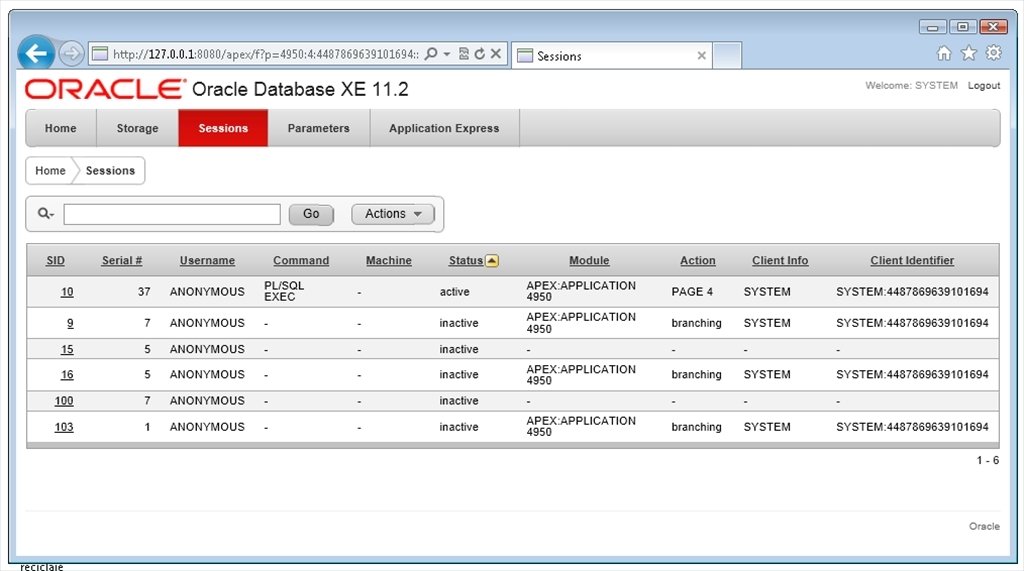
In an IT, DBA, or software development environment, when someone says "Oracle" without further context, they are likely referring to... Oracle Database. This is a relational database management system (RDBMS) that also supports the characteristics of the object-relational model. Oracle Database is designed to store, manage, and retrieve data for applications and users in a multi-user environment.
At a basic level, a business application might use a database to store information such as customers, products, transactions, orders, or accounting data. SQL is one of the primary methods by which applications and users access data within an Oracle database.
The key points to remember are: Oracle Corporation is a company; Oracle Database is a product of that company.
Therefore, if a business states, "Our system runs on Oracle," it cannot be concluded that they are using Oracle ERP. It is necessary to accurately identify the specific product and architecture the business is deploying.
What products make up the Oracle ecosystem?
For business readers, there's no need to memorize Oracle's entire product catalog. The four most important groups to differentiate are: Oracle Database, Oracle Cloud Infrastructure (OCI), Oracle Fusion Cloud Applications and Oracle NetSuite.
| Group | For example | What is it used for? | Primary users/business processes |
| Database | Oracle Database | Storing, managing, and retrieving data. | DBA, IT, application |
| Cloud infrastructure | Oracle Cloud Infrastructure (OCI) | Providing compute, storage, networking, database, and cloud services. | IT, cloud team |
| Enterprise applications | Oracle Fusion Cloud Applications | Finance management, HR, supply chain, sales/service, and business processes. | Business |
| Business management suite | Oracle NetSuite | Managing ERP/Financials, CRM, commerce, and related operations. | Business, finance, operations |
These four groups belong to different classes. Database focuses on data; OCI provides cloud infrastructure; Fusion Cloud Applications provides business applications; and NetSuite is a cloud-based business management suite.
Oracle Database
Oracle Database is a relational database management system (RDBMS) used for storing, managing, and retrieving data. Oracle also describes this product as an object-relational model, allowing for the handling of complex data models in addition to traditional relational structures.
From a business perspective, Oracle Database can be understood as data layer Behind the applications, data is organized in structures such as tables and can be accessed and processed using SQL.
For example, a business system might store supplier, customer, product, or transaction information in a database. End users typically work through the application, while the IT/DBA team is responsible for administering the backend database layer.
Therefore, Oracle Database is not ERP software.. It solves the problem of data management, while ERP solves the business processes of the enterprise.
Oracle Cloud Infrastructure (OCI)
Oracle Cloud Infrastructure (OCI) is a cloud infrastructure platform that helps businesses build and operate applications, services, and workloads in a cloud environment. Oracle describes OCI as a collection of complementary cloud services that enable the building and running of a wide variety of applications and services in a highly available, hosted environment.
Simply put:
Database = data management
OCI = infrastructure for running workloads
OCI offers a wide range of services related to computing, storage, networking, databases, analytics, AI, and application development.
This also means Oracle Cloud is not just a “cloud version of Oracle Database”. OCI is a broader cloud infrastructure layer, while Oracle Database is a type of data management technology that can be used in various architectures.
Oracle Fusion Cloud Applications
Oracle Fusion Cloud Applications is a suite of SaaS applications that serve business processes on a cloud platform. Oracle currently divides the Fusion Cloud Applications ecosystem into major groups such as Enterprise Resource Planning (ERP), Supply Chain & Manufacturing (SCM), Human Capital Management (HCM) and Customer Experience (CX), along with industry-specific solutions and AI capabilities.
The key difference is these groups. Not all of them are modules of Oracle ERP..
In Oracle's current taxonomy:
- ERP This includes Financials, Accounting Hub, Procurement, Project Management, Risk Management and Compliance, and related capabilities.
- SCM Focus on supply chain and manufacturing.
- HCM Serving human resource management.
- CX This includes applications related to sales, service, marketing, and customer experience.
For example, a business might use applications belonging to Fusion Cloud ERP One department uses it for finance and procurement, while another uses Fusion HCM for human resources. Because they all belong to the Fusion Cloud Applications Suite, they can be seen as an application ecosystem, but in terms of product classification, ERP, HCM, SCM, and CX are different families.
Oracle NetSuite
Oracle NetSuite is a cloud business management suite, This includes capabilities in ERP/Financials, CRM, commerce, and related enterprise management functions. Oracle currently describes NetSuite as a unified business management suite encompassing ERP/Financials, CRM, and e-commerce.
In the ERP layer, NetSuite supports various functions such as accounting, inventory, order management, project management, and employee management. The accounting section includes activities such as bookkeeping, banking, journal entries, chart of accounts, financial statements, revenue recognition, taxes, and fixed asset management.
Therefore, NetSuite should not simply be called that. “"Oracle ERP version for SMEs"”. NetSuite is a distinct product line/business management suite within the Oracle ecosystem, with its own range of functionality and architecture.
How do Oracle Database, Oracle ERP, Oracle Cloud, and NetSuite differ?
These concepts are all related to Oracle, but They are not in the same class and are not solving the same problem..
| Concept | Nature | The question it solves |
| Oracle Corporation | Company | Who creates/provides Oracle technologies? |
| Oracle Database | Database management system | How is the data stored and managed? |
| OCI | Cloud infrastructure | On what infrastructure do applications/workloads run? |
| Oracle Fusion Cloud ERP | Enterprise application | How are finance, procurement, projects, and back-office management handled? |
| NetSuite | Cloud business management suite | How do businesses manage ERP/Financials and related operations? |
A simple way to remember this is:
Oracle Corporation → provides the ecosystem
Oracle Database → data management
OCI → provides cloud infrastructure
Fusion Cloud ERP → supports enterprise management processes
NetSuite → cloud-based business management
For example, a business maybe We use Oracle Database to manage data, run workloads on OCI, and utilize Fusion Cloud ERP for financial operations. These are three different layers, not three different names for the same software.
However, this should not be understood as a mandatory stack. A business may use only one Oracle product or a combination of multiple products depending on its IT architecture, business processes, deployment model, and licensing scope.
If businesses want to learn more about Oracle ERP, Therefore, it's important to distinguish this overview from an in-depth article about ERP products, where modules, functions, and implementations are analyzed separately.
“What is the common understanding of "Oracle accounting software"?
Oracle does not have a single product simply named "Oracle accounting software". In the context of corporate finance, this term is often used to refer to financial capabilities belonging to Oracle Fusion Cloud ERP/Financials or financial functions in NetSuite, depending on the system the business is using.
In Oracle Fusion Cloud Applications, group ERP This includes Financials and capabilities such as Accounting Hub, Procurement, Project Management, and Risk Management and Compliance.
In the Financials layer, Oracle offers financial functions such as:
- General Ledger;
- Intercompany Accounting;
- Payables;
- Receivables;
- Payments;
- Cash Management;
- Tax;
- Expenses;
- Assets.
Oracle Financials is designed to support operations ranging from financial accounting, transaction processing and payments to cash reconciliation, expense management, and asset management.
From the perspective of Accounts Payable, for example, Oracle Fusion Payables offers functions and reports related to invoices, payments, reconciliation of Payables with Ledger, closing periods, and matching between invoices and purchase orders or delivery notes.
This shows when an accountant says “"Send invoices to Oracle"”, They might be talking about a process within the financial/ERP system, rather than directly manipulating the Oracle Database.
Similarly, NetSuite also has its own ERP and accounting functionalities, including bookkeeping, banking, journal entries, financial statements, taxes, and fixed assets management.
Therefore, before evaluating an Oracle accounting software solution, it is necessary to identify the business currently using it. Oracle Fusion Cloud Financials, another system within Fusion, or Oracle NetSuite.
When a company says they are "using Oracle," what should you consider?
“"Currently using Oracle" is not enough to determine which system a business is using. To properly understand the processes and integration capabilities, at least one system needs to be identified. Product name, business processes in use, and the system's role in the enterprise architecture..
1. What is the product name?
First, we need to identify the business that is using it:
- Oracle Database;
- Oracle Cloud Infrastructure;
- Oracle Fusion Cloud ERP;
- Other Oracle Fusion Cloud Applications;
- Oracle NetSuite;
- or another Oracle product.
This is the most important step because although they are all simply called "Oracle," each product has different functions and integration methods.
2. What type of service are you currently providing?
After identifying the product, it's necessary to know what the system is being used for:
- data management;
- Finance and accounting;
- shopping;
- supply chain;
- personnel;
- sell;
- customer service;
- or another business operation.
For example, if the IT department talks about Oracle Database, the conversation will primarily revolve around data and applications. If the Finance department talks about Oracle, they might be referring to Finance or another business application system.
3. Which application is a system of record?
Businesses also need to identify which systems are playing a role. System of records for each data type.
For example, a business might manage financial data in an ERP system, supplier data in a master data system, and use other applications for purchasing or invoicing. In this case, "pushing data into Oracle" must be understood in terms of the specific target system, rather than assuming all data goes directly to the database.
4. Is it necessary to exchange data with external software?
This is a particularly important question for financial and accounting processes.
If the AP department says: “"The invoice needs to be sent to Oracle."” then this statement It is not specified whether the target system is Oracle Database, Oracle Fusion Financials, or Oracle NetSuite..
In practice, data can pass through many different application and integration layers before being recorded into the business system. Oracle Fusion Cloud Financials now also provides REST APIs for accessing and managing Financials Cloud data, demonstrating that data exchange with external systems can be designed through appropriate integration mechanisms.
For businesses in Vietnam, designing invoicing processes and accounting data also needs to be considered within the context of current regulations on invoices and supporting documents. Decree 70/2025/ND-CP Amendments and additions to Decree 123/2020/ND-CP on invoices and documents will take effect from June 1, 2025; Circular 32/2025/TT-BTC Guidelines for implementing related regulations will also take effect from June 1, 2025.
Therefore, when designing the data flow between the invoicing system, document processing software, and ERP/NetSuite, businesses need to consider not only technical connectivity but also ensure that the data and processes meet the management, accounting, and tax requirements applicable to the business.
Conclude
Oracle Corporation is a company; Oracle Database is a database management system; OCI is a cloud infrastructure platform; Oracle Fusion Cloud Applications is an ecosystem of enterprise applications, including ERP, SCM, HCM, and CX; and NetSuite is a cloud business management suite belonging to Oracle. Therefore, "Oracle software" is not a single product but a term that can encompass many different technologies and applications.
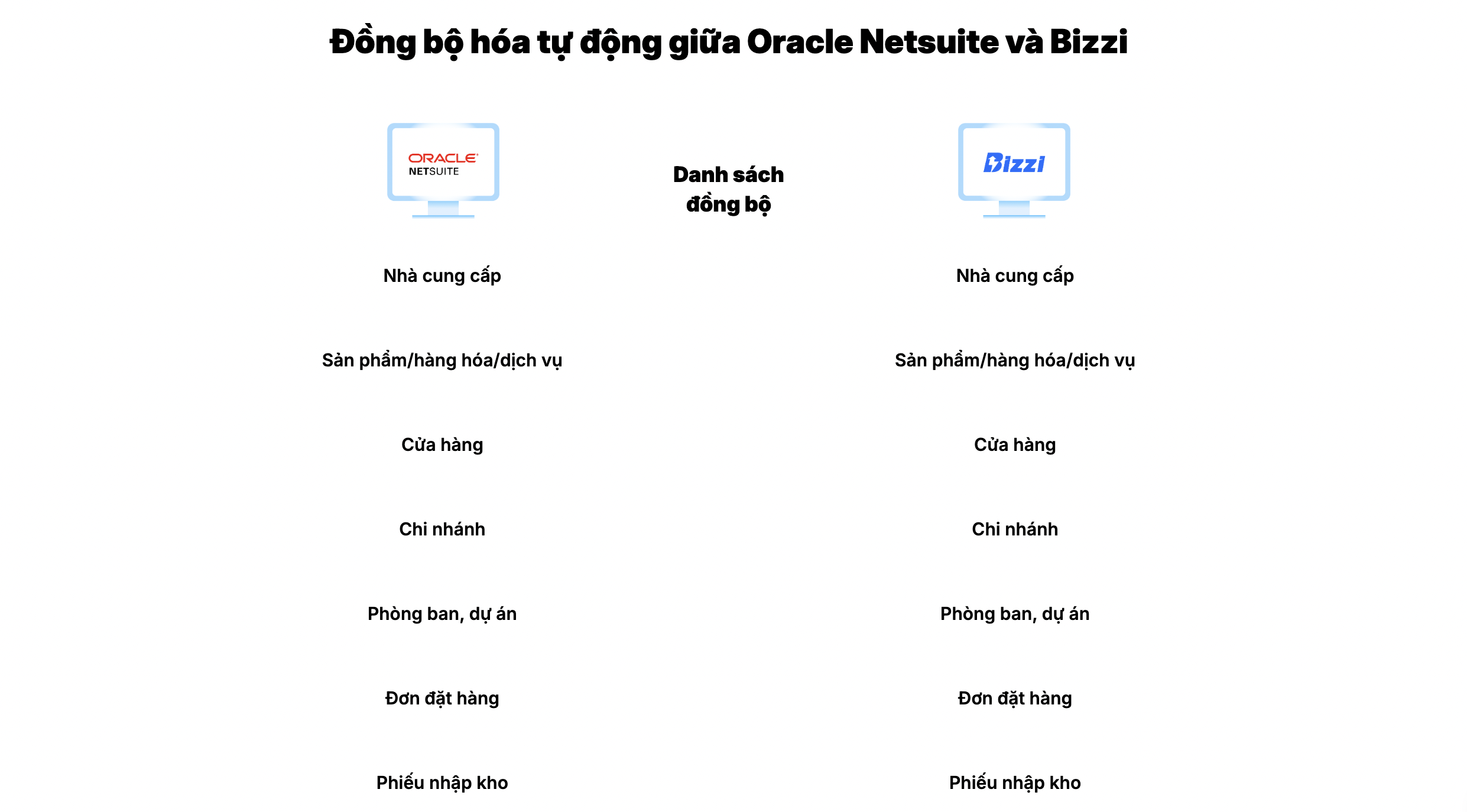
For businesses, accurate identification is crucial. Which Oracle product are you using and through which system is the data passing? This is the first step before evaluating integration or automation. If the business is using Oracle NetSuite And if you need to synchronize supplier data, purchase orders, warehouse receipts, invoices, or payment information with the Accounts Payable process, you can learn more about it. Bizzi integrates with Oracle NetSuite. Bizzi now announces API connectivity and support for synchronizing data groups such as vendor, product, PO, GR, invoice, and payment, depending on the actual integration configuration.
Sign up and learn more about Bizzi's automation solutions to improve operational efficiency and data control across your entire business process: https://bizzi.vn/dang-ky-dung-thu/