



Post-expense audits involve checking and verifying expenses after they have been incurred, in order to determine whether the expenses were used for the intended purpose, were properly documented, complied with policy, and could be explained when necessary. In the context of a regulatory mechanism increasingly shifting from pre-audit to post-audit, businesses need not only... correct spending, but also must proving that the expenditure was legitimate. Through clear data, documentation, and approval processes.
This places a new demand on CFOs, chief accountants, and finance departments: instead of focusing solely on processing transactions after they occur, businesses need to build a cost management process capable of tracking the entire lifecycle of each expense. From expense requests, approvals, payments, invoices, and accounting entries, all data needs to be interconnected to be readily available for internal audits and for accountability to tax authorities, auditors, or other stakeholders when necessary.
What is post-audit of costs?
Post-expense audit is the process of checking, reconciling, and evaluating expenses after they have been incurred to determine whether the expenses were for the intended purpose, fully documented, compliant with internal policies, and have sufficient basis for explanation when needed. This is a crucial step in corporate financial management, helping to detect errors, reduce accounting and tax risks, and enhance transparency in expenditure management.
What preparations do businesses need to make to replace pre-audit post-audits? In the context of businesses increasingly digitizing their financial operations and management trends shifting away from pre-inspection luxurious post-audit, The requirement no longer stops at simply "spending wisely," but also includes... The expenditure must be proven legitimate with clear data, documentation, and approval history.. This is especially important for CFOs and Finance Managers when ensuring compliance, readiness for audits, or accountability to regulatory authorities.
In practice, post-auditing of costs typically focuses on four main areas:
- DocumentAre invoices, receipts, contracts, statements, acceptance reports, or related documents complete and valid?.
- Purpose of expenditureDoes the expenditure serve production or business activities or align with the approved objectives?.
- Approval processWas the expenditure approved by the appropriate authority, in accordance with policy and internal procedures?.
- Accounting and reconciliation dataCheck if the information on the documents, payment transactions, and accounting records matches, and if there are any discrepancies or duplications.
Depending on the context, post-auditing of costs can take place at two different levels.
At the internal level, The Finance, Accounting, or Internal Control departments will conduct post-payment reviews of expenses to detect errors, assess policy compliance, and improve expense management processes. This is a regular activity in many businesses to minimize losses, improve budget efficiency, and better prepare for audits.
At the external level, Businesses may be required to explain expenses at the request of tax authorities, independent auditors, inspection agencies, or other relevant parties. In such cases, supporting documents, payment data, and approval history will be crucial in proving the validity of each expense.
As can be seen, post-auditing is not simply a final inspection step, but also a mechanism that helps businesses assess the quality of their expenditure control system. Issues discovered during post-auditing will serve as a basis for adjusting policies, improving processes, and minimizing risks in subsequent expenditure periods.
How does post-audit of costs differ from pre-audit of costs?
Both pre-audit and post-audit aim to control costs, but they differ in timing, type of data used, and risk management methods. Pre-audit helps prevent errors before money is spent, while post-audit focuses on verifying and proving the validity of the expenditure after the transaction has been completed.
In many businesses today, these two mechanisms are not interchangeable but rather They complement each other.. If businesses focus solely on pre-auditing, they may slow down operational processes because every expenditure must go through multiple layers of approval. Conversely, if they rely only on post-auditing without a pre-expenditure control mechanism, the risk of incurring off-budget or undocumented expenditures increases significantly.
| Criteria | Pre-audit of costs | Post-audit of costs |
| Time | Before spending or before approval. | After the expenditure, payment, or accounting entry. |
| Target | Prevent errors from the start. | Identify errors, make corrections, and demonstrate the validity of the expenditure. |
| Risks if controls are weak | Slow operation, bottlenecks in the approval process, impacting work progress. | The expenditure may be disallowed, difficult to account for, result in financial reporting errors, or pose tax risks. |
| Required data | Proposed expenditures, budget, spending policy, limits, approval information. | Invoices, contracts, acceptance certificates, payment vouchers, approval history, and accounting data. |
| The role of the CFO | Design pre-expenditure control mechanisms, develop budgets and spending policies. | Assess risks, improve policies, and increase the trackability and transparency of cost data. |
From a financial management perspective, pre-inspection It helps limit unnecessary expenses before money leaves the business, and post-audit This confirms that the expenditure truly meets all documentation, process, and purpose requirements. These two mechanisms form a closed loop of control, helping businesses maintain operational flexibility while ensuring accountability when needed.
Modern governance trends are also gradually shifting from a model heavily reliant on pre-auditing to Combining pre-auditing with data-driven post-auditing.. This helps businesses reduce unnecessary approval steps for low-risk expenditures while enhancing post-audit capabilities through centralized data, electronic documentation, and a comprehensive approval history.
For CFOs, the value of post-expenditure audit lies not only in detecting errors after spending, but also in the ability to... Learn from real-world data to adjust policies, optimize processes, and improve enterprise-wide visibility.. This also forms the basis for building a cost management system that is both flexible and meets the requirements of transparency and compliance in the context of businesses increasingly shifting towards post-audit mechanisms.

Why is post-auditing of costs becoming increasingly important for businesses?
Post-auditing of expenses is becoming an increasingly important requirement in financial management because the rate of expense generation in businesses is outpacing the ability to perform manual checks. As operations expand, the number of transactions increases, and more departments are involved in the procurement, business trips, client entertainment, or service payments processes, simply controlling expenses using Excel or reviewing documents after each accounting period is no longer sufficient to ensure transparency.
In many businesses today, expenses are no longer concentrated in the accounting department but originate from multiple departments, projects, branches, or employees in different locations. Each expense is accompanied by various types of data such as expense requests, approvals, electronic invoices, payment vouchers, contracts, or acceptance reports. If this data is stored in a fragmented manner, the finance department will spend a significant amount of time collecting and cross-referencing it when needed for audits or explanations.
Furthermore, expenses are becoming increasingly diverse, including travel expenses, SaaS software costs, online advertising, entertainment expenses, outsourced services, and small purchases. The high frequency of transactions makes entirely manual post-auditing time-consuming and prone to errors, especially when businesses have to process hundreds or thousands of documents each month.
If expense records are not standardized from the outset, businesses may face several consequences, such as:
- Gathering documentation and providing explanations takes a lot of time when audits or regulatory agencies request it.
- The expenditure may be at risk of not meeting the recognition criteria or may lack sufficient grounds to demonstrate its validity.
- Inaccurate management data makes it difficult for CFOs to assess budget utilization efficiency by department, project, or supplier.
- The lengthy settlement process affects the timeline for closing the books and preparing financial statements.
From a tax perspective, businesses also need to be aware of the following: The conditions for an expense to be considered deductible when determining taxable income for corporate income tax purposes usually revolve around the following factors.:
- Actual expenses incurred and related to the business operations of the enterprise.
- There are valid invoices and supporting documents as required by regulations.
- For expenses of value From 20 million VND or more (including VAT), Businesses often need to have non-cash payment voucher According to current regulations to meet the conditions for deductible expenses.
This shows that post-auditing is not simply... Check input invoices It's not just after payment, but a process of verifying the entire data chain of an expense. The more standardized a business is from the moment it generates data, the faster the post-audit process becomes, reducing risks and increasing accountability to stakeholders.
Which types of expenditures typically pose a risk during post-audit?
Not all expenses carry the same level of risk. In fact, expenses incurred outside the office, with numerous supporting documents, or involving multiple stakeholders are often the groups that require stricter scrutiny during post-audit.
| Cost group | Common post-audit risks | Documents should be included. |
| Business trip expenses | Exceeding quotas, lack of schedules, lack of invoices or related documents. | Work request, decision/approval, flight tickets, hotel booking, invoices, work report. |
| Advance payment/reimbursement | Advance payments are outstanding for too long, and supporting documents do not match the amounts disbursed. | Advance payment request, approval, reimbursement statement, original documents, payment vouchers |
| Reception | It is difficult to prove that the purpose is for business purposes. | Invoices, visitor lists or records, content and purpose of the meeting. |
| Purchase services | Missing contract or acceptance certificate. | Contracts, acceptance certificates, invoices, payment documents |
| Digital transformation costs | There are invoices, but there is a lack of evidence of actual implementation. | Contracts, implementation plans, handover documents, acceptance reports, performance reports. |
| Cost over budget | Paid but not in compliance with internal policy. | Explanation of budget overruns, exception approvals, approval history (approval log) |
The common thread among these expenses is that they all require more than one invoice to prove their validity. Businesses should establish clear regulations regarding the required documentation for each expense category, rather than simply requesting additional documents during audits.
What conditions must an expenditure be subject to "post-audit"?
An expenditure is considered "ready for post-audit" when the business can quickly demonstrate its validity through complete data, documentation, and processing history. Instead of simply memorizing concepts like "reasonable" or "valid," a Finance Manager can apply framework 5D Please review the following information before filing the records.
The 5D Framework helps businesses prepare for post-audits.
| Criteria | Meaning |
| Right for the purpose | Expenditures used for production, business operations, or objectives approved by the enterprise. |
| Sufficient documentation | There are complete invoices, contracts, acceptance reports, statements, payment vouchers, and related documents depending on the type of expense. |
| In accordance with policy | Do not exceed the allocated budget, or if exceeded, it must be with exceptional approval; comply with spending regulations and the correct level of approval. |
| Correct data | The information on expenditure requests, invoices, payments, and accounting data must be consistent and free from discrepancies. |
| Sufficient traceability | A complete history of request creation, approval, editing, payment, reconciliation, and processing status is available for explanation when needed. |
Framework 5D This helps the finance department shift from a "checking each document" mindset to "controlling the entire lifecycle of the expenditure." When all transactions simultaneously meet these five criteria, businesses will significantly reduce documentation preparation time, improve the quality of accounting data, and be more proactive in internal audits, inspections, or audits. This also forms the foundation for modern cost management systems to automatically reconcile data, detect exceptions, and support CFOs in monitoring spending risks in real time.
Proactive cost audit process for the finance department.
Post-audit cost effectiveness should not begin when an audit or regulatory agency requests an explanation, but should be conducted periodically according to a standard procedure. This helps the Finance department detect errors early, reduce end-of-period processing pressure, and continuously improve expenditure management policies.
A proactive post-audit process can be implemented in the following steps:
Identify high-risk expense categories.
It's not necessary to scrutinize all transactions with the same level of detail. Businesses should prioritize expense categories that are high-value or prone to errors, such as business travel expenses, entertainment expenses, service purchases, project costs, advances, and reimbursements. Categorizing by risk level allows the Finance department to focus resources on expenses that have a significant impact on financial reporting and tax obligations.
Compare with the budget and spending policy.
After defining the scope of the audit, it is necessary to review whether the expenditure falls within the approved budget, exceeds internal limits, is incorrectly categorized, or lacks the required approval level. This step helps assess the level of policy compliance before delving into the documentation audit.
Check the documents
Verify the completeness and consistency of records, including invoices, contracts, acceptance reports, payment vouchers, statements, and related documents depending on the type of expense. The goal is not only to check the completeness of the documents but also to determine whether the documents accurately reflect the economic transactions that occurred.
Reconciliation of accounting data
Next, compare the information between the expenditure request, supporting documents, payment transactions, and accounting data. Discrepancies in amounts, suppliers, accounting accounts, departments, or projects need to be detected and addressed before they affect financial statements or tax settlements.
Classify errors by group.
Instead of addressing each issue individually, businesses should categorize errors to identify the root cause. Common error categories include:
- Missing or incomplete documentation.
- Incorrect information on the invoice or record.
- Expenditures that exceed policy or budget limits.
- Incorrect accounting entries or expense allocation.
Grouping helps Finance easily identify recurring problems and prioritize process improvements.
Request for additions or adjustments
For expenditures that do not meet the requirements, it is necessary to clearly identify the department or individual responsible for supplementing documentation, correcting data, or providing explanations, and to specify a deadline for completion to avoid prolonging the settlement process.
Update the policy if the error recurs.
If the same type of error occurs repeatedly, the cause is usually not with individual employees but with the management process. Businesses should review and adjust spending regulations, quotas, forms, or approval flows to reduce the likelihood of recurrence in the future.
Report to the CFO or Finance Manager.
Post-audit results should be compiled into a management report rather than simply being recorded as an audit report. The report should highlight common error categories, risk values, relevant departments, trends, and corrective actions that have been or will be implemented. This forms the basis for the CFO to assess cost control effectiveness and make decisions about process improvements.
Where do businesses often go wrong by only controlling costs after they have already occurred?
Many businesses believe that simply checking invoices before accounting is sufficient. However, the majority of post-audit risks stem from operational processes, not just from documentation. When data is scattered and control only occurs after money has been spent, the finance department often has to deal with multiple issues simultaneously.
Some common mistakes include:
- Approval via email or chat app, no centralized history.
Many expenditures are approved via email, text message, or phone call without being stored on a unified system. When tracing is needed, businesses find it difficult to prove who approved the expenditure, when it was approved, and the basis for the approval.
- Employees submit invoices late or lose supporting documents.
Documents are often submitted days or weeks after they occur, wasting accountants' time on reminders and slowing down the process of reimbursement, settlement, and closing the accounting period.
- The accountant only checked the invoices without comparing them against the budget and initial approval.
A valid invoice doesn't necessarily mean the expenditure is in accordance with policy. Without reviewing the expenditure request, limits, and approved budget, businesses may overlook expenses that exceed internal regulations.
- The expense has been paid but lacks supporting documentation.
For service purchases, consulting, or project implementation, businesses may have invoices and payment receipts but lack contracts, acceptance certificates, or documents proving the business purpose, increasing the risk when providing explanations.
- There are no dashboards organized by department or project.
When data is only aggregated at the end of the period, it is difficult for CFOs to detect unusual expenditures or budget overruns by unit, leading to control that is primarily reactive rather than proactive.
- The data is located in multiple different systems.
Expenditure requests are stored on one platform, payments are made at the bank, invoices are sent via email, and accounting entries are processed in the accounting software. The lack of data connectivity means that each post-audit becomes a manual compilation process, which is both time-consuming and increases the risk of errors.
Overall, the biggest problem with post-audits is not the lack of invoices, but rather... lack of a consistent data sequence From expenditure proposals, approvals, payments to accounting. When these links are not connected, the accountability and risk control capabilities of the business also decline significantly.
How should pre-auditing and post-auditing be combined to effectively control costs?
Pre-audit and post-audit are not two substitute methods, but rather two complementary layers of control within the same cost management system; in other words, business cost management solutionsp. If pre-auditing is too strict, businesses may experience delays in approval and disruptions to operations. Conversely, relying solely on post-auditing means that finance companies will have to address errors after the money has been disbursed and risks have already arisen.
Therefore, the effective model is:
- Pre-auditing through policies, budgets, and approval processes., This helps prevent inappropriate spending from the start.
- Post-auditing using data, documents, and traceability., This helps verify the validity of expenditures and continuously improve governance processes.
| Stage | Things that need to be controlled | Tools/Processes |
| Before spending | Budget, limits, approval levels, spending policies | Internal policies, approval workflows, budget overrun alerts. |
| When expenses arise | Invoices, supporting documents, purpose of expenditure, transaction information | Upload documents, OCR invoices, check electronic invoice information. |
| After spending | Reconciliation, accounting, tracing, and reporting. | Expense reports, approval history (audit trail), management dashboard, accounting data reconciliation. |
By combining these two layers of control, businesses not only reduce the risk of expense disallowances or difficulties in accounting, but also build a transparent and continuously improving financial management system. This is also the approach many businesses are currently adopting. Control spending before funds are disbursed and use post-spending data to evaluate and optimize policies, as well as improve the quality of financial operations.
How does expense management software support post-auditing?
Cost management software does not replace the role of accountants in post-auditing, but it helps businesses standardize data, track the entire process, and significantly shorten the time spent preparing documents when audits or explanations are needed. Instead of gathering documentation from multiple emails, spreadsheets, or messages, businesses can manage the entire lifecycle of an expense on a single platform.
For businesses with numerous business expenses, departmental costs, or advances, digitizing processes from the outset will create a comprehensive data foundation for future audits.
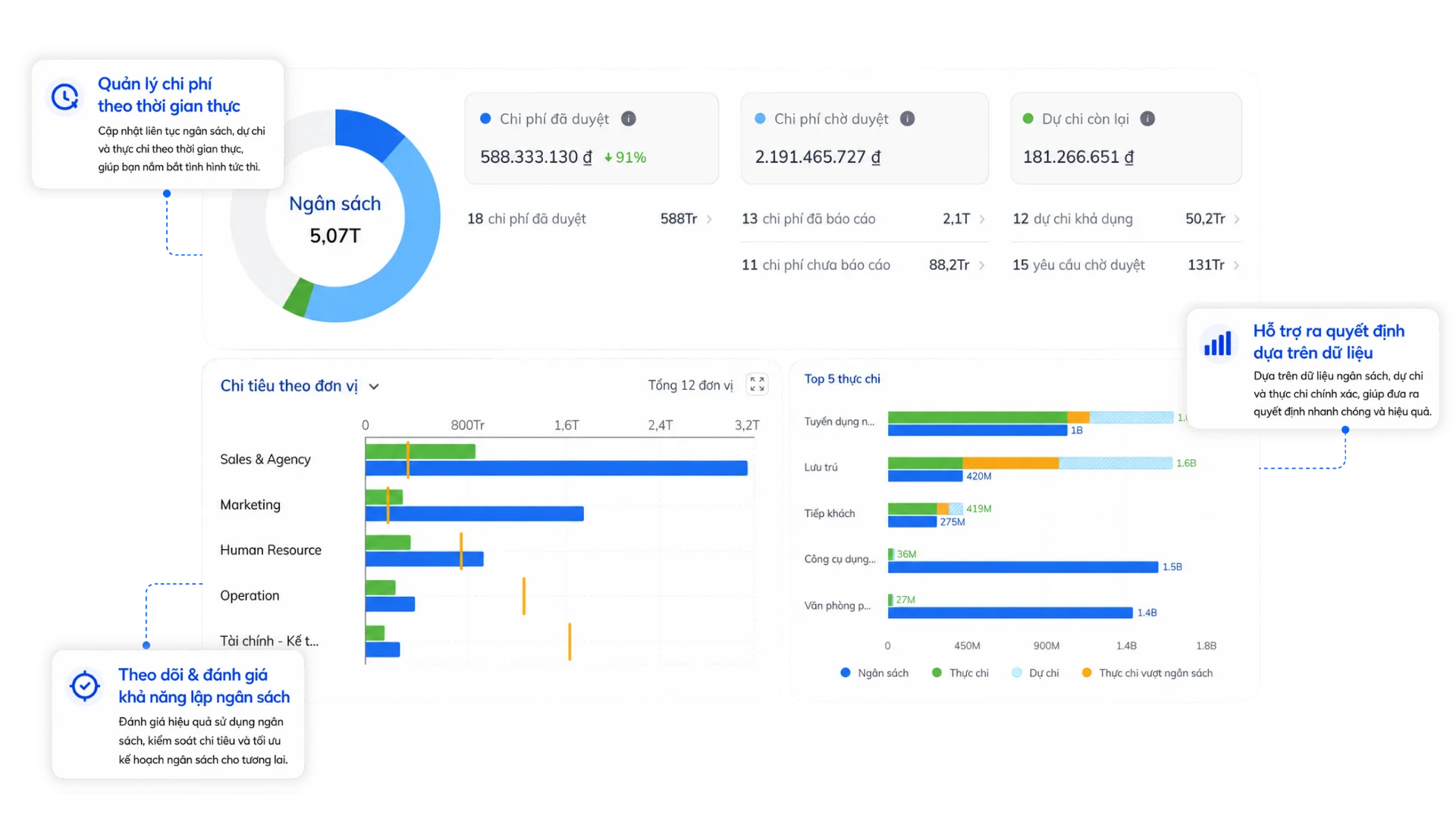
With Bizzi Expense, Businesses can manage their spending and operations across a single, unified platform. Creating expense requests, advance payment requests, booking tickets, managing travel expenses, collecting and reconciling invoices for payment.. As a result, data is no longer scattered across multiple systems or stored manually.
An important point is that the system is capable. Linking spending policies, budgets by department or project, approval workflows, and control conditions., This system then alerts businesses when expenses exceed limits, budgets, or fail to meet internal policies. This significantly reduces the number of errors that need to be addressed during post-audit procedures.
During the process of collecting documents, Bizzi Expense It assists in receiving and verifying electronic documents and invoices, and also helps detect cases such as:
- Duplicate invoices.
- The invoice shows signs of incorrect information.
- Lack of required documentation for each type of expense.
- The application is not yet eligible for further processing.
Instead of just storing documents, the system also Audit trail of the entire processing process., This includes the time the proposal was created, the proposer, the approver, revisions, payments, and reconciliation. This is a crucial data source for internal audits, post-audits, and subsequent accountability requests.
Businesses have numerous business expenses, advances, reimbursements, or other expenses arising from various departments. Consider digitizing the cost management process. To reduce the risk of missing documents, increase data accessibility, and be more proactive in post-auditing.
Checklist: Is your business ready for post-audit of expenses?
A business is considered ready for post-audit when it not only keeps complete documentation but also has the ability to trace the entire process of incurring, approving, and paying each expense. You can use the checklist below to assess the readiness of your current process.
- Yes spending regulations and clearly defined budgets for each cost category.
- Yes approval workflow by rank, budget, or department.
- ☐ Every expense has a full breakdown. Proposals for expenditure, approvals, invoices, and payment documents..
- ☐ Large-value expenditures are recorded. non-cash payment voucher where required by law.
- Yes audit trail Record full details of who created the request, who approved it, who made the edits, and who made the payment.
- Yes expense report Costs are allocated by department, project, category, or center to support administrative functions.
- ☐ There is a monitoring and handling process in place. Overdue advance or Refunds are being processed without supporting documents..
- ☐ Perform Regular internal audits are conducted monthly or quarterly., instead of just reviewing at the end of the year.
- Yes dashboard alerts Extraordinary expenses, expenses exceeding the budget, or expenses exceeding the set limits.
- ☐ Has a mechanism Update spending regulations when recurring errors are detected during post-auditing.
If a business doesn't meet many of the criteria on the list above, it signals that its cost management process still relies on manual operations and may pose risks during audits, settlements, or when explaining matters to stakeholders.
FAQ about post-auditing of expenses
Is post-auditing of expenses just about tax checks?
No. Post-auditing of costs can be an internal review conducted by the Finance, Accounting, or Internal Control departments, and can also arise during audits, inspections, or tax authority examinations. In modern financial management, post-auditing is considered an important part of the cost control system.
Is an expenditure approved by the boss guaranteed to be accepted during a post-audit?
Not certain. Internal approval is only one condition of the expense management process. During post-audit, the expenditure still needs to have a proper purpose, complete documentation, consistent data across systems, and compliance with relevant regulations and the company's internal policies.
How does post-audit of expenses differ from tax settlement?
Tax settlement is the process of declaring, determining, and fulfilling tax obligations according to the law. Meanwhile, post-expense audit is the process of reviewing expenses after they have been incurred to assess their validity, compliance with policies, and the justification of each expense. Effective post-auditing helps businesses be more proactive in the settlement and subsequent audit process.
How often should businesses conduct post-audits of expenses?
For businesses with numerous business expenses, advances, reimbursements, or expenses arising from multiple departments, periodic post-audits should be conducted. month or quarter. Regular audits help detect errors early, reduce year-end processing pressure, and continuously improve expense management processes.
Can cost management software replace accountants in post-audit procedures?
No. The software primarily supports the automation of tasks such as document collection, process tracking, exception alerts, data reconciliation, and report generation. Evaluating the nature of transactions, considering the reasonableness of expenses, and handling exceptions still require the expertise of the accounting and finance departments. This is a combination of... data automation and professional evaluation, instead of completely replacing the role of humans.
Conclude
Post-expense audits are not just a review process after an expense has been incurred; they also serve as a foundation for businesses to enhance transparency, reduce financial risks, and be prepared to explain their operations to auditors or regulatory agencies. In a business environment with numerous expenses scattered across departments, projects, and employees, relying solely on manual post-payment checks will waste the Finance team's time on reconciliation, while the CFO may lack a comprehensive view of the risks and effectiveness of budget utilization.
For post-auditing to be truly effective, businesses should build a comprehensive process from start to finish. From pre-expenditure control and document collection to data reconciliation and tracking of the entire processing process, everything is handled meticulously.. When data, documents, and approval history are centrally managed, post-auditing becomes a proactive governance activity rather than a problem-solving process at the end of the period.
In that process, Bizzi Expense It is a solution that helps businesses digitize their entire process. business cost management – from creating payment requests, approving them, managing advances and reimbursements, to collecting electronic invoices, reconciling documents, and archiving. audit trail on the same platform. This allows the Finance team to significantly reduce manual auditing tasks, increase data accessibility during post-audits, and help CFOs track costs by budget, department, and project to make more accurate and timely financial decisions.
To receive advice on effective corporate financial management solutions, schedule an appointment with Bizzi here: https://bizzi.vn/dat-lich-demo/