


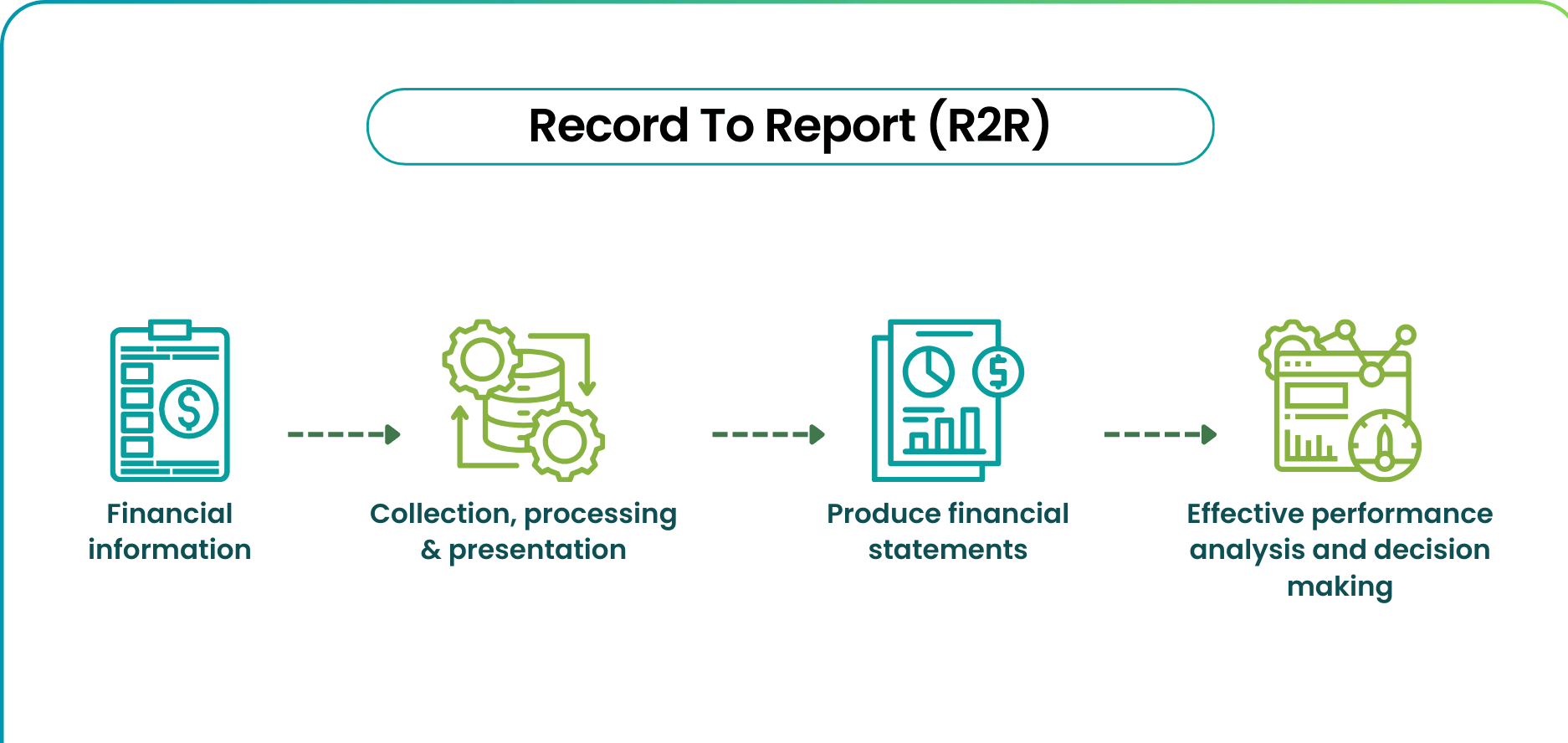
The R2R (Record-to-Report) process is a series of financial activities from recording transactions, reconciling, adjusting, closing the books to preparing financial reports, helping businesses transform accounting data into accurate, reliable financial information for decision-making.
In modern financial operations, R2R is one of the three core processes, alongside R2R. Procure-to-Pay (P2P) and Order-to-Cash (O2C). The quality of this process directly impacts the speed of closing the books, the accuracy of financial reporting, and the CFO's ability to respond to fluctuations in cash flow, costs, or business performance.
However, the challenges many businesses face today are not limited to slow report preparation. The deeper issues often stem from unclean input data, manual reconciliation in Excel, mismatched accounts payable, or a large volume of adjusting entries accumulating at the end of the period.
This article will help you understand what the R2R process is, its steps, common bottlenecks, and how to improve Record-to-Report using automation, AI, RPA, and ERP integration to move towards a Fast Close and Continuous Accounting model.
What is the R2R process?
The R2R (Record-to-Report) process is a financial process for converting transaction data that is generated. This results in accounting records, adjusting entries, reconciled data, and ultimately, financial or management reports for the business.
Simply put, Record-to-Report consists of two main components:
| Ingredient | Roles in R2R | For example |
| record | Record transaction data | Invoices, accounts payable, expenses, revenue |
| Reconcile | Data reconciliation | Reconcile bank accounts, accounts payable, and internal transactions. |
| Adjust | End-of-period adjustments | Provisioning, allocation, and revaluation of exchange rates. |
| Close | Close the books. | Lock period, check data completeness. |
| Report | Report generation | Financial reports, management dashboards |
Many businesses often mistakenly believe that R2R is simply the end-of-month or end-of-year reporting step. In reality, the report is merely the final output of a whole chain of data control processes that extends throughout the accounting period.
If input data is inaccurate, reconciliation is incomplete, or adjusting entries are missed, the quality of financial reports will be affected, regardless of how modern the ERP system a business uses is.
The results of the R2R process are used by many stakeholders:
- CFO and Executive Board
- Chief Accountant
- FP&A Department
- Internal audit and independent audit
- Investors
- Government agencies (when necessary)
Therefore, R2R is not just an accounting process, but also a data platform for all financial management activities.
Learn more: Intelligent automation in the Record-to-Report (R2R) process.
What are the steps involved in the Record-to-Report process?
A standard Record-to-Report process typically includes six main steps.
Step 1: Collect and verify transaction data
This is the stage where all financial data generated from business operations is received.
The data source could be:
- Electronic bill
- Payment documents
- Bank statement
- Accounts Receivable (AR)
- Accounts Payable (AP)
- Internal costs
- Purchase Order (PO)
- Goods Receipt (GRN)
- ERP system
- Sales software
The goal of this step is to ensure the data:
- Full
- Valid
- In the correct accounting period
- No duplicates
If invoices are delayed or supplier information is inaccurate, the entire R2R chain will be affected.
Step 2: Record the transaction and make the accounting entry.
Once verified, the transactions will be recorded in the accounting system or ERP.
Include:
- Accounts receivable
- Accounts payable
- Record revenue
- Record the expense.
- Record assets
- Record accounts payable
The goal is to ensure that all transactions are accurately reflected:
- Accounting accounts
- Related parties
- Cost center
- Project
- Accounting period
Step 3: Compare the data
This is one of the most important steps in the entire R2R cycle.
Common comparison activities include:
- Bank reconciliation
- AR/AP comparison
- Compare the invoice with the purchase order and gross receipt.
- Internal transaction reconciliation
- Compare ERP data with the satellite system.
The goal is to detect:
- Data discrepancies
- Duplicate Payment
- Incorrect recording period
- Missed transactions
For businesses with multiple subsidiaries, internal transaction reconciliation is often one of the biggest bottlenecks in the entire R2R process.
Learn more: [Internal Link – Internal Transaction Reconciliation Process]
Step 4: Process the year-end adjusting entry.
After the reconciliation is complete, the business needs to process the adjusting entries to ensure that the report accurately reflects the financial situation.
Common accounting entries include:
- Accruals (previous excerpt)
- Prepayments
- Depreciation
- FX Revaluation
- Reclassification
- Intercompany Elimination
If these entries are not processed properly, the financial statements may be significantly distorted.
Step 5: Close the books and lock the term.
Closing the books is the "data barrier" in the entire R2R cycle.
At this stage, the business performs the following actions:
- Check the cut-off.
- Check for data completeness.
- Review audit trail
- Approve the report
- Accounting term
Locking the file helps prevent unauthorized edits after the report has been released.
Learn more: Accounting closing procedure
Step 6: Prepare a report and conduct an analysis.
After the data is verified, the business will create:
- Financial report
- Management report
- CFO Dashboard
- Cash flow report
- Budget report
- Operational efficiency report
This is the stage where accounting data is transformed into insights that support decision-making.
| R2R Step | Control objectives | Risks of doing it manually |
| Data collection | Complete and valid | Missing documents |
| Accounting | Correct account | Incorrect accounting entry |
| Compare | Detecting discrepancies | Missed transaction |
| Adjust | Accurate financial situation | Incorrect accounting period |
| Close the books. | Data protection | Lack of audit trail |
| Report | Decision support | Late reporting |
Why are R2R processes often slow and prone to errors?
Although the R2R process is quite clear in theory, its implementation in businesses often encounters many bottlenecks.
1. The input data is not clean.
Common problems include:
- Incorrect invoice information
- Missing documents
- The supplier's declarations are inconsistent.
- Data is generated across multiple systems.
The "Garbage In, Garbage Out" principle is especially true in R2R.
2. Manual comparison using Excel
Many businesses still:
- Reconcile bank statements using Excel.
- Reconcile accounts payable via email.
- Manage multiple versions of a file.
This significantly increases the risk of errors and wasted time.
3. Pack up work until the end of the semester.
Activities:
- Check the invoice
- Compare
- Adjust
- Close the books.
They are usually concentrated in the last few days of the month.
The consequence is:
- Finance team is overloaded.
- Errors increased significantly.
- Report released late
4. Lack of audit trail
Many businesses face this situation:
- I don't know who modified the data.
- No approval history
- Difficult to explain to auditors.
5. ERP and its subsystems are out of sync.
A common situation is:
- We have ERP but still do manual data entry.
- The data is stored in emails, Excel spreadsheets, bank accounts, and various other systems.
This increases the risk of data discrepancies between systems.
| Bottleneck | Token | Impact |
| Distributed data | Multiple systems | Slow synthesis |
| Error documents | Missing or incorrect | Adjustments are being made. |
| Compare to Excel | Multiple files | Difficult to control |
| Unmatched accounts payable | AR/AP deviation | Delayed closing of accounts |
| Lack of audit trail | Untraceable | Difficult to audit |

Where should improvements to the R2R process begin?
Many businesses try to improve R2R by requiring accountants to work faster. However, a more effective approach is to redesign the data flow and control points throughout the entire cycle.
1. Normalize input data
Businesses should standardize:
- Vendor master
- Customer Master
- Chart of Accounts
- Cost center
- Project code
The goal is to ensure all systems use the same data language.
2. Automating document collection and verification.
Instead of manual data entry, businesses can use:
- WHO
- OCR
- E-invoice validation
to auto:
- Read the invoice
- Check tax code
- Check invoice status
- Verify supplier information
Learn more about the solution Automatic invoice processing
3. Automated Matching
The following activities should be prioritized:
- Bank reconciliation
- AR/AP comparison
- 3-way matching
- Internal transaction reconciliation
4. Switch from Month-End Closed to Continuous Accounting
Instead of waiting until the end of the month to check:
- Invoices are verified as soon as they are generated.
- Accounts payable are reconciled continuously.
- The discrepancy was resolved promptly.
This significantly reduces the pressure of closing the books.
5. Set up workflow and audit trail
A mature R2R process requires:
- Closed checklist
- Clear deadline
- Person responsible
- Data change log
- Electronic sign-off
6. Monitor R2R KPIs
Key KPIs include:
- Days to Close
- Reconciliation Completion Rate
- First-Time-Right Rate
- Exception Rate
- Audit Adjustment Rate
- Report Release Time
| Direction of improvement | Problem solved | Support technology |
| Data normalization | Heterogeneous data | Data governance |
| Check the documents. | Incorrect invoice | AI/OCR |
| Automatic reconciliation | AR/AP deviation | Matching engine |
| Continuous | Final deadline | Workflow |
| Audit trail | Difficult to trace | Decentralization |
| KPI dashboard | No effectiveness measured. | BI |
DBusinesses can refer to the document. Record-to-Report Bizzi's work aims to provide a better understanding of how AI and RPA are applied in the steps of transaction recording, reconciliation, adjustment, and closing.
How do AI, RPA, OCR, and ERP integration support R2R?
Many businesses view automation as a single tool. In reality, each technology plays a different role in the R2R chain.
| Technology | Roles in R2R | For example |
| OCR/AI | Read and check the documents. | Electronic bill |
| RPA | Automate repetitive tasks | Bank reconciliation |
| ERP Integration | Data synchronization | AP, AR, GL |
| Workflow | Work coordination | Closed checklist |
| BI Dashboard | Performance tracking | Days to Close |
OCR and AI help reduce the amount of data input.
RPA supports repetitive tasks such as transaction reconciliation or creating recurring journal entries.
ERP integration plays a role in creating a single source of data.
Workflow automation helps manage responsibilities, deadlines, and approvals.
The BI Dashboard provides CFOs and executives with the ability to track closing progress in real time.
Learn more: Integrating ERP into financial management
How are Fast Close and Continuous Accounting related to R2R?
Many businesses understand Fast Close as simply shortening the number of days to close the books. In reality, Fast Close is the result of redesigning the entire financial process in the following way:
- The data was cleaned sooner.
- Comparisons are being made more frequently.
- Exceptions are handled continuously.
- The work is distributed evenly throughout the month.
If a business simply asks its accounting team to work faster without changing the process, it's easy to trade speed for accuracy.
An effective Fast Close process needs to meet three criteria simultaneously:
- Faster.
- More accurately.
- Auditability is possible.
Continuous Accounting is changing the way we think about financial operations.
In the traditional model, financial activity typically occurs in cycles:
- Transactions were recorded at the beginning of the month.
- Compare results at the end of the month.
- Adjustments will be made at the end of the month.
- The books are closed at the end of the month.
In Continuous Accounting, verification and reconciliation activities take place continuously.
For example:
- The invoice is verified upon receipt.
- Accounts payable are reconciled weekly.
- Exceptions are flagged in real time.
- The dashboard is constantly being updated.
As a result, by the end of the period, most of the work is completed, and the business only needs to handle the remaining exceptions.
Strategic benefits for the CFO
When combining Fast Close with Continuous Accounting, the CFO can:
- Shorten the reporting cycle.
- Improve data reliability.
- Improve cash flow forecasts.
- Better control over working capital.
- Early detection of risks related to cost overruns.
- Receive near real-time business updates.
This lays the groundwork for shifting the finance department from a data-recording role to a decision-making support role.
Learn more: [Internal Link – Finance Shared Service Center]
How does Bizzi support improvements to the R2R process?
In many financial transformation projects, businesses often focus on dashboards or reports. However, reports are only effective when the source data is sufficiently accurate.
Bizzi focuses on bottlenecks at the operational data layer:
- Bill.
- Accounts payable.
- Expense.
- Approval flow.
- ERP synchronization.
This helps reduce the amount of manual processing required before data enters General Ledger and financial reporting.
Clean up input data with Bizzi Bot
Bizzi Bot support:
- Collect invoices
- Data extraction
- Checking for validity
- Standardize supplier information.
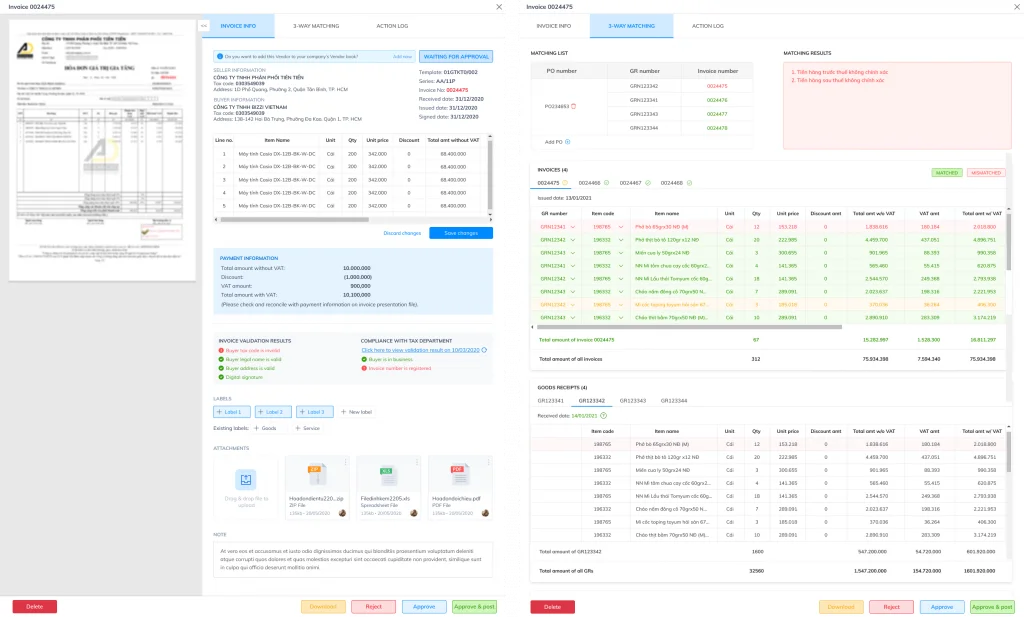
- Supports 3-way matching
The value gained is the reduction of data errors before the accounting and closing processes begin.
Support for comparison with Bizzi ARM
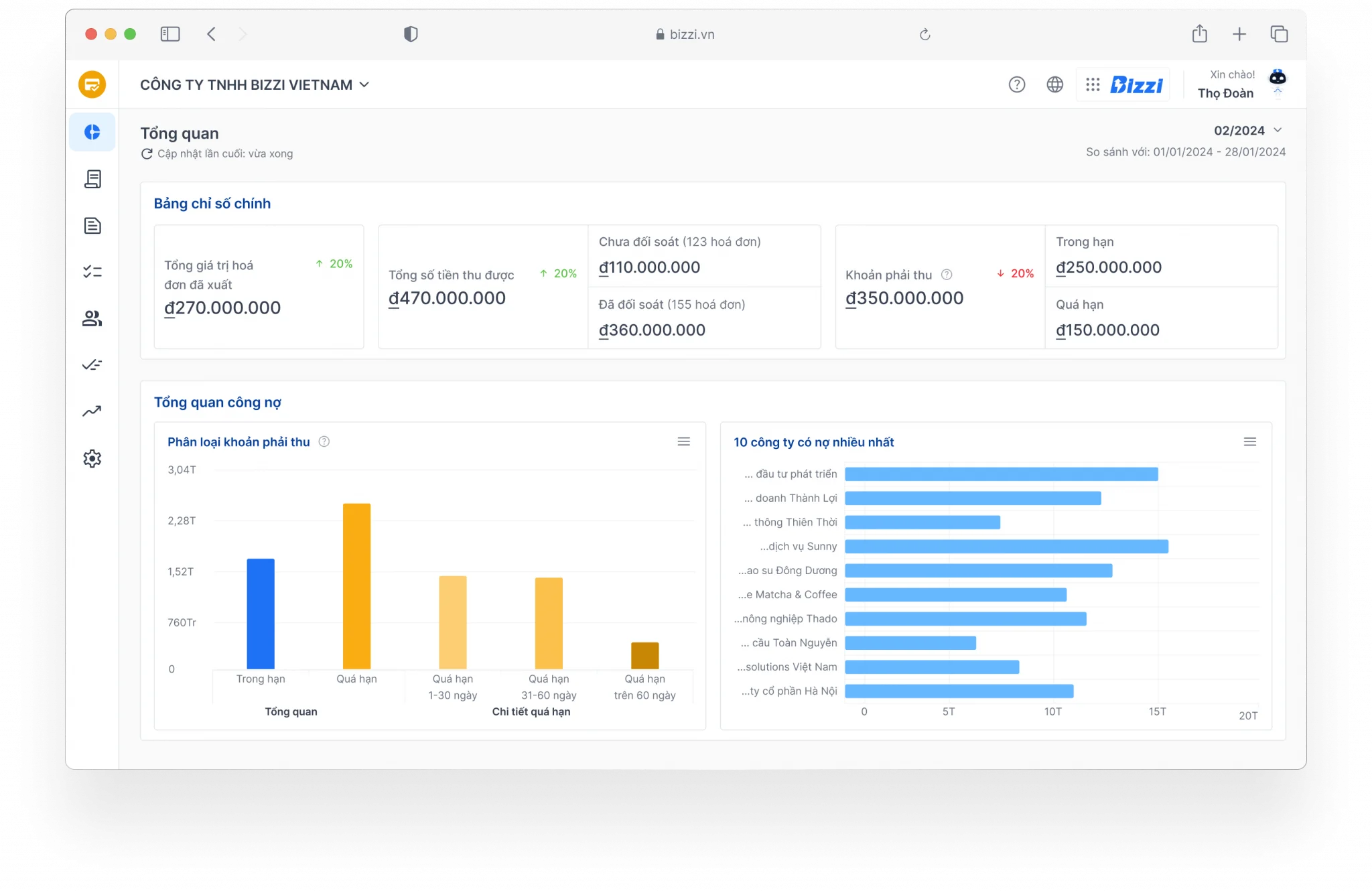
Bizzi ARM helps:
- Reconciliation of debts
- Assistance with reconciliation
- Connecting bank data
- Increase control over cash flow.
Standardize your costs with Bizzi Expense
Bizzi Expense supports:
- Workflow for cost approval
- Over budget warning
- Attach cost center
- Attach project code
This helps improve the quality of cost data before it is included in financial reports.
ERP integration
Bizzi supports data synchronization:
- Document
- Vendor master
- AP
- GL
- thousand information
Through a two-way API with ERP, this reduces double-entry data entry and data discrepancies.
| R2R bottleneck | Bizzi support | Value |
| Error invoice | Bizzi Bot | Clean input data |
| AP does not match | 3-way matching | Reduce discrepancies |
| Debt discrepancies | Bizzi ARM | Speed up reconciliation |
| Costs lack standardization | Bizzi Expense | More accurate report |
| Double input | ERP Integration | Single Source of Truth |
Throughout the entire Record-to-Report cycle, invoices are often one of the most important sources of input data.
If the bill:
- Incorrect information.
- Missing supporting documents.
- The purchase order does not match.
- GRN mismatch.
Then the entire accounting, reconciliation, and closing process that follows could be affected.
Therefore, many businesses choose to begin their R2R improvement journey by digitizing and automating their invoice processing workflow. When invoice data is collected, verified, and synchronized from the outset, the finance department can significantly reduce the volume of end-of-period adjustments and improve reporting reliability.
Learn more about Bizzi's automated invoice processing solution to build a clean data foundation for the entire Record-to-Report cycle. Bizzi can help assess bottlenecks in the R2R cycle and identify priority automation steps.
Checklist for assessing the maturity level of the R2R process.
A mature R2R process should meet the following criteria:
✓ Invoices are checked immediately upon issuance.
✓ AP, AR, Expense, banking, and GL are synchronized.
✓ Accounts payable are reconciled regularly throughout the month.
✓ Yes Perform 3-way matching
✓ Includes a checklist with clear owner and deadline for closing the account.
✓ There is an audit trail for all changes.
✓ Includes a dashboard to track book closing progress.
✓ Not overly reliant on Excel
✓ R2R KPIs are monitored regularly.
✓ The CFO receives the report early enough to make a decision.
| Number of criteria met | Level of maturity | Priority action |
| 0–3 | Manual, high risk. | Data normalization |
| 4–6 | It has a foundation. | Automated matching |
| 7–8 | Semi-automatic | ERP + Workflow |
| 9–10 | Mature | Fast Close & Analytics |
FAQ about the R2R process
The R2R (Record to Report) process is a series of accounting and financial activities that begins with collecting and verifying transactions, processing journal entries, and finally reconciling and preparing complete financial reports for the business.
Below are frequently asked questions (FAQs) about this core process:
What is Record-to-Report?
Record-to-Report is the process of converting transaction data into accounting records, reconciling, adjusting, closing the books, and generating financial reports for management and compliance purposes.
What are the steps involved in the R2R process?
Typically, it involves six steps: data collection, accounting, reconciliation, adjustments, closing the books, and report preparation.
How is R2R different from P2P and O2C?
P2P manages the entire purchasing and payment cycle, O2C manages sales and cash collection, and R2R aggregates data from these processes to generate financial reports.
Why is R2R important for CFOs?
The quality of R2R determines whether the CFO receives accurate, timely, and reliable data to make informed decisions.
What should be prioritized when improving the R2R process?
Businesses should start with input data, check documents, reconcile accounts payable, the closing workflow, and the audit trail.
Is Fast Close part of R2R?
Fast Close is an improvement goal in R2R aimed at shortening the time it takes to close books and issue reports while maintaining accuracy.
Can AI and RPA replace accounting in R2R?
No. AI and RPA support repetitive tasks, but accounting and CFOs remain responsible for final control, evaluation, and approval.
R2R is not just a year-end accounting process, but rather a company's financial data management capability. The quality of financial reports depends on the entire chain, from transaction recording, reconciliation, adjustments, closing, and analysis.
For many businesses, the R2R improvement journey should begin with cleaning up input data, standardizing reconciliation processes, and building control mechanisms throughout the accounting period, rather than focusing solely on the final reporting stage.
In the context of increasing transaction volumes and the need for faster decision-making, the application of AI, OCR, RPA, and ERP integration not only helps increase operational efficiency but also lays the foundation for Continuous Accounting and Fast Close models.
In particular, input data is the first link that determines the quality of the entire Record-to-Report cycle. Discrepancies in invoices, accounts payable, expenses, or documents, if not detected early, will continue to spread to the reconciliation, closing, and reporting stages. Therefore, investing in automated solutions for checking, processing, and standardizing financial data from the beginning of the period often has a greater impact than simply optimizing the final reporting step.
Through solutions such as automated invoice processing, accounts receivable reconciliation, expense management, and ERP integration, Bizzi helps businesses build an accurate, consistent, and auditable financial data platform. This also provides a foundation for CFOs to gradually reduce decision lag, shorten closing cycles, and improve the quality of management reporting.
If a business is reassessing the maturity level of its R2R process, starting with invoice and documentation data is a practical option. Learn more about the solution. Bizzi's automatic invoice processing in https://bizzi.vn/xu-ly-hoa-don/ To explore how AI supports the collection, verification, standardization, and synchronization of input data, creating a solid foundation for the entire Record-to-Report cycle.
- See more about Intelligent Automation in Record-to-Report (R2R) Processes here