


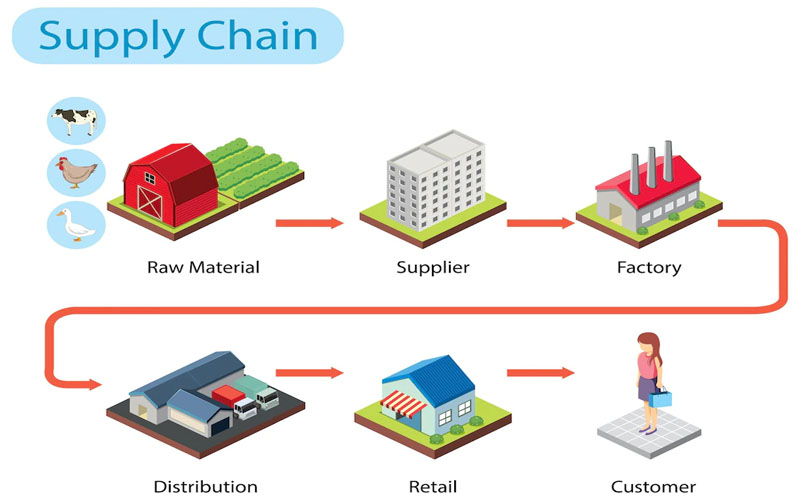
Supply chain model It is the way a business designs how its supply chain, orders, production or service delivery, inventory, distribution, and information coordinate to meet market demand. There is no one-size-fits-all model; the choice depends primarily on the business. Demand stability, product lifecycle, level of customization, and the trade-off between cost and response speed..
This article focuses on three practical questions: What does a supply chain model consist of, how do the six common models differ, and what criteria should businesses use to choose the right one?. The SCOR section has also been updated to the current SCOR Digital Standard instead of the old Plan–Source–Make–Deliver–Return structure.
What is a supply chain model?
Supply Chain Model It is the way businesses organize and coordinate activities in the supply chain to achieve specific operational goals, such as maintaining a stable flow of goods, reducing total costs, responding quickly to demand, or meeting specific customer configurations.
This concept needs to be distinguished from supply chain and Supply chain management (SCM). A supply chain is a physical network comprising suppliers, businesses, warehouses, distribution channels, and customers; while SCM is the planning, coordination, and control of that network. A supply chain model is a layer of operational design: businesses choose how to organize the chain to suit their market and product characteristics.
| Concept | Main question | For example |
|---|---|---|
| Supply chain | Which parties and activities are involved? | Supplier → Manufacturer → Warehouse → Distributor → Customer |
| Supply chain model | What operational logic should be used to organize the supply chain? | Continuous Flow, Agile, Flexible… |
| SCM | How do we plan, coordinate, and control the supply chain? | Forecasting, sourcing, inventory, logistics, data, finance |
What are the links and flows in a supply chain diagram?
A basic supply chain diagram can start from Supplier → Business/Manufacturer → Warehouse or Distribution Center → Sales Channel → Customer. However, simply drawing the flow of goods in one direction does not fully reflect how the supply chain actually operates.
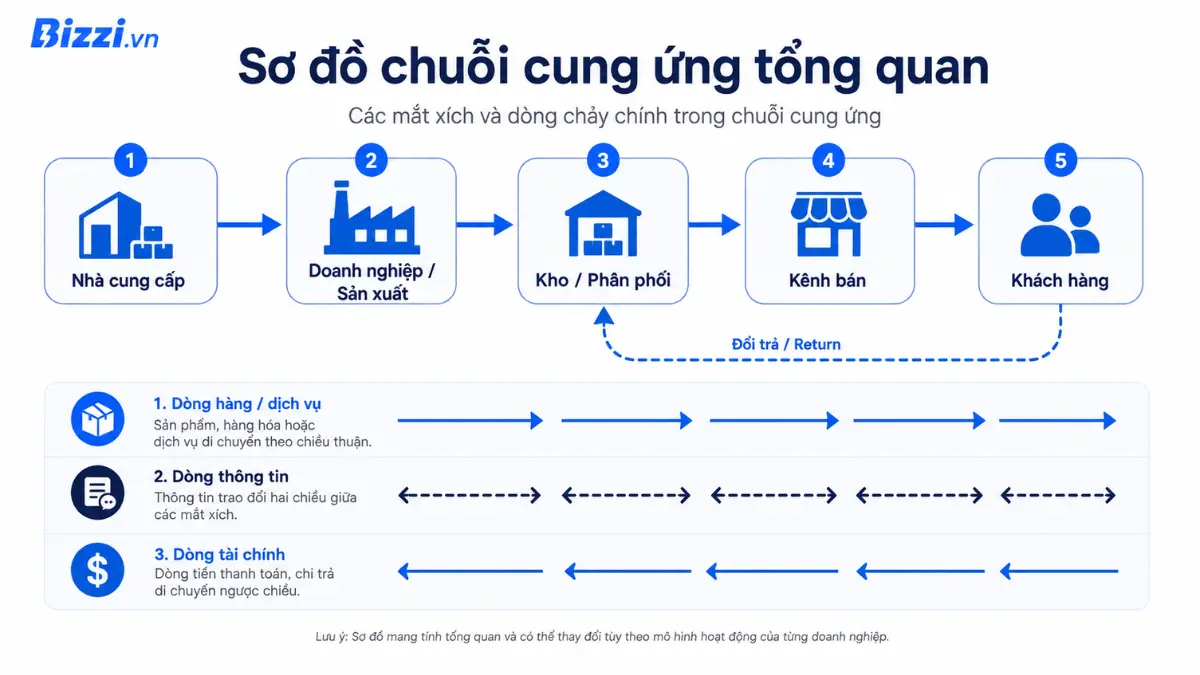
6 common supply chain models and when to apply them.
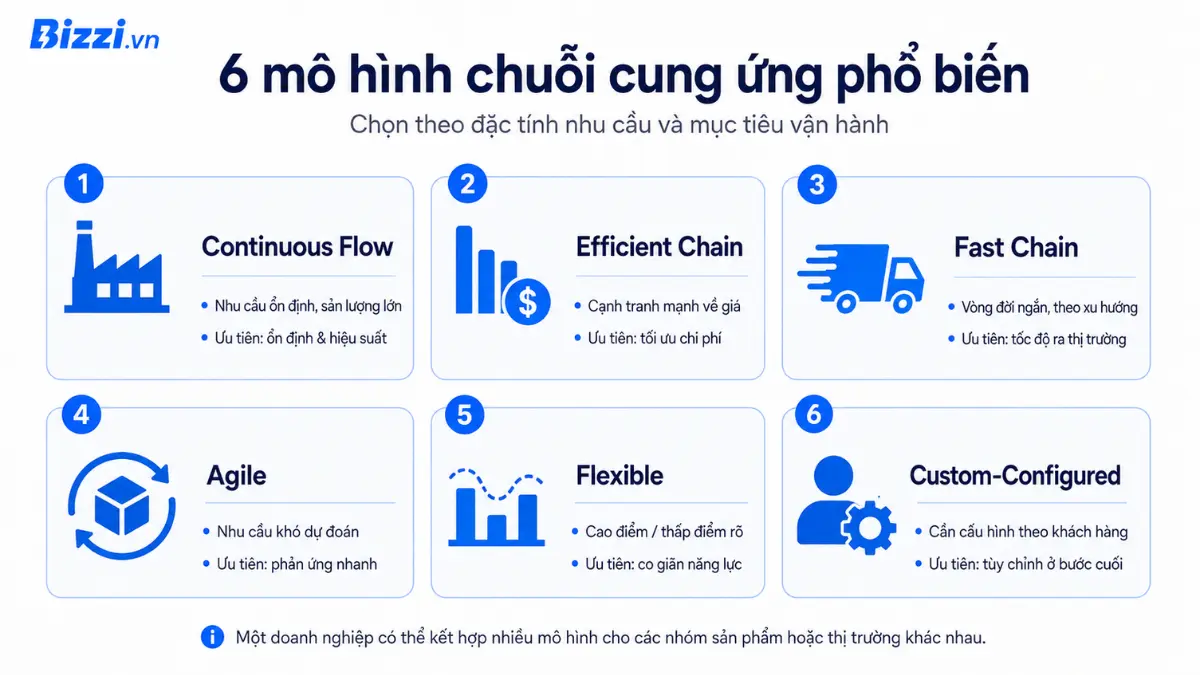
There isn't a single classification method that every business is required to use. In management and training practice, the six models below are commonly used to describe ways of balancing between efficiency, speed, responsiveness, and level of customization. These should be viewed as operational design guidelines, not six rigid templates.
Continuous Flow
Suitable when: The demand is relatively stable, the product is mature, production volume is large, and there is little variation.
Prioritize: Stability, efficient use of capacity, and reduced volatility in production and supply schedules.
Trade-off: It is difficult to react quickly if product needs or configurations change suddenly.
Fast Chain
Suitable when: Short product lifecycles, rapidly changing tastes, and value heavily dependent on the speed at which a product is brought to market.
Prioritize: Shorten the time from market signal to product ready for sale.
Trade-off: This requires rapid coordination and may involve accepting higher costs to protect speed.
Efficient Chain
Suitable when: The market is highly competitive in terms of price, profit margins are thin, and businesses need to optimize overall costs.
Prioritize: Asset productivity, inventory costs, purchasing, production, and logistics.
Trade-off: Over-optimization can reduce the room for maneuver when supply or demand fluctuates.
Agile — Agile Chain
Suitable when: Demand is difficult to predict, highly variable, or the market is changing rapidly.
Prioritize: Receive early signals, adjust resources, and make quick decisions based on actual needs.
Trade-off: This often requires greater redundancy, better data, and closer vendor coordination.
Custom-Configured
Suitable when: While some parts of the product/service are standardized, the final step requires configuration tailored to each individual customer.
Prioritize: Maintain efficiency at the standard level and delay customization until closer to actual needs.
Trade-off: Modular design, configuration data, and order coordination are more complex.
Flexible — Flexible chain
Suitable when: Demand has distinct peak/off-peak periods, requiring businesses to rapidly increase or decrease capacity.
Prioritize: Flexibility of production, labor, suppliers, or logistics capacity over time.
Trade-off: It is necessary to prepare in advance the capacity, contracts, and operating procedures for both peak and off-peak periods.
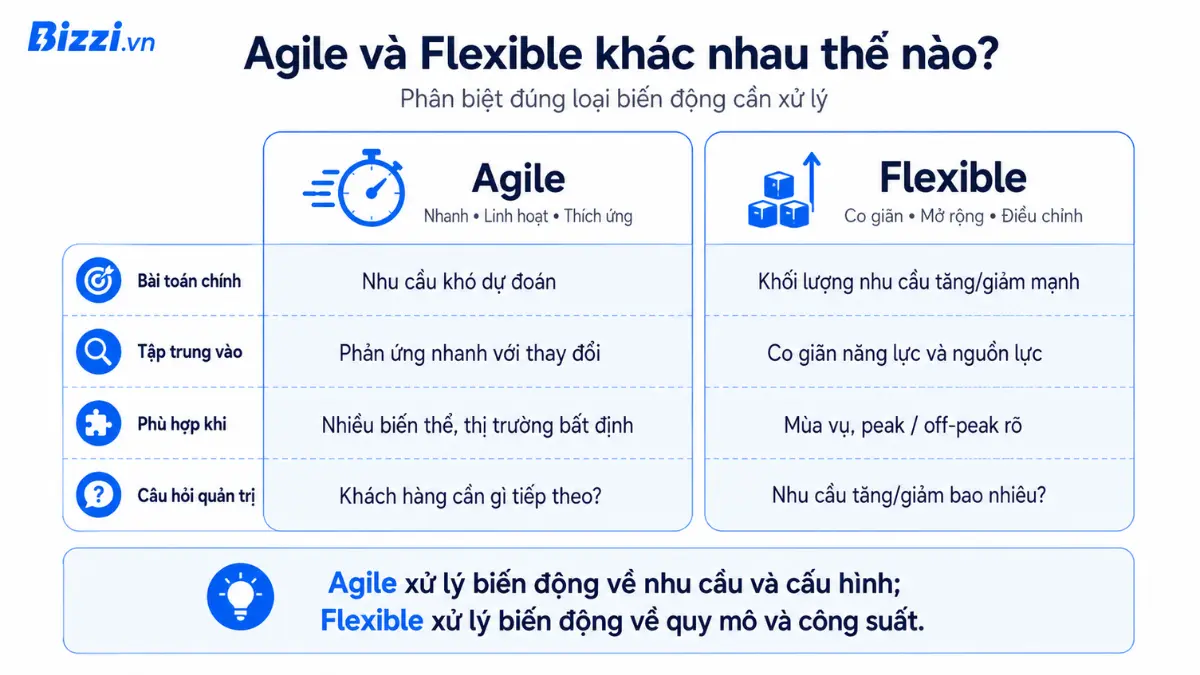
What is the difference between Agile and Flexible?
In Vietnamese, both agile and machine Both are easily translated as "flexible," so the two concepts are often used interchangeably. The most useful way to distinguish them is to look at... the type of volatility that the business is trying to handle.
| Criteria | Agile — agile | Flexible |
|---|---|---|
| Main problem | Demand is difficult to predict, and there are changes in product types or market priorities. | Demand volume fluctuates significantly over time. |
| The reaction is required. | Change decision, configuration, or supply quickly. | Rapid increase/decrease in capacity and resources |
| Typical situation | The product has many variations, and the market is uncertain. | Season, campaign, clear peak/off-peak |
| Management questions | “"The market has just changed; how do we change how we respond?"” | “"Demand fluctuates wildly; how do we scale?"” |
Which supply chain model should you choose?
Instead of starting with the model name, start with characteristics of needs and how customers evaluate value. The table below serves as a starting point for businesses to choose which areas require further in-depth analysis.
| Operating conditions | The direction to evaluate | Reason |
|---|---|---|
| Stable demand, little product variation, large production volume. | Continuous Flow | Focus on stabilizing operational flow and utilizing capacity efficiently. |
| Intense price competition, low profit margins. | Efficient Chain | Prioritize total cost and asset performance. |
| Trendy products, short lifecycles. | FastChain | Speed of market entry is more important than optimizing every penny spent. |
| Demand is difficult to predict and highly variable. | Agile | We need to react quickly to market signals. |
| There is a large difference between peak and off-peak hours. | Flexible | Capacity needs to be adjusted quickly to meet demand. |
| Customers need to configure it in the final step. | Custom-Configured | Combine the standardization part with the customization part. |
5 questions to answer before finalizing the model.
- Is demand predictable? View volatility, seasonality, and forecast error.
- Is the product life cycle long or short? Trendy products require a different pace than mature goods.
- Do customers buy based on price, speed, or customization options? This is the core trade-off of supply chain design.
- Which skills are the hardest to increase/decrease? Suppliers, machinery, inventory, labor, transportation, or working capital.
- What risks are unacceptable for a business? Out of stock, high inventory levels, delayed deliveries, inconsistent quality, or dependence on a single supplier.
How does SCOR differ from the six supply chain models above?
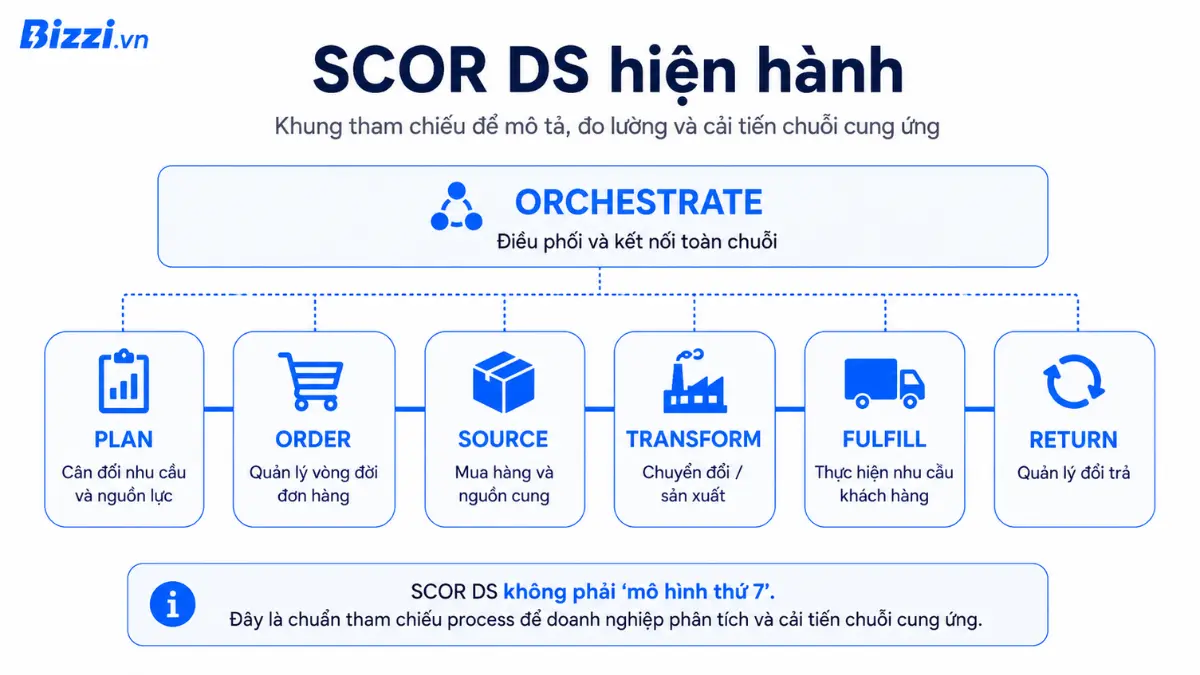
SCOR is not a “seventh model” that competes with Agile, Flexible, or Continuous Flow. SCOR is a reference standard for businesses to describe, measure, analyze, and improve their supply chain operations using a common process language.
According to SCOR Digital Standard (SCOR DS) In its current ASCM framework, SCOR is organized around seven key governance processes. Orchestrate Level 0 is the six Level 1 processes. Plan, Order, Source, Transform, Fulfill and Return. This structure differs from the legacy Plan–Source–Make–Deliver–Return diagram commonly found in older documents. Source: ASCM
| 6 operating models | SCOR DS | |
|---|---|---|
| Question | Should the chain prioritize efficiency, speed, responsiveness, or customization? | How are the processes currently operating, and where needs measurement/improvement? |
| Role | Operational design orientation | A framework for reference: process, metrics, practices, and capability. |
| Use | Choose a demand-driven approach and product strategy. | Describe the current situation, standardize the language, and identify areas for improvement. |
Where do Lean, PDCA, and Six Sigma fit into supply chain management?
Lean, PDCA, and Six Sigma can all support supply chain improvement, but they shouldn't be placed on the same level as the six operating models mentioned above.
Focusing on eliminating waste, reducing non-value-adding activities, and improving flow, Lean can be applied to many different supply chain models.
It is a Plan-Do-Check-Act cycle for continuously testing, checking, and improving a problem or process.
Focus on reducing variability and errors through process measurement, analysis, and control.
In short: The operating model answers the question of "which direction the chain should be designed in," while Lean/PDCA/Six Sigma helps improve how the chain is currently operating..
Is the service supply chain model different from the goods supply chain model?
There may be differences in the objects being "transferred," but the chain logic remains. For service businesses, the chain may not revolve around raw materials and finished products, but rather around... service delivery capabilities, partners, personnel, service schedule, data, and customer experience..
A service chain can be envisioned as:
Because “inventory” in services can be capacity that is not used after the time of delivery — such as expert hours, hotel rooms, or transport seats — the problem of forecasting and adjusting capacity is often just as important as managing physical inventory.
How does technology support the operation of supply chain models?
Technology doesn't automatically determine the direction a business is operating. The system's role is to provide data and execution capabilities to help the chosen model function better.
| System layer | Support problem |
|---|---|
| ERP | Order, purchasing, inventory, production, accounts receivable, and core financial data. |
| SCM / Planning | Forecasting, supply-demand balancing, network planning, and supply chain coordination. |
| WMS / TMS | Warehousing, inventory, picking, transportation, routing, and delivery execution. |
| Supplier / Procurement | Suppliers, sourcing, purchase orders, contracts, and purchasing performance. |
| AP / Finance Automation | Invoices, PO–GR–Invoice reconciliation, approvals, and payment data. |
If your business is evaluating the role of ERP in its supply chain, you can refer to a separate article. ERP and supply chain management. This article focuses only on the logic of model selection and does not extend to ERP implementation guidelines.
Where should we look for control over the flow of finances in the supply chain?
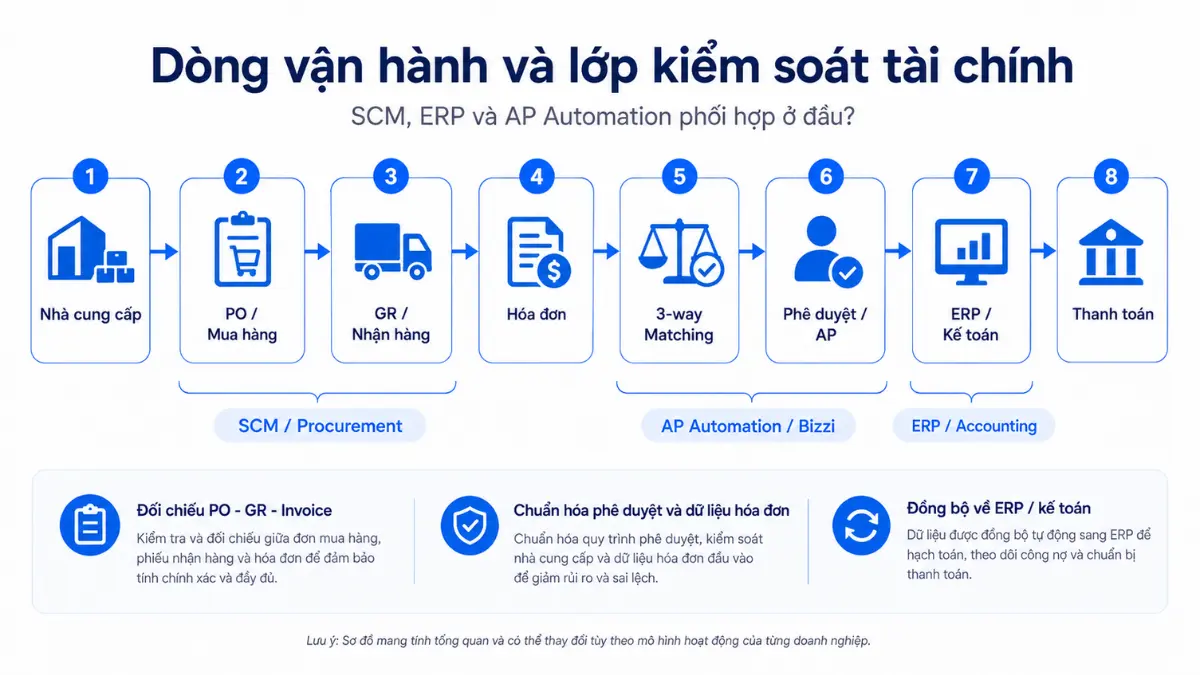
A well-functioning supply chain requires more than just the flow of goods and information. Businesses also need to maintain control. Purchase orders (PO), invoices, delivery notes, approvals, accounts payable, and payments. So that purchasing costs do not become a separate layer of data from operations.
The Bizzi product documentation identifies relevant capabilities including collecting and verifying incoming invoices, reconciling invoices (PO-GR), verifying suppliers, ERP/accounting integration, departmental or project-based budget management, and expenditure approval processes. These functions belong to Financial Control Layer/AP, This does not transform Bizzi into a SCM system that replaces ERP, planning, WMS, or TMS.
Frequently Asked Questions about Supply Chain Models
Is an agile or flexible supply chain?
Both can be translated as "flexible," but they address different issues. Agile emphasizes a rapid response to unpredictable or changing demand; Flexible emphasizes the ability to quickly increase/decrease capacity as demand fluctuates significantly. When writing internal documents, it's advisable to retain the English terminology to avoid confusion.
Is SCOR a supply chain model similar to Agile?
They shouldn't be placed at the same level. Agile is an operational design approach that prioritizes responsiveness. SCOR DS is a process reference standard that helps describe, measure, and improve the process through Orchestration, Plan, Order, Source, Transform, Fulfill, and Return.
Can a business use multiple supply chain models?
Yes. Different product groups, markets, or channels may have different demand characteristics. Businesses can use an efficiency-oriented approach for stable products and an Agile/Flexible approach for highly variable products.
Which model is best suited for a manufacturing business?
The choice cannot be based solely on whether the business is a "manufacturer." Demand, product lifecycle, level of customization, profit margins, capacity expansion/contraction, and stockout risks must be considered. Stable production of goods may favor a Continuous Flow/Efficient Chain approach, while production based on specific orders or variations requires a different approach.
Can the supply chain model be applied to service businesses?
Yes. In the service industry, the entities that need to be coordinated are typically capabilities, partners, personnel, service schedules, data, and customer experience, rather than just raw materials and finished products.