
Cost of capital is the rate of return that capital providers require to offset the risk involved in financing a business or project. Businesses use this level to evaluate investment options and select funding sources. The cost of capital includes the return on investment required by creditors and owners, not just the interest paid.
To calculate correctly, it is necessary to distinguish the cost of capital ratio from the amount of investment, determine the cost of each source, and assign appropriate weights. Even a correct WACC formula can lead to incorrect decisions if outdated data is used, inappropriate tax benefits are applied, or a discount rate that does not match the cash flows is chosen.
What is the cost of capital, and why does equity capital still have a cost?
The cost of capital is the opportunity cost of financing, typically expressed as 1 TP3T/year. Lenders demand interest and the ability to recover the debt. Owners accept business risk in the expectation of a commensurate return. From the business perspective, both are requirements to consider when using capital.
For example, a business that uses retained earnings to expand its factory will not have to pay bank interest on that capital. However, shareholders can still demand a return because they have left their money at risk within the business instead of receiving it back and investing it elsewhere. Therefore, equity capital does not mean free capital.
The cost of capital reflects the funding conditions and risks at the time of assessment. Interest rates on loans taken out many years ago can be helpful for comparison, but they do not automatically reflect the cost of borrowing today. Funding sources, debt and equity structure, operational risk, and market conditions can all cause the cost of capital to change.

Distinguish between cost of capital, interest expense, CAPEX, and book value-added tax expenses.
The cost of capital is a required rate of return; CAPEX is the expenditure on long-term asset investments. These two concepts may appear together in investment decisions but serve different purposes. The term "cost of capital" is sometimes used to translate Capital Expenditure, so the context and units need to be considered.
| Concept | Commonly used units | The question needs to be answered. |
|---|---|---|
| Cost of Capital | %/year | What level of return on capital is needed to offset the risk? |
| Interest | %/year or a fixed amount per period | How much does the company pay for the debt under the contract? |
| CAPEX – Capital Expenditure | Vietnamese Dong, million Dong, billion Dong | How much does it cost to purchase new, upgrade, or maintain long-term assets? |
| Accounting expenses for the period | Amount | Which amounts are recognized in the business results according to the applicable regulations and transactions? |
For example, purchasing a machine worth 10 billion VND is a decision regarding the scale of investment. The cost of capital of 10%/year is an assumption about the required return to assess the cash flow of that option. It's not possible to directly add 10 billion VND to 10% or consider the entire machine price as the cost of capital in the sense of Cost of Capital.
The cost of equity capital does not automatically become an expense or a cost accounted for similarly to interest expense. Management spreadsheets need to separate the investment amount, operating cash flow, financing costs, and the investor's required return on investment.

How are the cost of debt, equity, and WACC related?
The cost of debt and the cost of equity are two components; WACC is the weighted average of these financing components. In the spreadsheet, group together names of the same funding source, such as "loan" and "debt," to avoid duplication; differentiate common equity from preferred instruments, if any.
The cost of debt reflects the requirements of the lender.
The cost of debt before tax, denoted as Kd, reflects the cost of raising debt in line with current conditions and risks. For simple loans, the contract interest rate is a crucial input. When there are arrangement fees, issuance discounts, or different repayment schedules, it is necessary to consider the actual cash inflows and outflows instead of just looking at the quoted interest rate.
For example, let's assume you borrow 1 billion VND, with a fixed interest rate of 10%/year, the outstanding balance remains the same for the year, and there are no fees: the annual interest is 100 million VND. If you repay the principal gradually or if there are fees, the amount of money and the effective cost of borrowing will be different.
The cost of equity is the required rate of return, not just dividends.
The cost of equity, denoted as Ke, reflects the return that owners require when bearing the remaining risk after prior obligations. This return can come from dividends and capital appreciation. Therefore, simply dividing dividends paid by equity capital is not sufficient to determine Ke.
Initial capital contributions, newly issued common shares, and retained earnings all fall under the scope of equity, but the terms and conditions for raising capital and the costs of issuance may differ. For preferred shares or hybrid instruments, it is necessary to carefully review the actual rights and terms to determine their specific components, avoiding overlapping with both debt and common equity.
WACC aggregates the cost of each source by weight.
With a simple model consisting only of debt and common equity:
WACC = E/(D + E) × Ke + D/(D + E) × Kd × (1 − T)
E and D are the market values of common equity and debt within the scope of financing assessed, respectively; Ke is the cost of equity, and Kd is the cost of debt before tax. T reflects the assumption of appropriate tax impact. The rates must be concurrent and consistent with cash flows.
For valuation, weighting is typically based on market value or the explained target capital structure. Do not arbitrarily replace E with equity capital, or D with all liabilities on the balance sheet. Trade debt already reflected in working capital should not be included in financing debt again without checking the model.
CFA Institute's Cost of Capital document It also emphasizes that choices regarding target capital structure, estimation methods, and tax impacts can alter the conclusions of the analysis. WACC is an estimated assumption, not the only measure available for every business.
When is it appropriate to estimate Ke using CAPM or the dividend model?
Choose a method based on your data and business characteristics; don't choose one simply because the formula is short. CAPM and dividend growth models are two common approaches, but each has its limitations.
CAPM requires consistent risk and yield data.
Ke = Rf + β × (Rm − Rf), where Rf is the appropriate risk-free yield, β reflects systematic risk, and Rm − Rf is the market risk premium. For example, assuming Rf = 4%/year, β = 1.2 and the risk premium = 6%/year, then Ke = 11.2%/year.
Do not consider beta as a debt ratio, and do not mix USD yields with VND cash flows without consistent analysis. Historical data for a stock may not represent future operational risk. Unlisted companies often require comparative analysis, leverage adjustments, and explanations of their estimation methods, rather than arbitrarily using a ratio found online.
Dividend growth models need to assume stability.
In the model of steadily increasing dividends, Ke = D1/P0 + g. D1 is the expected dividend per share for the next period, P0 is the current price per share, and g is the assumed long-term growth rate. This formula is more suitable when dividend and growth policies can be predicted to be relatively stable; a constant growth valuation model requires Ke to be greater than g.
Do not use an extraordinary annual dividend as a long-term D1 indicator or to artificially inflate short-term growth rates indefinitely. For companies that do not pay dividends or whose dividends are likely to result in cash distribution, alternative methods should be considered. Results from different methods should be compared based on assumptions, rather than using a mechanical average to obtain a favorable figure.
Example of calculating WACC: separating input, density, and result.
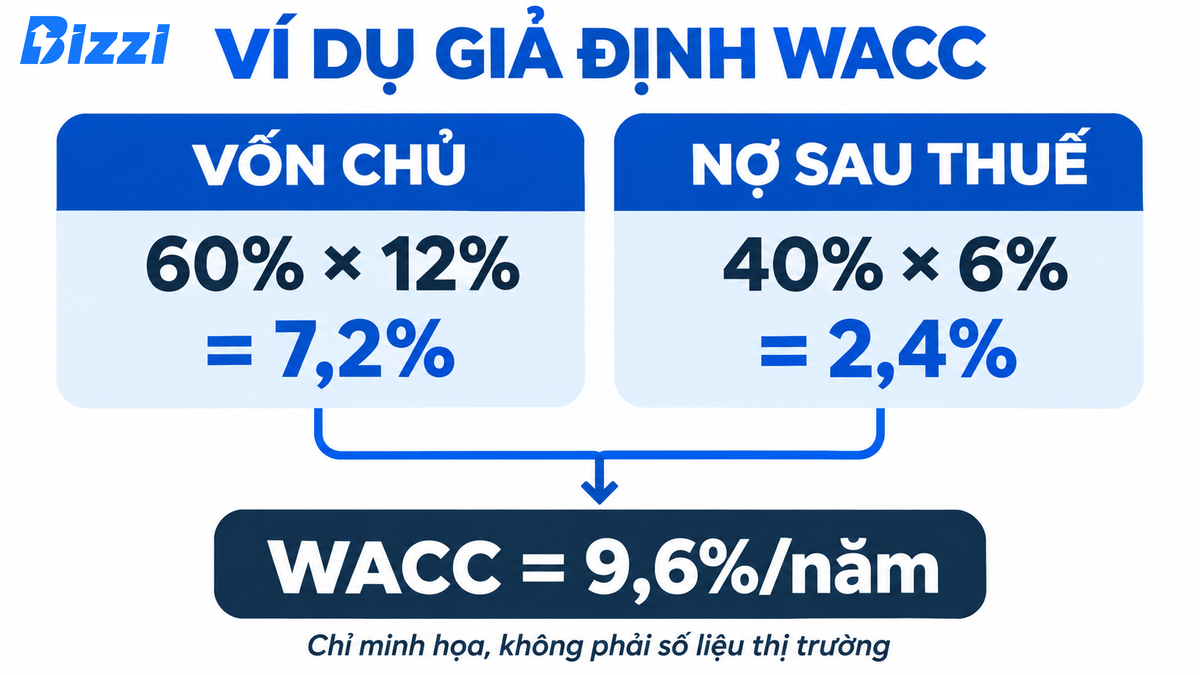
Assume the company has only common equity and debt financing, with proportions of 60% and 40% respectively. The assumed cost of debt is 12%/year; cost of debt after tax has been assessed separately That's 6%/year. This is not market data or a recommended interest rate.
| Ingredient | Proportion | Assumed costs | Contribute to WACC |
|---|---|---|---|
| Common stock | 60% | 12%/year | 60% × 12% = 7.2% |
| Debt after tax | 40% | 6%/year | 40% × 6% = 2.4% |
| Total | 100% | Do not add 12% + 6% directly. | 9.6%/year |
To see the impact of the tax assumption, consider another scenario: Pre-tax revenue is 8%/year, but the business does not yet have any usable tax benefits in the forecast period. If we temporarily disregard those benefits and keep the remaining inputs unchanged, the WACC is 60% × 12% + 40% × 8% = 10.4%/year. The two results differ due to assumptions, not because of arbitrary changes to the formula.
When there are additional preferred shares or complex financing structures, additional components need to be added and the total weighting recalculated. The two sources above, for example, do not represent every business.
How is the cost of capital used in investment and valuation decisions?
Capital expenditures assess the value created after considering risks and do not guarantee that the project will be profitable or generate enough revenue to repay debt. The finance department needs to match the correct ratios to cash flow and examine both the base scenario and the worst-case scenario.

- Project appraisal: Use appropriate ratios to calculate the net present value (NPV). Comparing IRR is only meaningful when cash flows and assumptions are consistent; do not approve a project simply because one metric exceeds the WACC.
- Pricing: Free cash flow to the entire business (FCFF) is usually associated with WACC; cash flow to shareholders (FCFE) is associated with Ke. These two ratios are not interchangeable.
- Capital utilization assessment: Compare the return on investment with the cost of capital over the same scope, period, and method of capital determination. One exceptional year is not sufficient to conclude long-term effectiveness.
- Funding options: Consider simultaneously the cost, term, conditions, refinancing risk, and repayment capacity. Increasing debt is not a way to indefinitely reduce WACC.
To properly track cash flow to the correct recipients, you can refer to the methods of differentiation. FCF, FCFF, and FCFE. When discounting FCFF using WACC already reflects the after-tax cost of debt, it is necessary to check to avoid deducting financing costs again within the same model.
A company's WACC is merely a reference point for determining the appropriate risk level for the project. Projects entering new markets, with foreign currency cash flows, or different financing structures may require a separate ratio. The ratio and cash flows must be consistent in terms of currency, nominal or real, pre- or post-tax, and duration.
Lower cost of capital can result in a higher discount value. while keeping cash flow and other assumptions constant.. That doesn't mean accounting profit increases on its own. If the goal is to determine the value of equity, guidance on enterprise value and equity This helps clarify the results that need to be calculated before choosing a model.
What factors can cause the cost of capital to change?
Market interest rates, business risk, credit risk, and financing structure all affect the cost of capital. A fixed WACC should not be maintained when input conditions have changed significantly.
Regarding debt, the lender's ability to repay on time, the quality of collateral (if any), contract terms, and maturity period influence the asking price. For equity, the volatility and risk of cash flow, financial leverage, industry, and market conditions affect the required yield.
Changes in debt ratios can alter both Kd and Ke, not just the two weights. Borrowing more may offer benefits to a certain extent but also increases debt repayment pressure and financial risk. Dividend or retained earnings policies need to be considered within the context of investment opportunities and risks; there is no single, fixed impact for every business.
The scale of new fundraising is also important: the price for additional capital may differ from the average cost of previous funding. When exceeding a fundraising threshold, the business may have to accept more expensive sources or different conditions. Assumptions need to be updated for each option rather than treating the "breakdown point" as a pre-existing threshold.

Prepare a cost of capital spreadsheet in five steps.
A useful spreadsheet should inform the reviewer where the data comes from, when it was used, and what caused the results to change. You can start with the following process:
- Finalize the purpose and scope: It specifies whether the valuation is for a business or a project, the valuation date, the currency, and the type of cash flow. The result is a unified set of baseline assumptions.
- Create a list of funding sources: Separate interest-bearing debt, common equity, preferred or hybrid instruments, if any. Compare contracts and financial statements to avoid under-accounting or double counting.
- Estimate the cost for each source: Record the quoted price or basis Kd, Rf/beta/risk premium or dividend data used for Ke; separately record any tax benefit assumptions that may be used. Each input requires a date and unit.
- Select the weight and calculate the result: Explain the target market value or capital structure, check the total weights and formulas. Do not replace unobservable data with arbitrary numbers.
- Sensitivity testing and approval: Modify each key assumption, compare its impact on WACC and NPV, record the reviewer, limit data, and specify when updates are needed.
Frequently Asked Questions about the Cost of Capital
What is a good WACC value?
There is no single ideal WACC for all businesses. Industry, risk, currency, timing, and financing structure must be considered. Comparing two WACCs is only meaningful when the assumptions and measurement methods are sufficiently similar.
If there is no debt, will the cost of capital be zero?
No. If only common equity is used, the cost of capital in the simplified model is Ke. The owner still requires profitability even though the business has no obligation to pay bank interest.
Is it possible to use the WACC from the previous year for the new project?
It can be used as an initial benchmark, but project risks, market conditions, capital structure, and currency must be re-examined. If they differ significantly, the appropriate ratios should be updated or estimated before making a decision.