


In the process of managing internal cash flow, transparently settling amounts that employees have received as advances or have paid on behalf of the company is a mandatory procedure. To accurately perform this procedure, accountants need to correctly identify the Advance Payment Receipt – Form 04-TT according to the accounting system currently applied by the enterprise.
This article will provide downloadable forms, instructions on how to select the appropriate version, how to fill in information, how to handle discrepancies, accounting, along with the required documents and strict tax conditions to check.
Download the cash refund template according to each accounting method.
Do not download the form based solely on the name "04-TT". Accountants need to determine the accounting system and accounting period being processed to select the correct version of the Advance Payment Receipt.
Sample form for advance payment according to Circular 99/2025/TT-BTC
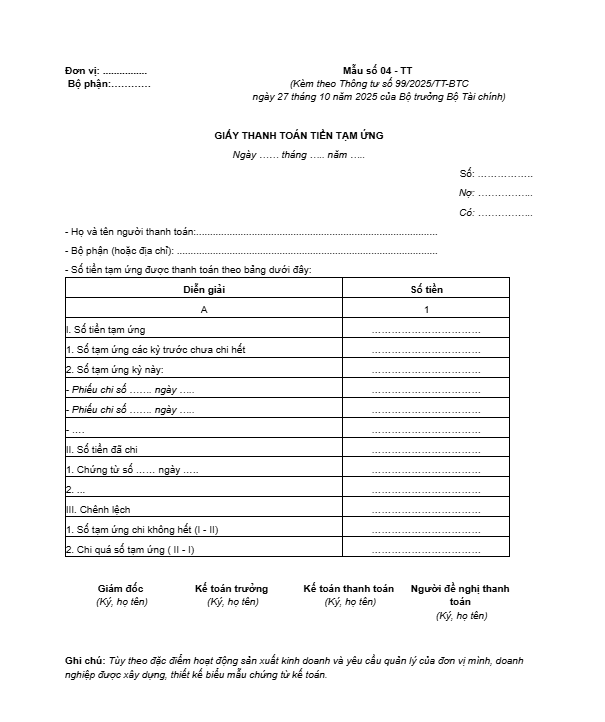
This is the version that should be prioritized for review by businesses falling within the scope of the latest accounting regulations under Circular 99 for the corresponding accounting period.
- Form name: Advance payment receipt.
- Number: Form No. 04-TT.
- Purpose: Used to settle advance payments after the work is completed.
Note: Businesses need to check the application period and scope of Circular 99/2025/TT-BTC according to current regulations to use the form correctly. Accountants can refer to additional resources. Accounting document templates according to Circular 99 To synchronize your records.
Sample form for advance payment according to Circular 133/2016/TT-BTC
Businesses applying the accounting regime for small and medium-sized enterprises according to Circular 133/2016/TT-BTC must use forms that are appropriate to their regime and must not mistakenly use the forms of Circular 99/2025/TT-BTC.
- Form name: Advance payment receipt.
- Number: Form No. 04-TT.
- Applicable objects: Small and medium-sized enterprises register to implement accounting procedures according to Circular 133/2016/TT-BTC.
Sample form for advance payment according to Circular 200/2014/TT-BTC
The form for advance payment issued with Circular 200/2014/TT-BTC is still highly valuable for accounting purposes when processing documents, records, or reconciling data from accounting periods prior to 2026.
- Purpose: Used to search old records, compare accounts receivable data, and verify documents generated during the application period.
- Legal note: The date of the transaction and the accounting method in effect at the time will determine the basis for using this form.
| Specific case of the business | Template to download and apply | Things to check before use
|
|---|---|---|
| Businesses applying Circular 99 | Form 04-TT according to Circular 99 | Scope of application, accounting period |
| Businesses applying Circular 133 | Form 04-TT according to Circular 133 | Current applicable subjects |
| This document pertains to the period when Circular 200 was in effect. | Form 04-TT according to Circular 200 | On the date the transaction occurred, the accounting method in effect at that time |
| The accounting system currently in use has not been clearly identified. | Don't rush to choose a design yet. | Review the registered accounting policy. |
After selecting the correct version, the accountant needs to determine whether the transaction being processed is actually a reimbursement or another type of payment.
What is an advance payment reimbursement? When is it necessary to prepare an advance payment settlement form?
Reimbursement is the process of settling the amount of money that a company has advanced to an employee for work. After completion, the recipient of the advance compares the amount received with the approved expenditure and actual supporting documents. Understanding this is crucial. What are advances and reimbursements? It helps businesses to have transparent cash flow.
Three quantities need to be determined when settling accounts, including:
- The amount has been advanced.
- The actual costs have been approved.
- The difference in price.
Note that "reimbursement" is the practical term, not always the official name of the document. Reimbursement should not be equated with "the company paying back money to its employees.".
For example: The company advanced 10,000,000 VND to an employee for a business trip. After the trip, the total approved expenditure was 8,500,000 VND. The employee must settle the advance and repay 1,500,000 VND. The advance payment settlement slip is only valid if there is an outstanding advance requiring settlement.
Before creating the form, accountants need to distinguish it from other documents with similar names.
Distinguishing between Advance Payment Request Form, Advance Payment Settlement Form, and Payment Request Form
These three documents appear at three different points in the payment process; choosing the wrong form can distort the nature of the transaction and make it difficult to reconcile records.
| Document | Time of occurrence | Have the workers received their money? | Main purpose
|
|---|---|---|---|
| Advance payment request formForm 03-TT) | Before the business hands over the money | Not yet | Please request an advance. |
| Advance payment receipt (Form 04-TT)) | After spending from the advance payment | Have | Settlement of advanced funds |
| Payment request formForm 05-TT) | A payment obligation arises. | Maybe not | We request that the business make the payment. |
When should you use the Advance Payment Request Form?
This is used when an employee is preparing to perform a job and needs the company to pay them in advance. It is not considered a reimbursement at this time.
When should you use an advance payment receipt?
This should only be used when the employee has received an advance payment, the work is completed, or a partial settlement is required, and valid expenses and documentation are available to determine any remaining balance or overspending.
When should you use a Payment Request Form?
This is used primarily for business obligations that need to be paid. It does not automatically mean the settlement of account 141, and is particularly useful in cases where employees use personal funds to make payments.
Highlights: Accountants should not select documents based on the company's internal names but must identify the cash flow that occurred previously. If it has been determined that this is an advance payment requiring settlement, the next step is to accurately calculate the amount to be refunded or repaid.
How to determine the reimbursement amount
The reimbursement amount is determined by comparing the amount advanced with the total actual expenses approved by the company, not simply adding up all the invoices submitted by employees.
Recipe: Difference = Amount advanced – Actual approved expenses
The actual cost equals the amount of the advance payment.
For example: A deposit of 10,000,000 VND was made, and an approved expenditure of 10,000,000 VND was received. The difference is 0 VND.
In this case, the advance payment is fully settled, there is no need for employee reimbursement, and the company does not have to pay any additional amount.
The actual cost was lower than the amount advanced.
For example: A sum of 10,000,000 VND was advanced, but 8,500,000 VND was approved for expenditure. The employee must repay 1,500,000 VND.
At this point, supporting documents for receipts or refunds of excess funds are required. Amounts lacking sufficient documentation or not yet approved will not be automatically included in the final settlement expenses.
The actual cost was greater than the amount advanced.
For example: A deposit of VND 10,000,000 has been made, and an approved expenditure of VND 11,200,000 has been disbursed. The company must pay an additional VND 1,200,000.
Any expenditure exceeding the advance payment must be carefully reviewed and approved. It shouldn't be assumed that the company is obligated to reimburse employees for overspending.
| Compare | Result | Handle
|
|---|---|---|
| Chi = ứng | The advance payment has run out. | Close the advance payment. |
| Expenses < amount | Excess advance payment | The staff will return the remaining balance. |
| Expenses > advance | Expenditure exceeds budget. | The company will pay the remaining balance after approval. |
After determining the correct amount, the accountant can fill in each item on the form.
Instructions on how to prepare the Advance Payment Receipt Form 04-TT
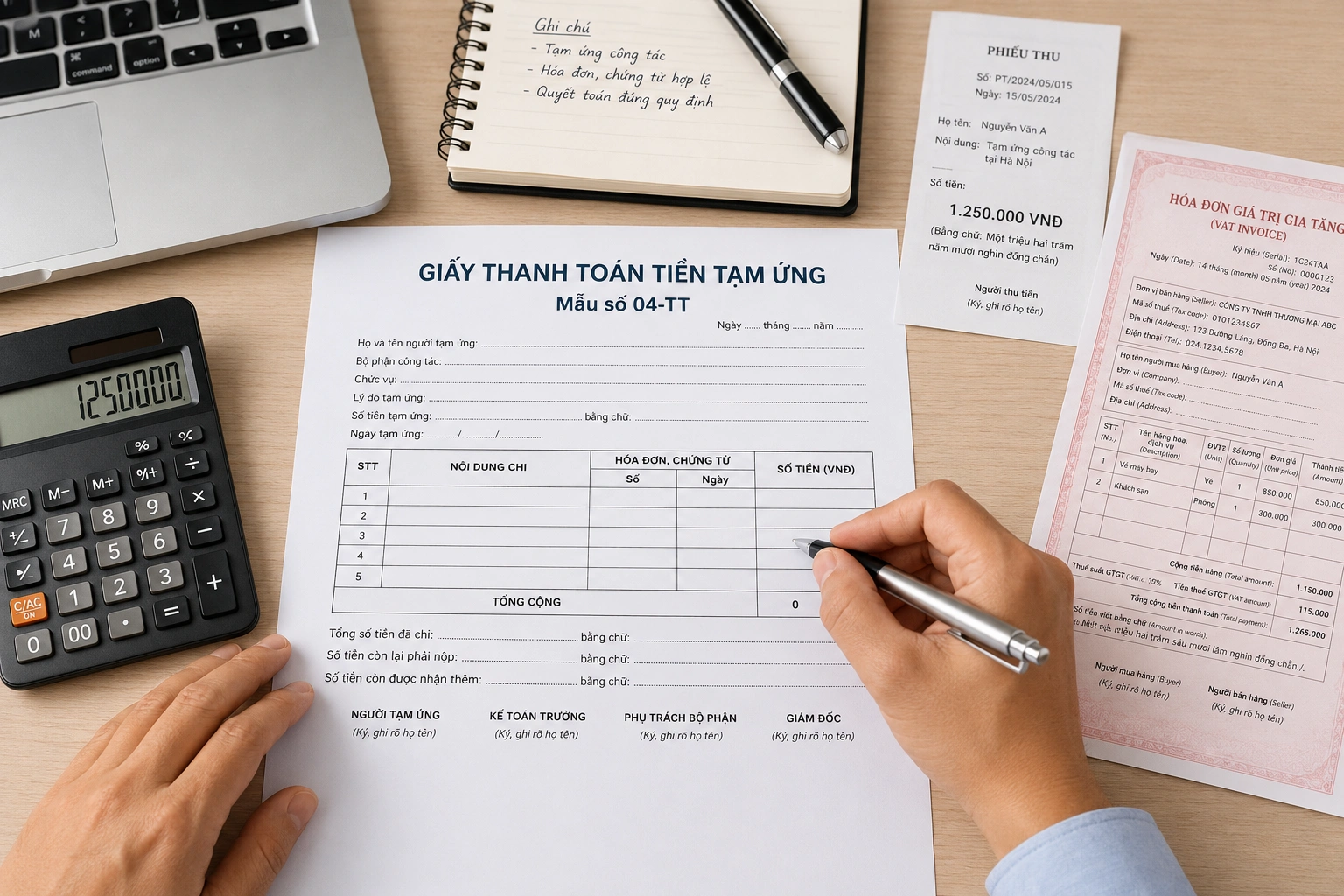
The advance payment receipt must show the amount received, the total approved expenditure, and the remaining difference to be collected or paid.
Fill in the information for the unit and the person receiving the advance payment.
Clearly state the name of the unit/department, document number, date of issue, full name of the payer, and title (if required by the form). Ensure that the notes are clear and accurate.
Enter the advance payment amount.
Clarify the amounts to be reconciled, including the previous advance payment balance (if any), the current advance payment amount, and the supporting documents for each payment. Avoid grouping multiple unrelated advance payments into one file simply to "close the balance.".
Enter the actual amount spent.
Use the approved figures for settlement and compare them with the supporting invoices. If a document is only partially accepted, do not include its entire value in the approved expenses.
Determine the amount of excess or overspending from the advance payment.
It is clearly stated: If there is any surplus, the employee must reimburse it; if there is an overpayment, the company must pay the remaining amount.
Record the attached document number and complete the approval process.
Clearly state the number of attached documents (invoices, receipts/bank statements for the refund portion, and summaries). Complete the approval signature according to the company's internal form and procedures.
Note: Form 04-TT This is a summary settlement document; the form itself does not replace the original invoices and supporting documents for each expenditure. Before approving the reimbursement, the accountant must check all the documentation behind the figures on the form.
What documents are included in a reimbursement application?
A reimbursement claim file needs to demonstrate the entire transaction chain: reason for the advance → company disburses the funds → employee makes the payment → payment is approved → difference is processed.
Documents generated prior to the advance payment
This may include the advance payment request, approval from the competent authority, assigned plan/task, budget, and relevant internal regulations.
Documents proving the expenditure
Depending on the specific transaction, this may include invoices, contracts, purchase orders, delivery receipts, tickets, fee and charge documents, detailed statements, and supporting documents related to business operations.
Documents required when settling advance payments.
This includes advance payment slips, detailed statements, original documents, management approval, employee refund documents for excess payments, or additional payment documents from the company.
Mini Checklist:
- Is the advance payment going to the right person?
- Is it for the right purpose?
- Are the documents sufficient?
- Has the budget been approved?
- Matching cash flow?
- Has the difference been processed?
Cases where employees do not receive an advance payment but use their personal funds to make payments should be treated as a separate issue.
Is it considered reimbursement if an employee uses personal funds to pay on behalf of the company?
This should not be assumed to be a reimbursement transaction. If the company has not yet paid the employee in advance, the accountant needs to determine the nature of the payment made by the employee on behalf of the company before selecting the appropriate documents and accounting accounts.
Decision chart:
[Did the company pay in advance?]
├── Yes -> Advance payment settlement.
└── Not yet -> Employees paid using personal funds.
├── Check for approval/authorization.
├── Check the invoice and payment method.
└── Determine the amount the business must pay back to its employees.
The employee received the advance payment before making the final payment.
This is a typical reimbursement flow: Company provides funds → Advance payment is incurred → Employee uses the funds for work → Documentation is submitted → Settlement → Reimburse excess or receive additional funds for deficit.
The employee paid the bill using personal funds instead of receiving an advance.
In this case, there is no advance payment for settlement. The business is obligated to reimburse the approved expense to the employee. The accountant needs to request the preparation of a settlement. payment request form and determine the nature of the payable, do not force it into account 141 just because of internal practice called "reimbursement".
What checks are needed when an employee makes a payment to a supplier using their personal account?
- What operation will the purchase serve?
- Who is the invoice for (and does it contain the correct business information)?
- Are employees authorized by their employers to receive payments?
- How are internal financial regulations reflected?
- What payment methods will be used to inform suppliers?
- How do companies reimburse their employees?
- Does the transaction value fall within the threshold for verification of non-cash payment documents?
After correctly identifying the nature of the transaction, the accountant then selects the appropriate journal entry.
Accounting methods for advances and reimbursements.
Account 141 is used to track advances made by businesses to employees and the settlement status; the corresponding account upon settlement depends on the nature of the expenditure.
Accounting when a business makes an advance payment.
Record the amount of money disbursed from the fund to the employee (Example: 10,000,000 VND):
Debit Account 141 – Advances (employee name details)
Credit account 111, 112 – Cash or Bank deposit
Accounting when expenses are approved.
When an advance payment is reduced, the corresponding asset/expense is recognized, and VAT is only separated if the conditions are met.
Debit related expense and asset accounts (Accounts 152, 153, 156, 621, 627, 641, 642,…)
Debit Account 133 – Deductible VAT (if eligible)
Account 141 – Advances
Accounting when an employee returns excess advance payments.
Business cash increases, advance balance decreases (For example, refund of VND 1,500,000):
Debit accounts 111, 112 – Cash, Bank deposits
Account 141 – Advances
Accounting treatment when a business has to pay an amount exceeding the advance payment.
Clearly distinguish between recording expenses, closing advances, and handling additional payments (e.g., expenses exceeding 1,200,000 VND):
Debit expense accounts and related assets.
Account 141 – Pay off all advances received.
Accounts 111 and 112 exist – amounts paid additionally to employees.
Accounting when an employee makes payments themselves without receiving an advance.
In this case, the accounting should be based on the nature of the amount the business owes to the employee, not using account 141.
Debit expense accounts and related assets.
Account 3388 – Other payables and liabilities
Correct accounting does not necessarily mean that the expense is definitely deductible for VAT or included in deductible corporate income tax expenses.
What conditions regarding invoices and taxes must be met for a reimbursement?
Reimbursement is an internal settlement procedure; the conditions for VAT deduction and the calculation of deductible expenses when calculating corporate income tax must be checked separately according to the original transaction.
What should invoices and supporting documents be checked for?
Actual transactions must occur and serve the business's operations. Invoices and supporting documents must be appropriate, belong to the correct buyer, have sufficient documentation to prove the purpose, and be properly approved.
When should you check non-cash payment documents?
Businesses must use cashless payment methods for invoices of 5 million VND or more (or other thresholds as stipulated in current regulations at the time of issuance) to be eligible for VAT deduction and inclusion as deductible expenses.
When can an employee making payments on behalf of a business qualify for VAT deduction?
The following conditions must be met simultaneously: Goods/services are within the scope of deduction; a valid invoice is provided; there is an authorization agreement; employees make cashless payments when required; and the business transfers the refund to the employee.
When are advances reimbursed as deductible expenses for corporate income tax?
The original expenditure must be considered, not the internal designation of "reimbursement". The expense must be related to business operations, supported by valid invoices and documentation, comply with cashless payment regulations, and not fall under any of the excluded items under legal provisions.
Checklist for reviewing documents before approving refunds.
Advance payments should not be closed simply because the employee has submitted all the necessary signatures; the accountant needs to conduct a thorough verification.
- The correct person is receiving the advance payment.
- Correct amount/advance payment.
- The expenditure is appropriate for the assigned tasks.
- The total amount of advances received has been reconciled and matched in the accounting records.
- The total approved cost has been recalculated.
- The invoices/documents are not duplicates.
- Complete documentation proving the transaction.
- The payment method has been verified.
- The conditions for VAT and corporate income tax have been considered separately.
- The excess money or overspending has been processed.
- The employee's advance payment balance was reconciled to zero after completion.
4 common mistakes when getting a refund:
- Using Form 04-TT incorrectly, contrary to accounting regulations/accounting period.
- Add up all invoices to get "actual expenses" that have not yet been approved.
- Account 141 should be used for transactions even if the employee has never received an advance payment.
- There is sufficient internal documentation, but the payment conditions for tax purposes (such as cash payment for large invoices) are overlooked.
If a business generates numerous advances and repayments each month, the next challenge is to monitor record status and cross-check documents instead of simply standardizing a single form.
When the number of refund applications increases, what should businesses control?
When multiple advances arise, the major difficulty no longer lies in filling out Form 04-TT, but in tracking who is holding the money, which files lack sufficient documentation, which advances are overdue for settlement, and which transactions have not yet been reconciled. Four common bottlenecks include:
- Track multiple employee advances.
- Expenditure requests and approvals are processed through multiple fragmented channels.
- Matching transactions with invoices/documents is done entirely manually.
- It is difficult to determine which amounts are still in surplus, deficit, or incomplete.
Businesses with numerous advances, reimbursements, and employee expenses may consider this solution. business cost management To standardize the workflow of requests, approvals, payments, and automated document reconciliation, minimizing the burden of manual processing.
Frequently Asked Questions about Reimbursement Forms
What is the current reimbursement form?
That is the Advance Payment Receipt.Form 04-TTHowever, businesses need to choose the version that matches the accounting regulations (Circular 99, Circular 133, or Circular 200) and the actual accounting period.
Are the reimbursement forms under Circular 99 and Circular 133 the same?
While the purpose of the settlement is the same, the structure of the detailed indicators differs. Businesses need to refer to the appendix of the applicable circular for proper use.
Can businesses continue to use Form 04-TT as per Circular 200?
This depends on when the transaction occurs, the accounting period, and the accounting system the business is using during that period.
What should be done if an employee spends less than the amount they were initially paid?
The accountant settles the approved expenditure, requests the employee to return the excess amount, prepares a receipt, and settles the corresponding advance payment balance.
What happens if an employee spends more than the amount they were given as an advance?
The accountant reviews and submits the excess expenditure for approval. The company makes the additional payment to the employee if approved and records the increase in expenses according to the nature of the expenditure.
Do employees who pay for goods themselves need to create a reimbursement form?
If the employee has not received an advance payment beforehand, it should not be considered an advance payment settlement by default. It is necessary to determine that this is an amount paid by the employee on behalf of the company and to prepare appropriate payment request documents.
Can employees who use their personal accounts to pay bills claim a VAT deduction?
The deduction is only allowed if all the following conditions are met: there is a valid authorization document, the payment method is a proper bank transfer, the business transfers the refund to the employee's personal account, and the invoice/document meets the general VAT deduction requirements.
Conclude
A reimbursement request form helps businesses standardize the settlement of advances, but its true value lies not only in using the correct form. An effective reimbursement process requires ensuring accurate identification of advances, verification of actual expenses, thorough checking of invoices and supporting documents, and accurate handling of discrepancies before final settlement.
With Bizzi Expense Pay – a comprehensive business payment and expense management solution – businesses can digitize the entire process from advance request → approval → payment → document collection → reimbursement → reconciliation on a centralized system. Not only does it support tighter management of advances and reimbursements, Bizzi Expense Pay also helps businesses expand to a holistic expense management model with multiple payment methods, limit control, cash flow tracking, and expense data standardization, thereby reducing manual operations and improving financial control efficiency.
Register here to receive consultation and experience solutions from Bizzi:Bizzi Expense Pay