



When an accounts receivable is overdue or shows signs of being difficult to collect, businesses should not rush to write it off the books. The appropriate course of action usually follows this order: Verify balances and records → remind debtors, reconcile and negotiate → classify risks, make provisions when conditions are met → consider legal measures → process or write off accounts receivable when conditions are met.
What are uncollectible accounts receivable?
In accounts receivable management, uncollectible accounts receivable This can be understood as the amount of money a business has the right to collect, but the likelihood of collecting it fully or on time has significantly decreased. Common signs include customers experiencing prolonged overdue payments, repeatedly breaking promises, disputes arising, inability to pay, or legal issues that make recovery difficult.
It is necessary to distinguish between the three states because the treatment methods are different:
| Status | Simply put | Things that should be done |
|---|---|---|
| Overdue debt | The payment deadline has passed, but the full payment has not been made. | Verify accounts, send payment reminders, identify the cause of the debt, and establish a payment schedule. |
| Uncollectible accounts receivable | The potential for recovery has decreased and there are clearer signs of risk. | Continue the recall process; assess contingency conditions and legal options. |
| Uncollectible debt | There is evidence to suggest that the receivable falls under the category of losses that can be treated as a result of the regulations. | Prepare documentation, request a decision from the competent authority, and account for the transaction in accordance with regulations. |
If your business needs a broader perspective, from recording accounts receivable and tracking payment deadlines to reconciliation and collection, see our additional guidance on... managing accounts receivable. This article focuses only on the stage where accounts receivable show signs of being difficult to collect and the next steps to take.
One point that is easily confused is the marker. Overdue by 6 months The provision for doubtful debts in the regulations is not the only definition of "bad debts" in management. It is one of the important conditions for determining the provision level for overdue receivables according to Circular 48/2019/TT-BTC, along with relevant documentation and evidence.
How to handle bad debts in 5 steps
Once a risky receivable has been identified, it's crucial to avoid having the sales, accounting, and legal departments handle it in a fragmented manner. Businesses should create a unified record for each receivable and follow the steps below.
Step 1: Compare and verify the accounts receivable accurately.
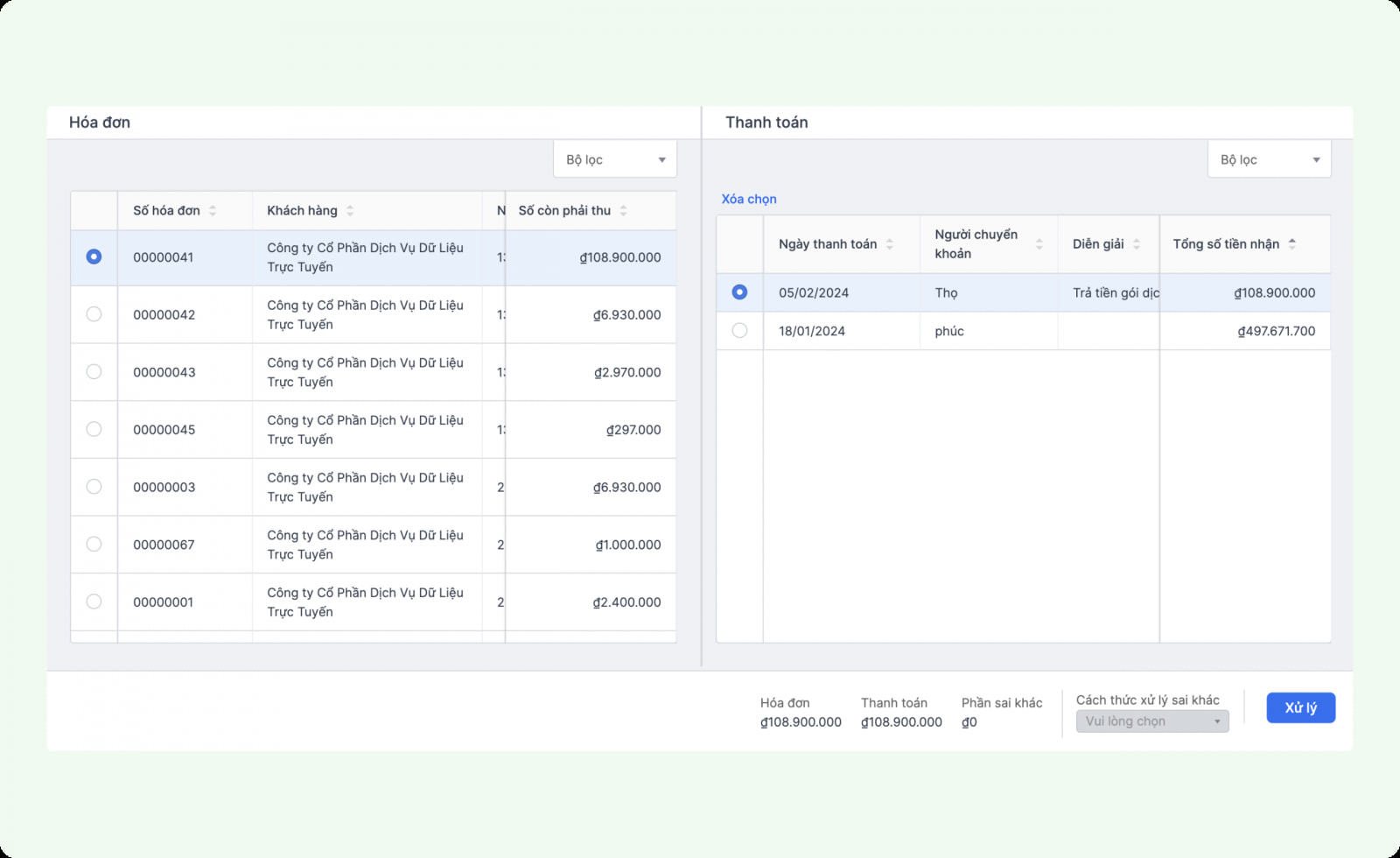
Before submitting a stronger payment request or proceeding to accounting, review all supporting documents for the receivable: contract and appendices, invoices, delivery or acceptance records, due date, amount paid, remaining balance, and any dispute communications.
If the figures between the two parties don't match, the first step is to reconfirm the balance. Bizzi is available. debt reconciliation form For businesses to refer to when they need to standardize this step.
Step 2: Remind the debtor and negotiate a payment plan.
For new overdue debts or when customers remain cooperative, the goal should be to bring the receivable back to a specific payment schedule. Businesses can make phone calls, send emails, or write to the customer, but the content should clearly state the amount, the basis for the overdue debt, the due date, and the requested response timeframe.
If the client is experiencing temporary difficulties, both parties may consider a phased payment schedule, extension, or other options that are consistent with the contract and the interests of the businesses. New commitments should be in writing to avoid continued reliance on verbal agreements.
If you need a template and instructions on how to organize each stage of reminders—pre-determining, due date, and overdue date—see the guide. customer debt reminder notice. If your goal is to build a complete collection process for multiple customer groups, rather than just handling a single bad debt, see more. corporate debt recovery process.
Step 3: Classify risks and make provisions when eligible.
Setting aside provisions is not a way to "collect debts," but rather a way for businesses to reflect the risk of loss on receivables in their financial statements and handle them according to current regulations. Therefore, the recovery process continues even after the business has set aside provisions.
For overdue receivables, businesses need to determine the age of the debt based on the original payment term and examine supporting documentation. For receivables that are not yet due but the debtor shows signs of being unlikely to pay on time, the assessment must be based on concrete evidence, not just subjective judgment.
Step 4: Consider legal options before the statute of limitations expires.
If repeated debt collection and negotiations are unsuccessful, businesses should review the contract, dispute resolution clauses, transaction evidence, and statute of limitations before deciding to file a lawsuit or use arbitration if applicable.
The Civil Code also stipulates several cases where the statute of limitations for filing a lawsuit restarts, such as when the obligated party acknowledges part or all of the obligation, performs part of the obligation, or the two parties reach a settlement through mediation. Therefore, debt acknowledgment records, new payment schedules, and partial payment documents should be fully preserved.
Businesses also need to avoid an outdated approach: Hiring a "debt collection company" as an independent service industry.. According to point h, clause 1, Article 6 Law on Investment 143/2025/QH15, Debt collection services are a prohibited business activity. When professional support is needed, businesses should utilize appropriate legal channels such as consulting lawyers, authorized representatives, arbitration, or the courts, depending on the circumstances.
Step 5: Financial settlement or debt write-off when eligible.
Only when the receivable is determined to be uncollectible and the business has sufficient documentation and an authorized decision, will the accountant proceed with handling the debt according to regulations. This should be separate from the provision for doubtful debts.
When can provisions for doubtful receivables be made?
According to Circular 48/2019/TT-BTC has been amended and supplemented. According to Circular 24/2022/TT-BTC, businesses need to provide documentation proving accounts receivable and the basis for determining risk. For the category of overdue debts, the provision level is determined based on the age of the debt as follows:
| Overdue | Provisioning level |
|---|---|
| From 6 months to less than 1 year | 30% |
| From 1 year to less than 2 years | 50% |
| From 2 years to less than 3 years | 70% |
| From 3 years or more | 100% |
In cases where accounts receivable are not yet due but there is evidence suggesting the debtor is unlikely to make full and timely payment, the business assesses the expected loss based on actual records. However, certain accounts receivable from telecommunications and retail businesses, whether in the form of deferred or installment payments to individuals, have a separate aging schedule as stipulated in Circular 48; the above table should not be applied mechanically to this group.
The documentation should be prepared according to the nature of the debt, usually including original documents establishing the receivable, reconciliation or payment collection documents, detailed statements, and documents proving the debtor's status.
Which account should bad debts be recorded in?
This is a point that can easily lead to confusion. Account 2293 is not an account containing the principal amount of accounts receivable. Accounts receivable are still reflected in the account appropriate to the nature of the transaction, such as Account 131 – Accounts Receivable from Customers or Account 138 in the corresponding case. Account 2293 is used to reflect provision for doubtful receivables.
For fiscal years beginning on or after January 1, 2026, businesses will apply the following accounting system: Circular 99/2025/TT-BTC. When the required reserve amount for this period is greater than the remaining reserve amount, the additional amount is recorded as follows:
Debit account 642 – Business management expensesAccount 2293 – Provision for doubtful receivables.
If the provision required for this period is lower than the amount previously set aside and not fully utilized, the difference is reversed.
Debit account 2293There is account number 642.
Circular 99/2025/TT-BTC has replaced Circular 200/2014/TT-BTC regarding the accounting regime for enterprises from the fiscal year beginning on or after January 1, 2026. Therefore, enterprises should not continue to use the old guidelines as the basis for current accounting for the 2026 fiscal year. The journal entries in this section are guidance on... accounting records; Whether an expense is deductible when determining tax liability depends on a comparison with tax regulations and actual records.
When can uncollectible accounts receivable be written off?
Writing off accounts receivable is a process for dealing with debts deemed uncollectible, not a way to "clean up" accounts receivable when new customers are late in payment. Depending on the case, the basis may relate to the bankruptcy, dissolution, or cessation of operations of the debtor organization; the legal status of the individual debtor; or the fact that sufficient provisions have been made but the debt remains uncollectible after the prescribed period.
If businesses consider handling based on the provisioning timeline, Circular 48 stipulates that for the group of ordinary accounts receivable: debts that have been fully provisioned for but after 100% 3 years from the time the full amount of 100% was deducted. Unrecovered debts may fall under the category of uncollectible debts and be considered for processing. This is not the only condition; bankruptcy, dissolution, or other legal statuses of the debtor may create other grounds and must be proven with corresponding documentation.
Therefore, when assessing a debt for write-off, the correct question is not simply "how long has the debt been overdue?", but rather:
- Does the receivable have sufficient legal basis for its existence?
- Has the company carried out and retained evidence of the recall and verification?
- Which type of debt is considered uncollectible?
- Is there documentation proving the debtor's status?
- Has the matter been decided upon by an authorized person or authority within the company?
What documents are required to write off bad debts?
The actual documentation required depends on the reason for the debt non-recovery. However, businesses should prepare documents in four groups:
- Records for creating and tracking accounts receivable: Contracts, invoices, delivery or acceptance documents, accounts payable ledger, reconciliation statements, and partial payment documents, if any.
- Debt recovery file: Letters/emails/official documents requesting payment, confirmation of delivery and receipt, meeting minutes, debt repayment commitments, payment schedules, and related evidence.
- Documentation proving the debt is uncollectible: Documents relating to bankruptcy, dissolution, cessation of operations, or other legal documents appropriate to each case; if processing is based on the time of provision allocation, supporting documents proving the allocation process are required.
- Decision on handling the case file: Minutes of the debt resolution committee or corresponding internal records, a detailed list of the amounts processed, and the decision of the competent person/agency.
The authority to decide on handling the matter depends on the business model and governance structure. Circular 48 stipulates that handling is based on minutes and supporting documents, with a decision made by the competent authority/person such as the Board of Directors, Board of Members, Chairman of the company, General Director/Director, owner of a private enterprise or owner of an economic organization, depending on the applicable case.
Accounting for the write-off of uncollectible accounts receivable according to Circular 99.
When a receivable has been decided to be written off in accordance with the proper documentation and authority, Circular 99 instructs accountants to use the established provision, any compensation, and the remaining amount to be included in expenses as prescribed to handle the outstanding receivable balance.
Debit accounts 111, 112, 331, 334… – the portion that the organization/individual must compensate, if any.
Debit account 2293 – the reserve fund has been established
Debit account 642 – the remainder is included in the cost.
There are accounts 131, 138… – accounts receivable processed
After writing off a debt, the business must still maintain detailed records to track the written-off debt as required by regulations. According to Circular 48, uncollectible debts, after being written off, must still be monitored in the management system and financial statement disclosures for a minimum period. 10 years, Meanwhile, the company continues to implement appropriate recall measures.
If the written-off debt is later recovered, the actual amount recovered is recorded as follows:
Debit accounts 111, 112…There is account 711 – Other income.
How can we limit the recurrence of bad debts?
Bad debts don't usually appear suddenly. There are often warning signs beforehand, such as unconfirmed invoices approaching due, customers repeatedly requesting extensions, increasing debt age, or discrepancies in the outstanding balance between the two parties. Therefore, the most effective prevention is to monitor the situation from the moment credit is granted until the money actually arrives in the account.
- Set credit limits and terms: Customer classification, clearly defined terms, exception approval, and follow-up responsibilities.
- Tracking debt aging: Don't just look at the total amount of receivables; you need to know which ones are 0–30, 31–60, 61–90 days overdue, or longer.
- A reminder before the deadline: Don't wait until a customer is long overdue before contacting them.
- Periodic reconciliation: Address discrepancies in invoices, payments, or documents immediately upon detection.
- Measuring revenue collection effectiveness: monitor DSO Using debt aging reports helps identify trends in delayed payments before overdue balances accumulate into bad debts.

How does Bizzi ARM help manage overdue accounts receivable?
As the number of customers and invoices increases, tracking using separate files can easily lead to teams missing overdue payments, inconsistent debt reminders, or wasting time on payment reconciliation. This is where technology can directly support the accounts receivable management process.
Bizzi ARM focuses on operations directly related to accounts receivable: tracking accounts receivable by customer and payment status, alerting about due or overdue amounts, monitoring DSOs and reporting aging, reconciling payments, and supporting the organization of a debt reminder workflow.
The system's role is not to replace legal assessment or debt forgiveness decisions. Its main value lies in helping businesses. This allows for earlier detection of potentially overdue accounts, standardization of tracking evidence, and reduction of manual steps in the reminder-reconciliation-reporting process..
Frequently Asked Questions about Bad Debt
What are uncollectible accounts receivable?
These are accounts receivable where the likelihood of full or timely collection has significantly decreased. In accounting and taxation, the creation of provisions must also meet prescribed conditions and documentation, and not simply be based on the subjective assessment that the customer is "unlikely to pay.".
How long does a loan have to be overdue before a provision for bad debts can be made?
For the group of overdue receivables under Circular 48, the provision for overdue receivables is 30% for amounts from 6 months to less than 1 year; 50% for amounts from 1 to less than 2 years; 70% for amounts from 2 to less than 3 years; and 100% for amounts from 3 years or more, provided that the relevant documentation and evidence are met. Some specific types of receivables have their own separate provision limits.
What is considered a bad debt account?
The principal receivable remains in the account according to the nature of the transaction, such as Account 131 or Account 138. Account 2293 is a provision for doubtful receivables, not an account to replace the principal receivable.
Can the provision for account 100% be written off immediately?
No. Setting aside a provision under account 100% and writing off accounts receivable are two different steps. Writing off accounts receivable is only done when the debt is deemed uncollectible according to regulations, with sufficient documentation and a decision from the competent person/agency.
What documents are required to write off bad debts?
Depending on the cause, the file typically includes documents proving the receivable, reconciliation and recovery documents, evidence of uncollectibility, documents on the provision process (if any), handling records, and competent decisions.
How should the accounting be done if a debt is written off and then the money is recovered?
According to Circular 99, when recovering a debt that has been written off, the enterprise debits accounts 111, 112… and credits account 711 – Other income, based on the actual recovered value.
Can businesses hire debt collection companies?
Debt collection services are prohibited from investment and business activities according to Law 143/2025/QH15 on Investment. Businesses should use internal recovery methods and appropriate legal channels such as legal advice, arbitration, or the courts, depending on the case, instead of hiring debt collection services as an independent business activity.
Conclude
Effective handling of bad debts doesn't begin with writing them off, but rather with accurately identifying the receivables and acting early enough. Businesses need to cross-check records, organize debt reminders and negotiations with evidence, assess the conditions for write-offs, protect legal rights, and only write off debts when they truly meet the criteria.
If accounts receivable are tracked by age, due date, and payment status from the outset, the finance team has a much greater chance of addressing the issue before the receivable becomes bad debt. This is also where a systematic accounts receivable management process delivers the greatest value to a company's cash flow.