“The term "List of 1,500 businesses at risk of invoice fraud" is often used to refer to aggregated files from multiple documents and periods. It should not be viewed as a constantly updated national blacklist, nor should it be concluded that all invoices from businesses listed are illegal.
When verifying a supplier, identify the correct tax identification number, source documents, relevant timeframes, and records of each transaction. The files below help review historical information; current status should be cross-referenced through official channels.
Which list of 1,500 businesses are you referring to?
It is necessary to read the document titles and the scope of each appendix instead of relying solely on the numbers in the file names. A summary table may combine different review periods, repeat tax identification numbers, or contain data from multiple localities. Adding up the businesses in the documents does not produce a unique number of businesses currently at risk.
Two historical texts need to be clearly distinguished:
- Official document No. 1798/TCT-TTKT dated May 16, 2023, from the General Department of Taxation: The directive requires a focused review of invoices from 524 businesses listed in Appendix 1, demanding explanations when businesses under management are found to have used related invoices, and taking action according to the actual violations and applicable regulations.
- Official document 3385/TCT-TTKT dated August 1, 2024: Citing the first-instance judgment No. 115/2023/HS-ST dated December 29, 2023, of the Phu Tho Provincial People's Court regarding a specific case, the document mentions 637 companies, including 524 companies already mentioned in Official Letter 1798 and 113 additional companies. The case concerns the period from December 2020 to October 2022.
So, the number 637 = 524 + 113 Each case has its own source and context. The conclusions drawn in this case cannot automatically be extended to conclusions about every invoice from every buyer or the current operating status of every legal entity.
Download history files and check the scope before use.
The links are archived for reference purposes only, not data confirming the current status. The date in the upload folder is not the date the document was issued. Keep the original for traceability; if duplicate filtering or standardization of tax identification numbers is necessary, do so on a copy and retain the source note column.
| File and source identification | Things to know before comparing |
|---|---|
| List of 524 businesses — Excel Official document 1798/TCT-TTKT, May 16, 2023. |
The file is titled in accordance with Official Letter 1798. Historical data is for invoice review purposes; this table alone should not be used to conclude on the current status or tax obligations of the buyer. |
| Appendix 113 companies — Word In accordance with Official Letter 3385/TCT-TTKT, dated August 1, 2024. |
The table is numbered from 1 to 113. This is an additional group in the case cited in the document, not 113 new businesses identified in 2026. |
| The compilation file is titled "1,498 businesses" — Excel | This is a compilation of multiple sources, with notes citing documents from different periods and repeated tax identification numbers. It is not a list specific to Phu Tho province. The file name does not prove the unique legal entity number or the number of businesses in violation. |
| File 31 businesses — Excel File title refers to Official Letter 633/CV-CSKT(Đ3), October 17, 2024, Nam Dinh Provincial Police. |
Read the verification request and related transaction information. Being named in a verification coordination document does not automatically supersede the final processing conclusion. |
| The file is named 305 companies — Excel File name refers to Official Letter 24903/VPCQCSĐT-Đ3, dated 31/10/2024. |
There are different data pages. The original document, tax identification number, and verification purpose must be cross-referenced; do not infer information from phrases in the file name. |
| The file is named 185 companies — Excel | There are pages “2937” and “TMS”; some cells contain data errors. The number of rows pre-formatted as business numbers is not counted. Refer to the official document and appendix when handling specific cases. |
| Text and appendices according to Official Letter 3379/CCT-KT2 — PDF Thu Dau Mot City Tax Department, June 12, 2023. |
The scanned document contains 39 pages, including the warning text and appendices. Read the warning content and its scope; do not consider the “742” label on the introduction as certifying the current status of each business. |
| Related data file for Official Document 2731 — Excel | The file currently being saved contains serial numbers up to 225 and columns for address, managing agency, and province/city. The number 237 is mentioned in the information about the entire case, and the data for business 225 may be outside the scope. A complete appendix must be consulted; do not use line numbers in the file to refute or replace the total number of entries in the document. |
If you are looking for documents from the 2024 inspection in Tan Phu District, List of 1,520 businesses according to Official Letter 1328/ĐCSKT This is a separate document. The correct appendix needs to be identified instead of lumping this number into the "1,500" group.
Information regarding the 168 businesses or other coordinated verification efforts should also be accompanied by corresponding documentation, timeframes, and scope. Upon receiving new notifications, priority should be given to those sent to the businesses by the competent authority or published through official channels.
Look up the supplier by tax identification number and specific notification.
The lookup process should be divided into three parts: viewing taxpayer information, reviewing related risk warnings, and checking each invoice. A "currently active" result does not automatically prove a transaction is real; conversely, the absence of a name in an aggregate file does not necessarily mean the business is completely risk-free.
Step 1. Prepare the correct tax identification number and transaction time.
Obtain the tax identification number from contracts, invoices, and supplier records. Keep the initial digits unchanged, distinguishing the head office's code from that of subsidiary units. Record the contract signing date, delivery or acceptance date, invoice date, and payment date. These dates help in tracing the scope of a subsequent notice.
Step 2. Verify taxpayer information.
Access Taxpayer information lookup page from the tax authority. Enter the tax identification number and confirmation code according to the form, then compare the name, address, and status information returned. Save the search date and the results document; if there is a notification about inactivity at the registered address or cessation of invoice usage, read the correct document and the applicable date.
Step 3. Compare the list of risks and violations on the public channel.
Above Business risk and violation lookup page, The public form includes fields for the provincial/city tax authority, the managing tax authority, the tax identification number, and the verification code. Select the appropriate range, enter the information to be searched, and then check the decision number, decision date, notification date, and status if the system returns results.
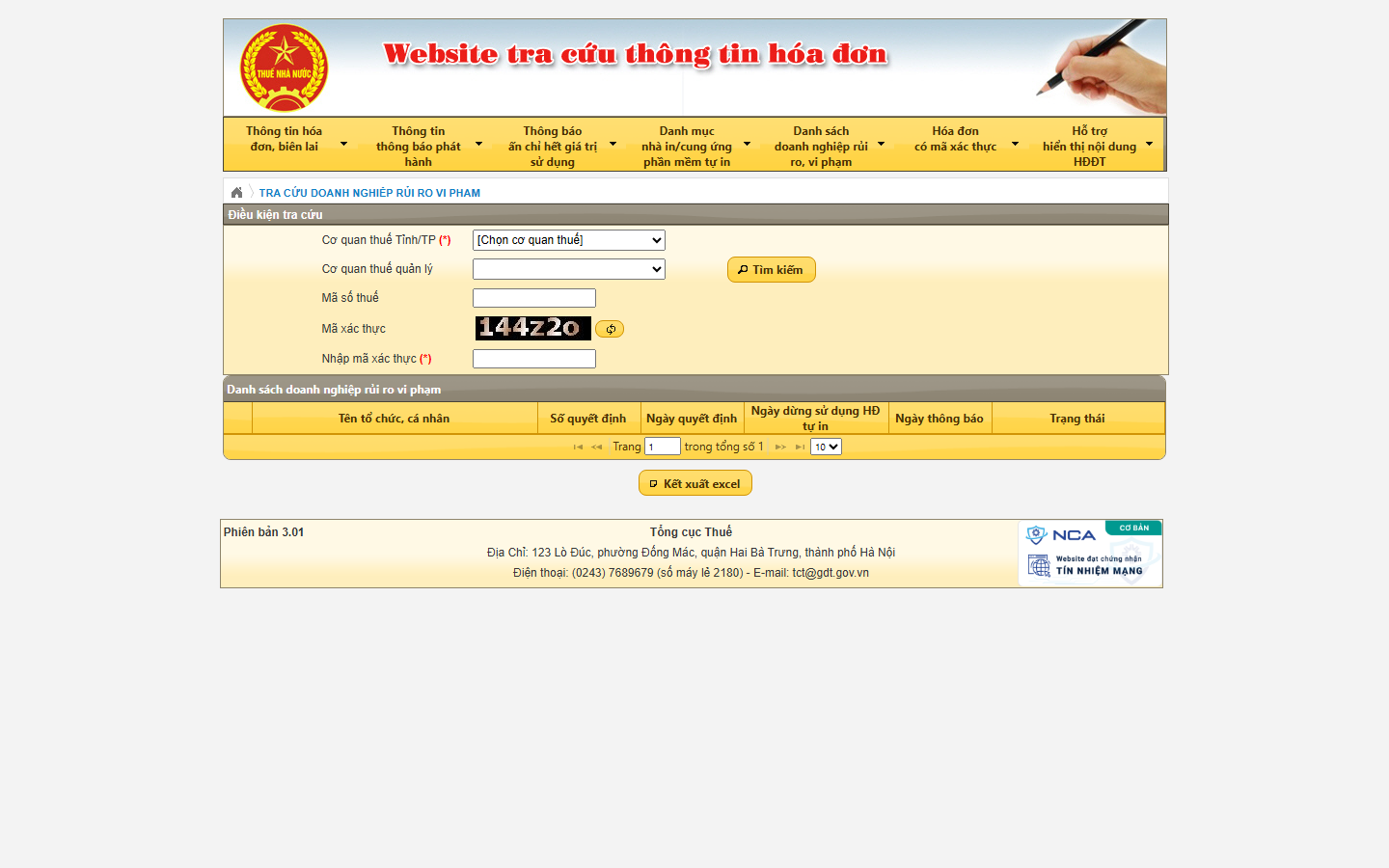
If the place name or administrative agency on the old document differs from the current catalog, contact the tax authority to determine the reference. If the page is inaccessible or the necessary information cannot be found, record the situation and inquire through the official contact; do not use the unsuccessful search as the sole evidence.
Step 4. Review each invoice and link it to the transaction record.
Verify the seller's information, tax identification number, invoice number and symbol, date, goods/services, value, and related information. For operations on the invoice portal, follow the instructions. Look up electronic invoices and resolve access errors.. The result stored in the system is a layer of information; accountants still need to cross-reference contracts, deliveries, or acceptances and payments.
Output to save: The audited tax identification number, source and date of lookup, relevant notification, list of invoices requiring review, missing documents, and the person in charge of processing. This is an internal control record, not a violation conclusion issued by the business itself.
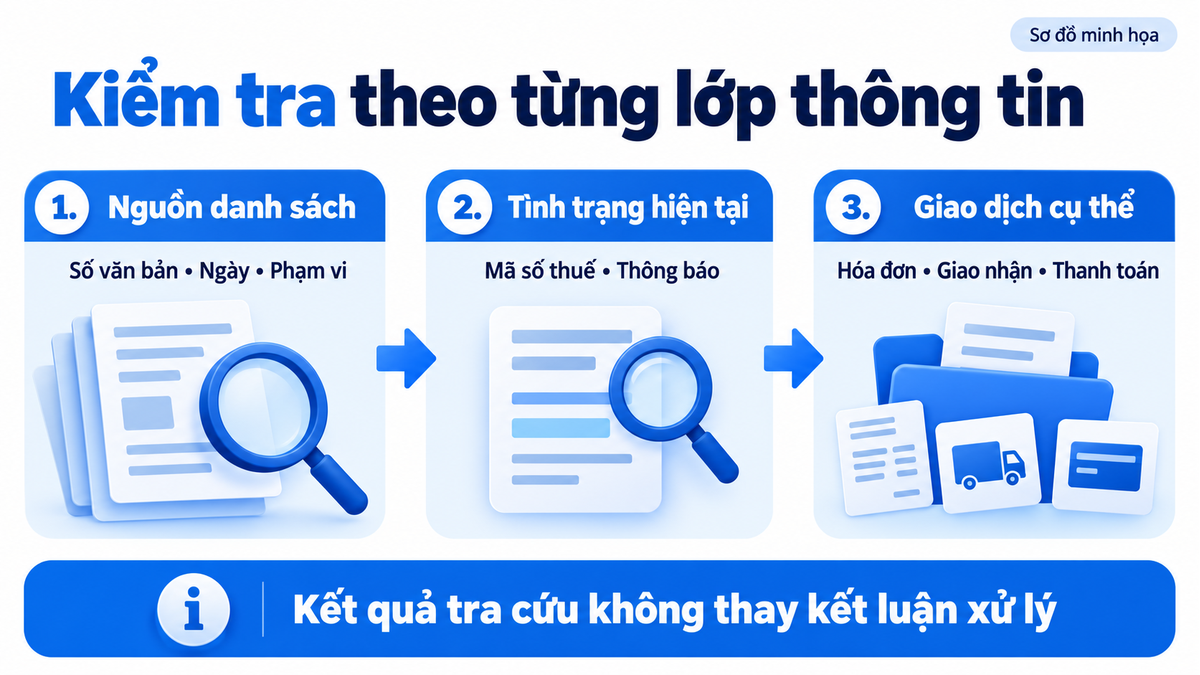
How do risk, operational status, and invoice violations differ?
Risk classification serves management purposes and helps in selecting inspection measures; conclusions regarding violations must be based on specific circumstances and authority. A single indicator such as a change in address, registered capital, or increased revenue cannot be used to definitively identify a business as selling fake invoices.
| Information is currently available. | What can it be used for? | Don't jump to conclusions. |
|---|---|---|
| The name is included in the history summary file. | Find the source document, tax identification number, and relevant time period. | There is currently a violation, or all invoices are illegal. |
| Notification of taxpayer status or invoice usage | Compare the subject, effective date, and content of the notification. | Automatically draw conclusions about all previous periods and transactions. |
| Irregularities in the records | Request additional documentation, verification of delivery and receipt, payment, and responsible party. | A single piece of evidence is sufficient to prove the existence of invoice trading. |
| Judgments, conclusions, or decisions of competent authority | Read the subject matter, behavior, invoice, time period, and decision-making scope correctly. | Extend the conclusion to legal entities, buyers, or invoices outside the scope already defined. |
In internal control, situations such as discrepancies between contract information and invoices, mismatched quantities of goods received, unexplained missing acceptance or payment are reasons for further verification. Clearly record the facts observed and the missing documentation; avoid labeling the company as "fraud" or "shell company" without evidence. When distinguishing between actions and responsibilities, refer to the guidance on... Invoice trading and the scope of handling vary depending on the case., and compare the regulations applicable to the actual case file.
What should I do if I've received an invoice from a business on the list?
First, identify which invoices, transactions, and notifications are involved; do not automatically exclude entire expenses or deductions based solely on names on a list. The conditions for VAT deduction and the conditions for deductible expenses when calculating corporate income tax are two different issues; it is necessary to compare the regulations applicable to the period in which the transaction occurred and the specific documentation.
The Ministry of Finance previously explained the review under Circular 1798 in its response published on September 9, 2023: the focus was on illegal invoices and those without accompanying goods; businesses with invoices that accurately reflect actual transactions were required to declare them according to current regulations. This explanation was given in the context of a 2023 document and did not guarantee tax benefits for all current records. Read the Ministry of Finance's response..
Not yet declared or payment not yet completed.
Identify the suspicious transaction, verify the supplier, and request any missing documentation before proceeding with further approval. Pausing a step should be in accordance with the contract, authority, and internal procedures; do not automatically cancel every transaction simply because of a warning.
Risk information was only received after the declaration had been made.
Create a reconciliation table for each invoice against the contract, goods/services received, payments made, reporting period, and new notification. Determine whether the notification is a request for information, explanation, or a decision. Do not attempt to edit multiple records based solely on downloaded files; the chief accountant, tax department, or consulting firm must review the basis of each case and the appropriate reporting and adjustment plan.
Receive requests for explanations or decisions from competent authorities.
Record the date of receipt, the content of the request, the scope of the invoice, the deadline, and the contact person for feedback. Prepare focused documentation, clearly stating what has been verified and what is still being supplemented. Keep a record of all correspondence, minutes, documents sent, and responses received. If the content or scope is unclear, request guidance through the official channel instead of sending sensitive data to an unverified contact.
The date on the notice is important, but the formula "if it's before the warning date, it's fine; if it's after the warning date, you lose tax benefits" should not be applied. It's necessary to read the type of notice, the invoice usage status, the regulations for the period, and the transaction records. Consequences such as tax adjustments, late payment penalties, fines, or other liabilities are only determined when there is a basis for application, not automatically resulting from appearing in a summary table.
Which records should be kept so that the review process is substantiated?
Each transaction requires a series of documents linking the purchase request, execution, invoice, and payment. The following checklist is a suggested management guideline; specific documentation varies depending on the type of goods, services, and applicable regulations.
- Identification and agreement: Supplier profiles, quotations, contracts or purchase orders, approvers, and condition changes.
- Execute the transaction: Delivery notes, shipping documents, warehousing documents, acceptance reports, product handover documents, or other relevant service delivery evidence.
- Bill: Original electronic data, representations when needed, lookup information, and any amendments/replacements.
- Pay: Documents, recipients, amounts, timing, and supporting documents explaining specific offsetting or payment transactions.
- Review and feedback: Alert source, inspection date, relevant invoice, additional requirements, handler, and approved result.
For example, a raw material purchase invoice needs to be linked to the contract, the actual quantity received, and the payment document. For services, the documentation might require product delivery and acceptance instead of a warehouse receipt. The absence of a document should not be replaced by a photograph of the supplier "in operation.".
If processing multiple invoices, it's advisable to standardize the location of records and the method for flagging items requiring review. Data lookup, reading, or comparison tools only assist in identifying areas needing verification; businesses still need to verify transactions and have someone approve the results. A green checkmark on the software does not replace actual documentation or the conclusions of an authorized agency.
Questions arise when using lists of high-risk businesses.
Is there a single file containing the 1,500 most recent businesses that can be used for all cases?
A single aggregated file should not be considered a complete and current list for all localities and periods. The source, date, scope, and current information related to the specific tax code must be identified.
If the tax identification number is not visible in the file, can the file check be skipped?
No. The file may be outdated, out of scope, or contain formatting errors. It's still necessary to verify the current information, invoices, and proof of transaction.
If the supplier is currently operating, will the invoice definitely be accepted?
The transaction status is for verification purposes only and does not confirm the authenticity of the transaction or the entirety of applicable tax conditions.
Is it possible to delete duplicate rows to count the number of businesses?
Filtering on copies is possible for review purposes, but the full tax identification number, notes, and source must be retained. Do not use line numbers or sequence numbers as unique legal entity numbers unless the data has been standardized and verified.
Is the old list still valid?
It can be used as a reference point for locating documents and cross-referencing invoices during the relevant period. It does not automatically prove the current status; further information regarding notices and processing results relevant to each case is required.