


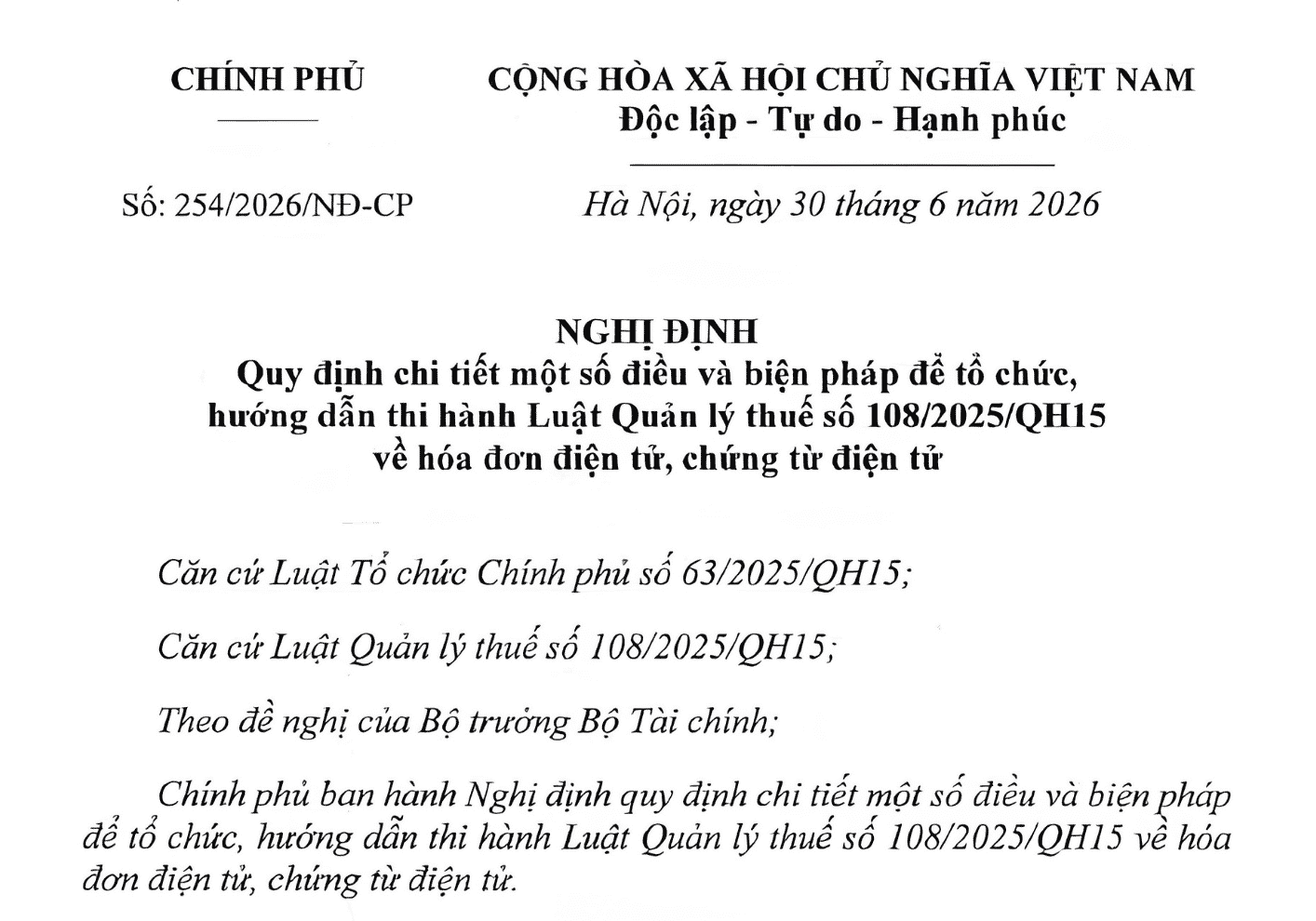
On June 30, 2026, the Government officially issued the following: Decree No. 254/2026/ND-CP This document provides detailed guidance on the implementation of the Law on Tax Administration No. 108/2025/QH15. It takes effect from [date]. 01/07/2026, This document brings about groundbreaking changes regarding... Electronic invoice and electronic documents.
Below is a detailed analysis of the six most important new points of this Decree for businesses, organizations, and taxpayers.
1. Overview of Decree 254/2026/ND-CP
Decree 254/2026/ND-CP guiding the Law on Tax Management regarding invoices will take effect from July 1, 2026.
» Download file Decree 254/2026/ND-CP: Guiding the Law on Tax Administration regarding electronic invoices and electronic documents.:
| Text type | Decree |
| Number, symbol | 254/2026/ND-CP |
| Issuing organization | Government |
| Date of issue | 30-06-2026 |
| Effective date | 01-07-2026 |
| Abstract | Regulations detailing certain provisions and measures for organizing and guiding the implementation of Law No. 108/2025/QH15 on Tax Administration regarding electronic invoices and electronic documents. |
| Download the decree | Decree 254/2026/ND-CP: Guiding the Law on Tax Administration regarding electronic invoices and electronic documents. |
2. Summary of the notable NEW POINTS in Decree 254/2026/ND-CP
2.1. Cases where electronic invoices are not required from July 1, 2026
Specifically, Article 7 of Decree 254/2026/ND-CP stipulates the cases where electronic invoices are not required, including:
Household businesses, individual businesses:
- The sale of goods and services is subject to the requirement of preparing a list of purchased goods and services as stipulated by corporate income tax laws, excluding registration for the use of electronic invoices.
- Income derived from real estate rental activities; income from providing digital content products and services related to entertainment, video games, digital films, digital photos, digital music, and digital advertising to organizations and individuals abroad.
- Acting as a lottery agent, insurance agent, or multi-level marketing agent where the lottery, insurance, or multi-level marketing companies have already deducted taxes.
Specific revenues and transactions:
- Fees and other income arising from reinsurance activities, deposit taking, financing activities, debt sales, foreign exchange transactions, and derivative products.
- Contributing assets of business organizations and individuals to economic organizations.
For assets transferred and loaned:
- Assets transferred from: the parent company to its dependent accounting units and vice versa; dependent accounting units within a business entity; assets transferred during division, separation, merger, acquisition, or conversion of business type.
- The machinery and equipment lent are fixed assets and tools used for processing goods of the lender; no payment is collected, and no ownership is transferred.
Cases related to value-added tax:
- Goods and services used to continue the production and business process of a business establishment: Goods exported for internal warehouse transfer, materials exported, and semi-finished products exported to continue the production and business process within a business establishment.
- Goods and services provided by a business establishment for use in its production and business activities.
- Income not related to the sale of goods or provision of services by the business establishment: Income from monetary compensation, bonuses, third-party claims from insurance activities, collections on behalf of others, etc.
2.2. Adjusting regulations on the timing of invoice issuance
2.2.1 Receiving deposits for service contracts without issuing invoices
According to Clause 2, Article 9 of Decree 254/2026/ND-CP, the time of issuing an invoice for a service is the time when the service is completed, regardless of whether payment has been received or not. If the service provider collects payment before or during the provision of the service, the time of issuing the invoice is the time of payment.
However, this regulation does not include the collection of deposits under the 2015 Civil Code to guarantee the performance of service contracts. Meanwhile, according to the old regulation at point a, clause 6, Article 1 of Decree 70/2025/ND-CP amending clause 2, Article 9 of Decree 123/2020/ND-CP, the time of issuing this invoice does not include the collection of deposits/advance payments to guarantee the performance of service contracts for specific services: Accounting, auditing, financial and tax consulting; Valuation; Surveying, technical design; Supervision consulting; Preparation of construction investment projects.
Therefore, when a business only receives a deposit to guarantee the conclusion and performance of a contract, it is not required to issue an invoice at the time of receiving the deposit, and this is no longer limited to specific services as before.
2.2.2 Additional services must have a 7-day reconciliation and invoicing period.
Specifically, according to point a, clause 4, Article 9 of Decree 254/2026/ND-CP, the Government has added services with a large volume, occurring frequently, and requiring time for data reconciliation between businesses selling goods, providing services and customers/partners, including:
- Maritime pilotage services.
- Advertising services on online news websites.
- Digital technology services, digital platforms.
- Information technology services include payment intermediary services used on telecommunications and information technology platforms.
- Cryptocurrency asset services.
- Services to support trading on the carbon exchange.
- Insurance services.
- Security services.
- Industrial catering services.
- Commodity exchange services.
- Credit information services.
- Passenger transport business services (using taxis, contract vehicles, and two-wheeled motorcycles with software supporting transport connectivity in accordance with road traffic laws) provide services to customers who are businesses and organizations.
2.2.3 Adding cases where end-of-day total invoices are issued.
Specifically, according to point m, clause 4, Article 9 of Decree 254/2026/ND-CP, the Government adds a case where medical facilities are allowed to compile and issue electronic invoices for medical services performed on the same day when patients receive medical examination and treatment services that require printed receipts, such as X-rays and scans. Conditions include:
- It is a healthcare facility that uses healthcare management software.
- Manage hospital fees, track each medical examination and treatment transaction, and process services with printed receipts.
- It is stored on the information technology system.
- Patients who come for medical examination and treatment do not need a receipt.
Conversely, if the customer requests an invoice, the medical facility will issue an electronic invoice to the customer.
2.2.4 Adding cases where transactions occur during nighttime working hours.
According to Clause 5, Article 9 of Decree 254/2026/ND-CP, if the seller does not have automatic invoicing software, the latest time to issue the invoice is the next working day.
2.3. Land management agencies, police, health agencies, etc., must share electronic invoice data with the Tax Department.
To align with the current model of local government organization, Clause 4, Article 40 of Decree 254/2026/ND-CP has adjusted some regulations regarding the responsibility for connecting and sharing necessary information and data related to their respective areas of management with the Tax Department to build an electronic invoice database, compared to previous provisions.
Specifically, the data receiving point has been replaced from the General Department of Taxation to the Tax Department, and the names of some agencies have been updated according to the new organizational structure. The agencies responsible for sharing and connecting information include:
- Market regulatory agency.
- Land Management Department.
- Vietnam Geological and Mineral Resources Department.
- The police agency.
- Conveyance.
- Health agency.
- Other relevant agencies.
2.4. Reporters who expose the failure to issue electronic invoices will be rewarded up to 10 million VND.
This matter was not previously regulated. Specifically, according to Clause 1, Article 41 of Decree 254/2026/ND-CP, the conditions for consumers to be considered for commendation for reporting sellers who fail to issue and deliver electronic invoices when selling goods or providing services include:
- Provide truthful, accurate, and timely information; and establish a basis for determining the time, location, and perpetrator of the violation.
- The information accurately reflects the actual situation and provides sufficient grounds for the tax authorities to determine the nature and extent of the violation and to conduct inspections and verifications.
- The tax authorities have issued administrative penalties for tax and invoice violations based on the information provided.
Specifically, the reward for reporting the failure to issue and deliver invoices in a single case shall not exceed the administrative penalty amount and a maximum of 10 million VND per case. Consumers can report such cases through one of the following methods: via eTax Mobile; the National Public Service Portal; official email; the tax authority's electronic information reception system; or by sending a written report directly to the tax authority's headquarters.
2.5. Cancel unused printed invoices issued by the tax authority.
This regulation is stipulated in Clause 3, Article 44 of Decree 254/2026/ND-CP. Specifically, from July 1, 2026, pre-printed invoices issued by the tax authority will no longer be valid. Tax authorities, economic organizations, business organizations, household businesses, and individual businesses that have not yet used up pre-printed invoices issued by the tax authority must destroy the remaining invoices according to the procedures prescribed by the Minister of Finance.
This regulation also applies to self-printed and custom-printed paper receipts as stipulated in Decree 123/2020/ND-CP. However, while the destruction of paper receipts will begin on January 1, 2027, unused self-printed and custom-printed paper receipts may continue to be used until December 31, 2026. Simultaneously, organizations using paper receipts must convert to electronic receipts in a standard data format.
2.6. New regulations on invoice content
Based on the appendix on invoice content issued with Decree 254/2026/ND-CP, some new regulations on invoice content are stipulated as follows:
Additional regulations regarding invoice content for certain specific entities have been added:
- Household businesses and individual business owners are required to use electronic invoices and their tax identification numbers for all their stores: The invoice must include the name, code, and address of the business location.
- For petroleum businesses: The code and address of each business location, issued by the competent authority, must be shown on the invoice.
- Authorized electronic invoice: Name, address, and tax code of the authorizing party, and name, address, and tax code of the authorized party.
- Auctioning assets to enforce a judgment: Name, address, and tax identification number of the agency assigned to auction the assets, and name, address, and tax identification number of the seller.
Additional instructions on how to record the buyer's name on the invoice: According to the new regulations in point b, clause 4 of the Appendix issued with Decree 254/2026/ND-CP, if the buyer is a consumer who does not provide their name, address, and personal identification number, the seller must not leave the buyer's information blank but must clearly state it on the invoice. “"Sell to consumers"”.
Conversely, if the buyer provides their name, address, and personal identification number, the invoice must show their name, address, and personal identification number. For foreign buyers, the invoice must show their passport/entry and exit document number and nationality.
While according to the old regulation at point a, clause 7, Article 1 of Decree 70/2025/ND-CP amending and supplementing clause 5, Article 10 of Decree 123/2020/ND-CP, the Government only stipulated:
- Buyer does not have a tax identification number: The buyer's tax identification number is not displayed.
- For buyers who are foreign customers visiting Vietnam: Address information can be replaced with passport number/entry/exit document number and nationality.
Above is a detailed summary of the 6 New points in Decree 254/2026/ND-CP about Electronic invoice and electronic documents Most importantly, proactively updating these changes will help businesses, organizations, and individuals comply with the law, avoid penalties, and optimize tax management processes from July 1, 2026.
Download Decree 254/2026/ND-CP (PDF version) here.