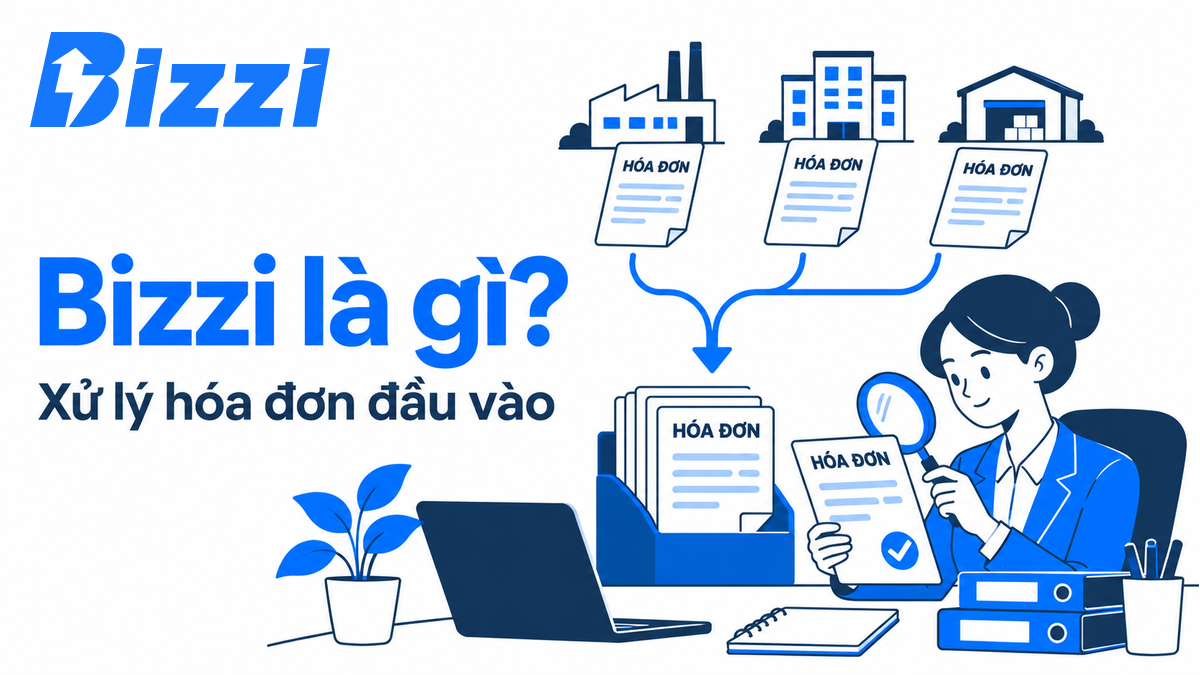
Bizzi provides digital and automation solutions for financial and accounting operations, including processing incoming invoices from suppliers. In this role, Bizzi assists in gathering documents, verifying data, cross-referencing with purchase records, and forwarding discrepancies to the person in charge for review.
The value of automation lies in reducing repetitive tasks and helping accountants identify the right issues to address. Software assists in data control; however, decisions regarding recording, approval, and payment still need to remain within the company's processes and authority.
To what extent does Bizzi handle input invoices?
The scope of processing input invoices begins with the documents the business receives from the supplier. This is from the buyer's side: the accountant needs to know which invoices have been received, whether the data is complete, whether there are any overlaps or discrepancies, and whether they match the purchase transaction.
For example, a supplier might send an invoice via email while the purchase order and delivery note are in a different system. The process manager must connect that information before moving on to the accounting step or requesting payment. Automated data extraction only solves part of the problem; businesses also need reconciliation rules and someone responsible for handling exceptions.
This process needs to be distinguished from the creation, signing, and issuance of sales invoices to customers. While both are electronic invoices, the implementing parties, input data, and required results are different. When reviewing documents, this distinction is crucial. electronic invoice data and readable representation This helps avoid saving only an image or printout and missing the file that needs to be compared.
Bizzi developed from the problem of automating accounts payable.
Processing supplier invoices is part of Bizzi's growth journey. A press release dated October 7, 2021, from Money Forward introduced Bizzi as a provider of accounts payable automation solutions in Vietnam, and announced the investment through Money Forward Fund. The press release stated that Money Forward led the Pre-Series A round which took place in September 2021.
This reference point can be found at Money Forward's 2021 investment report. This information is about a historical event, not a description of current customer base or processing capacity.
In a related announcement, Do Ventures reported a $3 million funding round with Money Forward, Do Ventures, and Qualgro. The founding team was introduced as Vu Trong Nghia and Nguyen Bao Nguyen, with experience in business development and technology. (This information can be viewed as follows...) Do Ventures announces funding round. To compare the context and team in 2021.

When researching technology providers, development milestones help identify the business context. However, implementation choices should be based on actual processes, test data, and agreed-upon service scope, rather than solely on the achievements or metrics of a previous phase.
What stages does an input invoice go through?
The process for handling input invoices consists of four stages: collection, verification, reconciliation, and review. Bizzi describes the capabilities for receiving invoices, verifying data, reconciling invoices (PO - GR), and exporting or synchronizing data according to configuration. Specific steps need to be confirmed based on the source of documents and the system the business is using.
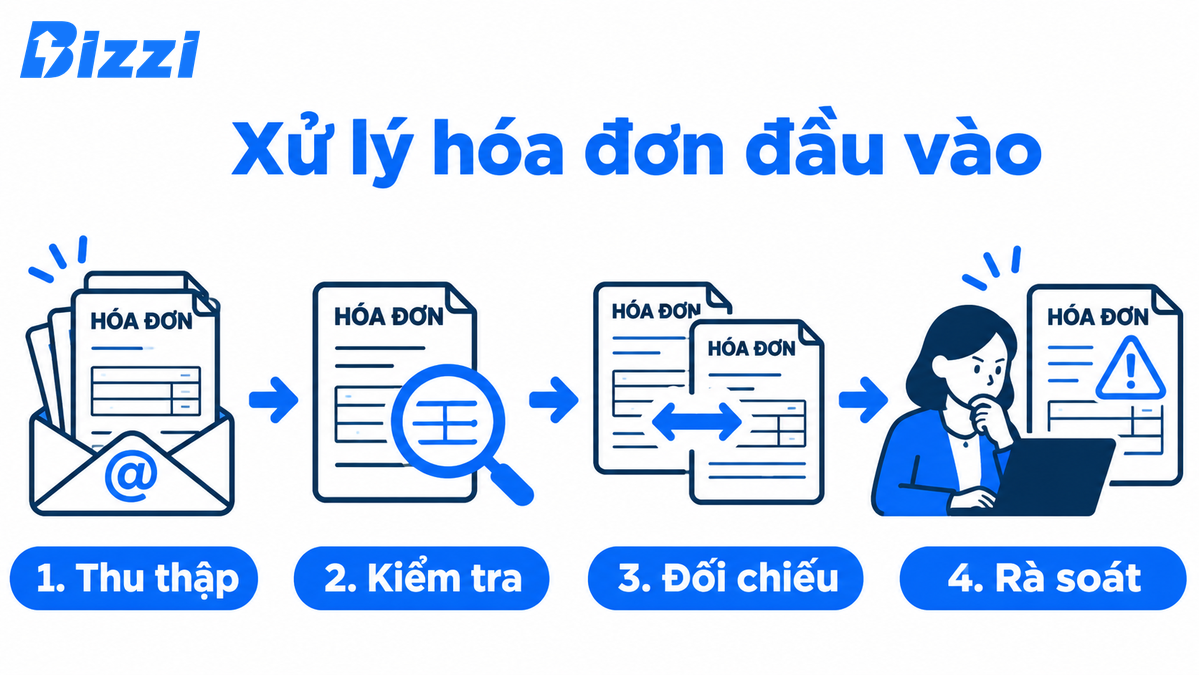
| Processing stage | Required data or results | Business points that need verification |
|---|---|---|
| Collection | Gather invoices and related files from connected channels. | Which receiving sources are supported, how to detect missing files, and how to handle resubmission invoices. |
| Check the data. | Read the invoice information, check it against the established criteria, and display an alert. | The criteria currently being applied, how to view original documents, and how to correct incorrect identification data. |
| Verify the documents. | Compare invoice data with purchase orders and delivery notes when sufficient data is available. | Item code, unit of measurement, quantity, unit price, situations involving multiple deliveries, and the person responsible for handling discrepancies. |
| Review and transition | The person in charge handles the discrepancies; the data is exported or moved to the next step according to the configuration. | Approval authority, processing traces, data format, and results received in the accounting system. |
The Purchase Order (PO) shows the contents of the order placed, while the Gross Receipt (GR) or delivery note reflects the actual receipt of the goods. To prepare the reconciliation data, the purchasing and accounting departments need to agree on the details. Content and usage of purchase orders (PO)., instead of just merging files with similar names.
For example, let's say the purchase order (PO) is for 100 products, the warehouse records 80, but the invoice shows 100. The reconciliation should highlight the 20-product discrepancy and forward it to the responsible person for verification. The discrepancy could be related to multiple deliveries, missing receipt updates, or incorrect documentation; do not jump to conclusions or make payments based solely on a single warning.
Even with software to assist in auditing, accountants still need to control transactions.
Extracting the correct data does not mean the transaction has been approved or is eligible for tax processing. The results of verifying digital signatures, tax identification numbers, or supplier information should be reviewed in conjunction with the supporting documents and the context of the transaction.
Businesses need to determine who verifies the actual transaction, who supplements the documentation, who accepts the discrepancies, and who has the authority to approve payments. Software doesn't automatically generate proof of delivery for missing items, and an invoice may still require review even if the data has been fully read.
The ability to integrate with ERP or accounting software also needs to be confirmed for the correct version, data fields, and implementation method. Similarly, retention periods, access rights, data export capabilities at service completion, and operational support should be clearly stated in the service record or applicable agreement.
What preparations should be made before evaluating a business solution?
A useful audit requires sample documentation, processing instructions, and acceptance criteria. Accounting, purchasing, warehousing, and IT departments can collaborate to prepare by following these steps:
- Description of the current flow: It records the recipient of the invoice, the person responsible for checking it, how it's stored, and where the data is entered. The result is a workflow diagram with someone responsible for each step.
- Choose a sample set of documents: Prepare invoices and corresponding purchase orders/grocery packages (PO/GR) if applicable; include common scenarios such as multiple deliveries or different units of measurement. Use only authorized data and mask unnecessary information.
- Final processing rules: Define the required matching fields, the margin of error to be considered, the approved team, and how to submit additional documents. Don't let the rules be based solely on the experience of a single staff member.
- Check your connection and security: Compare the system version, access rights, data structure, storage requirements, and security records that need to be provided.
- Standardize testing criteria: Record the method of measuring the identification results, any necessary interventions, and acceptance conditions. Only use clearly defined test results to calculate benefits for your business.
In the final step, clearly discuss the service package, connection and support costs, document volume, and trial conditions if applicable. Current pricing and policies need to be confirmed in person; offers from a previous campaign do not automatically apply to a new registration.
Frequently Asked Questions about Bizzi and Billing
Is Bizzi's input invoice processing software the same as invoice issuance software?
These are two different tasks. Processing input involves receiving documents from suppliers; issuing output involves creating invoices for customers. When discussing needs, it's important to clearly state whether you are on the buyer's or seller's side.
Is it possible to default to processing each invoice within a fixed timeframe?
No. The results depend on the file type, data quality, connection source, and the circumstances requiring human intervention. Try a real set of documents and clearly define whether you are measuring extraction time or the entire process up to approval.
What should a business do if it doesn't have enough purchase orders (POs) and delivery receipt data? Where should it start?
First, identify the existing data sources and the areas you want to improve, such as invoice aggregation or reducing re-entry. Three-way reconciliation requires sufficient corresponding information; agree on a data acquisition roadmap before requesting full automation.
We spoke with Bizzi about the company's input invoicing process. Prepare a set of sample documents and the system being used to jointly determine the appropriate scope for data collection, verification, reconciliation, and transfer.