


The appendix on VAT reduction in 2023, according to Decree 44/2023/ND-CP, consists of four parts: Appendices I, II, and III identify groups of goods and services not eligible for tax reduction; Appendix IV is Form No. 01 for declaring tax reductions. This document is for reference purposes only and covers policies in effect from July 1, 2023, to December 31, 2023.
If examining invoices or tax records from that period, correctly identify the appendix and conditions for each item before concluding that 8% applies. For transactions in 2026, the regulations and appendices of the current period should be used.
Download and search the four appendices on VAT reduction for 2023.
You can consult the list in Bizzi's reference document and compare it with the signed decree on the Government's Electronic Information Portal. The first three appendices help check for exclusions; the last appendix is for declaration purposes.
Open the official PDF version of Decree 44/2023/ND-CP, including Appendices I–IV.. The PDF reader allows you to save the file to your computer. The signed version contains 105 pages; Form No. 01 is on the last page. The images below are for illustrative purposes only and do not represent the complete list.
| Appendix | Content | When should I use it? |
|---|---|---|
| I | List of goods and services not eligible for VAT rate reduction. | Compare the product name, description, and corresponding code. |
| II | The list of goods and services subject to excise tax is not eligible for VAT reduction. | Check the group subject to excise tax and note any exclusions. |
| III | The list of information technology goods and services is not eligible for VAT reduction. | Compare IT products and services with the specific catalog. |
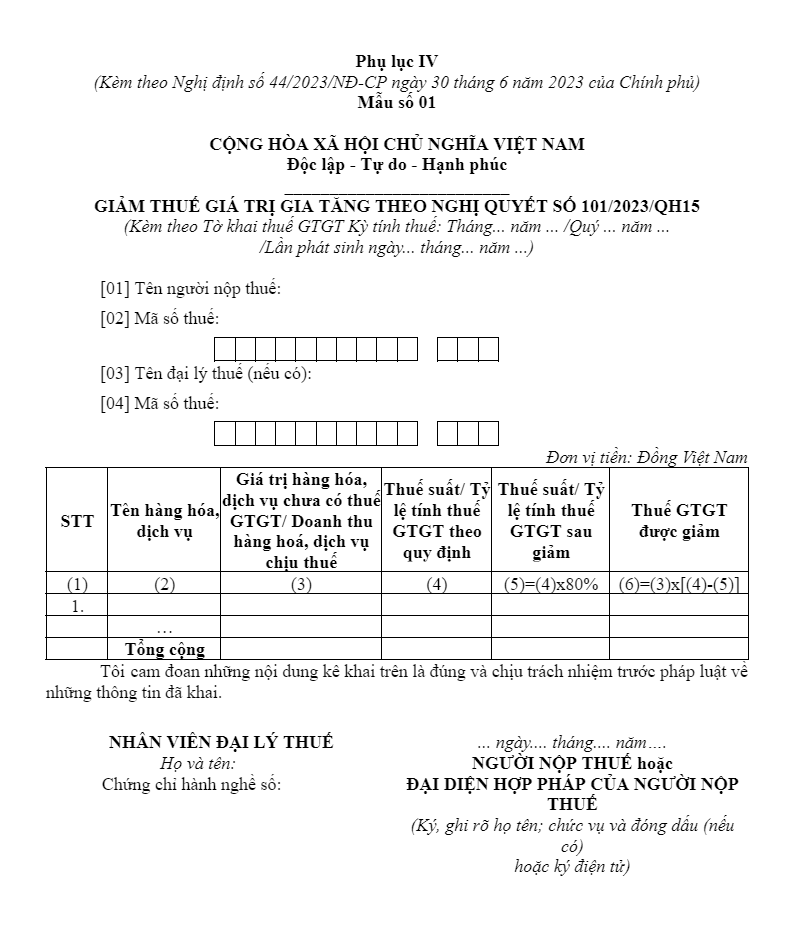
| son-in-law | Form No. 01 regarding VAT reduction according to Resolution 101/2023/QH15. | Declare goods and services eligible for tax reduction along with the VAT return for the corresponding period. |
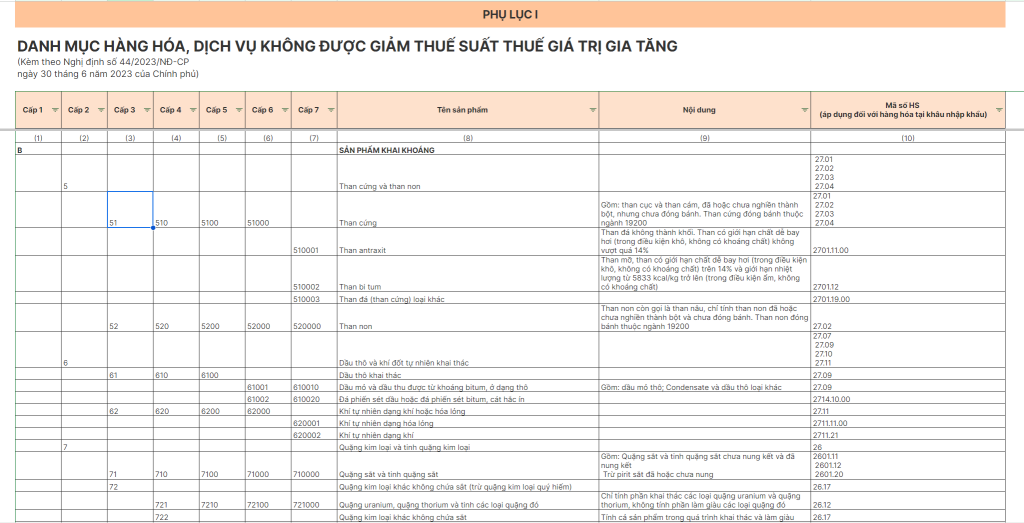
Appendix I: Checking the list of items not eligible for tax rate reduction
Appendix I details the exclusion groups mentioned in point a, clause 1, Article 1, such as telecommunications, finance, banking, insurance, real estate, and some groups of mining, metals, and chemicals. When checking a specific item, both the product name and the description column should be read; the trade name on the invoice may not be sufficient to correctly identify the group.
Open the Bizzi Appendix I reference table.. The HS code column in the appendix clearly indicates the scope of application to goods at the import stage. The HS code alone should not be used to replace the determination of the nature of all domestic transactions.
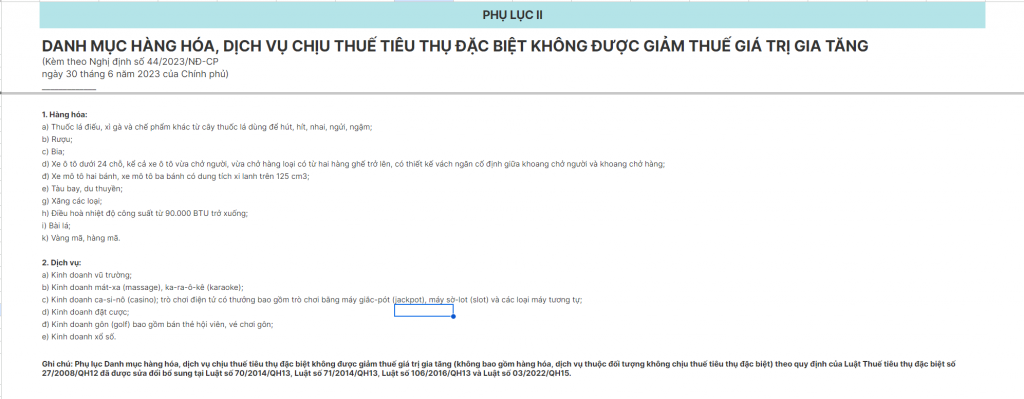
Appendix II: Inspection of goods and services subject to excise tax
Appendix II is a list of goods and services subject to excise tax that are not eligible for VAT reduction under this policy. The list includes groups such as alcoholic beverages, beer, certain vehicles, and conditional business services. This is Appendix II, not Appendix III.
Open the Bizzi Appendix II reference table.. The appendix notes exclude goods and services that are not subject to excise tax under the law referenced in the 2023 version; therefore, one should not simply read the group name and ignore this condition.
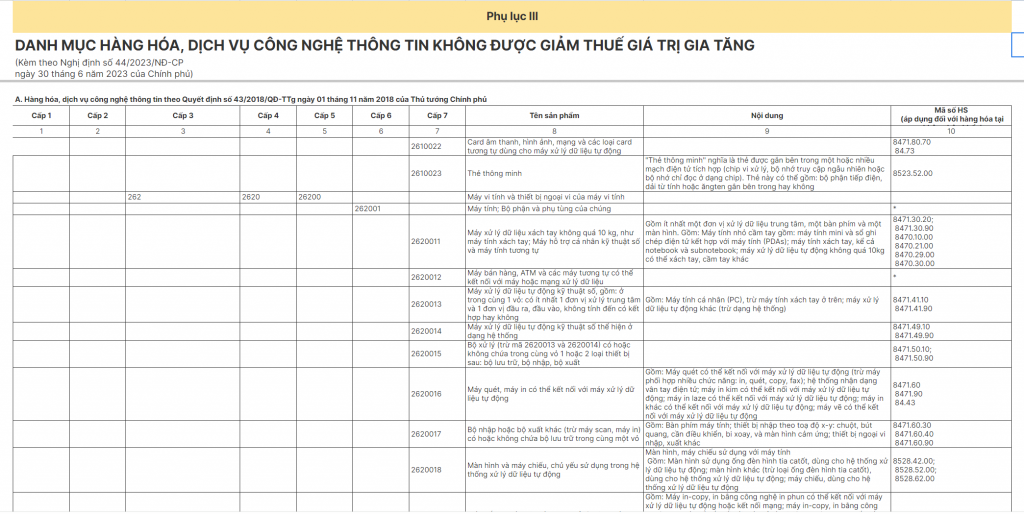
Appendix III: Comparison of the Information Technology Catalog
Appendix III details information technology goods and services that are not eligible for VAT reduction. The table includes product lines, classification codes, descriptions, and HS codes for imported goods. A general term such as "electronic equipment" or "technology services" is not sufficient to determine the tax rate.
Open the Bizzi Appendix III reference table.. Compare the technical description, intended use, and actual service scope with the corresponding line. If the item is exempt from tax or subject to tax rate 5%, apply the tax regime applicable to that item; do not switch to 8% simply because you are looking for a tax reduction appendix.
Appendix IV: Use Form No. 01 to declare tax reductions.
Appendix IV contains Form No. 01 “Value Added Tax Reduction according to Resolution No. 101/2023/QH15”. The form includes taxpayer information, tax code, declaration period, and a table of goods and services values, tax rates before/after reduction, and the amount of tax reduced.
Open Bizzi's Reference Form No. 01. When compiling historical records, compare them with the template in the official decree. This template records the tax reduction results; the appearance of the product name on the template does not automatically prove that the product is eligible for the reduction.
How to consult the appendix to determine the tax reduction conditions for each item.
Checking the product name is one verification step. The final tax rate depends on the time of transaction, the standard tax rate, the product description, and any exclusions. Accountants can follow the following procedure for records under Decree 44/2023:
- Determine the stage of the transaction. Verify the tax assessment period and related documents to select the correct policy. The result should include: the basis for why the transaction falls within the period of July 1st–December 31st, 2023. Do not select a document based solely on the date the file is being reviewed.
- Determine the tax regime before implementing the reduction. Clarify whether the goods and services are subject to tax under Article 10%, Article 5%, or are exempt from tax; and determine the seller's method of calculating the tax. The result should include: the tax rate or pre-reduction tax rate, with justification.
- Gather descriptions sufficient to identify the goods or services. Read the invoice along with the contract, specifications, or service details. Note the specific name, purpose, and transaction step; avoid drawing conclusions from abbreviations or company names.
- Compare all three exclusion lists. Find the product name and group in section I, check the excise tax conditions in section II, and check the information technology in section III. If the PDF is a scanned document and no text is found, open the reference table and compare it to the original page. The result should include: the checked line or group, not just "not found".
- Read the notes and exceptions before selecting a post-reduction level. If there is any doubt regarding classification, record the question and verify it with the tax authority or the relevant department before issuing the invoice. Without sufficient data, it cannot be concluded whether the goods are eligible for 8%.
- Keep records and compare invoices and declarations. Record the document, appendix, description, reason for choosing the tax rate, and the inspector. Then compare it with the tax amount on the invoice and the data in Form No. 01 for the corresponding period. The result should be a document that can be re-checked during handover or explanation.
Exceptions that require reading Appendix I: According to point d, clause 1, Article 1, mined coal sold is subject to tax reduction, including cases where it undergoes screening and sorting through a closed-loop process before being sold. Coal listed in Appendix I at stages other than mining and sale is not eligible for this reduction. The same conclusion should not be applied to all stages of coal transactions.
If you need to see more about the scope of groups in this phase, refer to the guidance on List of goods with reduced VAT in 2023 Explain the policy context. When determining the tax for a transaction, always compare official documents and specific records.
The reduction varies between the deduction method and the percentage-based method.
For eligible goods and services, the deduction method applies a tax rate of 8%; the revenue-based method reduces the tax rate by 20%. These two methods have different bases for calculation.
| Method | Before the reduction | After the reduction | Conditions that need to be maintained |
|---|---|---|---|
| Deduction | Tax rate 10%. | Tax rate 8%. | Goods and services eligible for the reduction and within the specified period. |
| The ratio of % to revenue | The tax rate corresponds to the activity. | Pre-reduction rate × 80%. | Reduce the tax rate by 20%, but do not reduce the total revenue by 20%. |
| Goods subject to tax under code 5% or not subject to tax. | According to the tax regime for goods and services. | It will not be converted to 8% according to Decree 44. | Review the tax regime before implementing any reduction policies. |
Example of the deduction method: price before tax is 20 million VND.
Suppose a transaction during the application period has a taxable value of VND 20,000,000, taxable capital of 10%, and has been determined to be eligible for a reduction. The VAT after the reduction is equal to 20,000,000 × 8% = 1,600,000 VND; The total payment amount is 21,600,000 VND.
Compared to the rate of 10%, the tax reduction is 20,000,000 × (10% − 8%) = 400,000 VND. This represents a 2 percentage point reduction in the tax rate. For example, it is not possible to conclude that a specific product is eligible for a reduction without first verifying the complete list and documentation.
Example of the ratio method: reduce 20% by the ratio 1%
Assume the taxable revenue of a qualifying transaction is VND 100,000,000 and the pre-reduction tax rate is 1%. The post-reduction rate is 1% × 80% = 0,8%. The tax amount before the reduction was 1,000,000 VND; the corresponding reduction is 100,000,000 × 1% × 20% = 200,000 VND.
The 1% ratio is merely an illustrative example of the calculation. For activities requiring a different ratio, use the correct ratio for that activity; it is not assumed that all businesses will automatically apply the 1% ratio. The method of recording sales invoices must comply with the specific regulations below.
Record invoices and Form No. 01 as prescribed for the 2023 period.
After determining eligibility for the reduction, the invoice must accurately reflect the reduced tax rate or amount; Form No. 01 accompanies the VAT declaration for the corresponding period. Paragraphs 3–6 of Article 1 provide separate instructions for the implementation of the two methods.
- Deduction method: The VAT invoice records the tax rate as 8%, and the tax amount and total amount the buyer has to pay for the goods and services are reduced.
- Multiple tax rates on a single invoice: Clearly state the tax rate for each item and service. Do not apply the 8% tax code to the entire invoice simply because one item is eligible for a tax reduction.
- The ratio of revenue method: In the "Total Amount" column, record the full amount of goods and services before the discount; the total amount line should show the discounted amount (20%) based on the percentage of revenue, and also include a note indicating the discount amount according to Resolution 101/2023/QH15.
- Comparison of declarations: Both the seller and the buyer will base their decision on the invoice with the reduced tax amount; the figures on the form must match the records for the period.
The method of tax calculation also determines the type of invoice used. When it is necessary to distinguish between documents before checking the tax line, see how to identify them. value-added tax invoices and VAT invoices.
In Form No. 01 of 2023, column (3) is the value of goods and services excluding VAT or taxable revenue; column (4) is the tax rate/rate before reduction; column (5) is equal to column (4) × 80%; column (6) is equal to column (3) × [column (4) − column (5)]. With the above deduction example, the corresponding values are VND 20,000,000, 10%, 8% and VND 400,000. Do not record the tax amount after reduction of VND 1,600,000 in the “Reduced VAT” column.
If the invoice has already been issued and declared at the non-reduced rate, Clause 5 of Article 1 requires the seller and buyer to process the invoice in accordance with the law on invoices and documents, and then adjust output and input tax if necessary. For old records processed at the present time, it is necessary to check the applicable regulations on invoice processing and supplementary declaration; a single adjustment operation cannot be inferred from Decree 44.
Will the 2023 appendix be used for transactions in 2026?
The appendix to Decree 44/2023 should not be used as a direct basis for selecting the tax rate for transactions in 2026. Article 2 of Decree 44 limits the application period to December 31, 2023.
As of October 11, 2026, Decree 174/2025/ND-CP stipulates a tax reduction policy for the period from July 1, 2025 to December 31, 2026. If you are processing a transaction within this period, please check. Decree 174/2025/ND-CP and its appendices, along with regulations relating to goods, services, and the timing of tax determination.
When reviewing records spanning several years, it's advisable to separately document the relevant regulations and application periods for each transaction. The same product name does not necessarily mean the tax reduction conditions are the same across different periods.
Questions when checking the appendix on VAT reduction in 2023
If the item name is not found in the table, can we conclude that a discount is applicable immediately?
Insufficient information. The product description and group, all three exclusion categories, normal tariff rates, periods, and exceptions need to be checked. The trade name may differ from the name used in the annex.
Can Google Sheets or Google Docs replace legal documents?
This is a reference document for reference purposes. When finalizing the basis, compare it with the official decree and related notes. Permission to copy or download this reference document depends on the document settings and user account; no editing permission is required to read the official PDF.
Is it necessary to apply for separate tax reductions for each item?
Article 1 of Decree 44 stipulates the application of discounts, invoicing, and declaration using Form No. 01 along with the VAT declaration; it does not require a separate application for discounts for each item. Businesses must still determine the correct conditions themselves and keep records of the application results.