


A warehouse receipt is a document used to confirm the actual quantity of materials, tools, equipment, products, or goods entering the warehouse. It serves as the basis for recording inventory cards, settling payments, determining responsibilities, and recording in accounting books. In the system of document templates issued with Circular 99/2025/TT-BTC, the warehouse receipt is Form No. 01-VT.
Filling out the form correctly is only the first step. Accountants and warehouse managers must also differentiate between the quantity on the documents, the actual quantity received, and the recorded data to detect discrepancies before they go further into the accounting and payment process.
What is a warehouse receipt?

A warehouse receipt serves as a legal document recording an increase in a company's assets. It's the starting point for documenting all physical changes in goods as they enter the company's management area.
What is a warehouse receipt used for?
The warehouse receipt is used to confirm the actual quantity of goods and materials received into the warehouse and provides a basis for recording, checking, and determining related responsibilities. According to the instructions accompanying Form 01-VT, the purpose of the receipt includes recording on the inventory card, paying for goods, determining responsibility, and recording in the accounting ledger. Specifically:
- Warehouse: Confirm that the goods have actually entered the warehouse.
- Accountant: There is data available to record the transaction.
- AP/Purchasing: There is proof of receipt of the goods.
- Manage: Accountability will be determined if the documents and the actual goods differ.
| Part | Data of interest | Purpose |
|---|---|---|
| Warehouse Keeper | Item, item code, actual quantity received | Manage incoming goods |
| Accountant | Quantity, value, documents | Record the transaction |
| Purchase/AP | Order, received goods, invoice | Check before payment |
| Manage | Difference, responsibility, timing | Operational control |
In what situations is a warehouse receipt created?
According to the instructions in Form 01-VT, the cases that arise include:
- Supplies and goods purchased from external sources.
- This is a self-produced product.
- Goods are processed and manufactured by external contractors.
- Assets and goods received as capital contributions.
- Excess goods were discovered during inventory checks.
Download the latest Warehouse Receipt Form 01-VT: Here
What information is included in the warehouse receipt form 01-VT according to Circular 99?
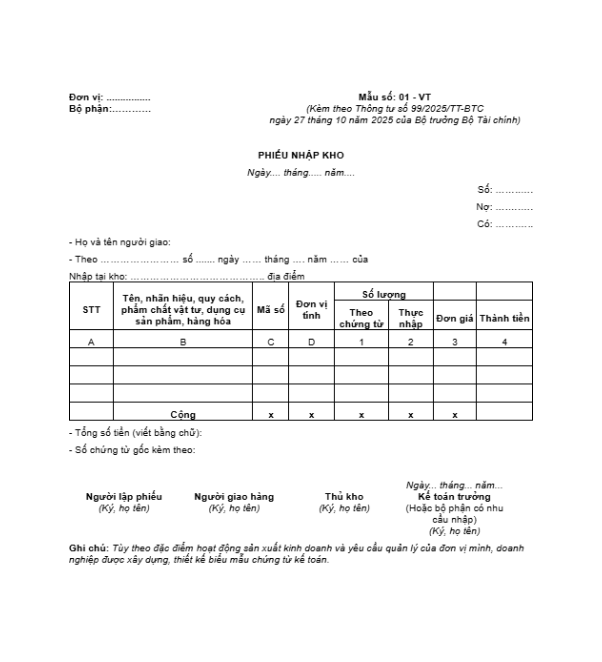
The warehouse receipt form, according to the template issued with Circular 99/2025/TT-BTC, is Form No. 01-VT. The form includes information identifying the document, the basis for receiving the goods, warehouse information, a materials and goods table with two columns for quantity ("According to document") and "Actual received", along with unit price and total amount.
General information on the form
This information helps to identify and recognize the business:
- Unit/Department: Identify the legal entity and the managing department.
- Date created, ballot number: Record the time and order in which documents are managed.
- Debit and Credit information on the form: Used for accounting purposes.
- Name of the person delivering: Identify the person directly responsible for delivering the goods.
- Based on the entry, number, and date of the relevant document: Show the origin of the transaction (invoice, purchase order, production order).
- Warehouse name, warehouse location: The place where goods are physically stored.
Information on goods and materials entering the warehouse.
The detailed table includes the required fields:
- No.
- Name, brand, specifications, quality.
- Code number.
- Unit of measurement.
- Quantity as per documentation.
- Actual quantity imported.
- Unit price.
- Total amount.
What is the difference between receiving goods into inventory "based on documents" and "actual receipt"?
Distinguishing between these two criteria is extremely important:
- According to the documents: The quantity is shown based on the documentation related to the import transaction.
- Actual input: The actual quantity will be confirmed when the goods are received in the warehouse.
For example: The document records 100 products, but the warehouse only received 97. The receipt needs to reflect the quantity as stated in the document (100) and the actual quantity received (97). The difference doesn't necessarily mean the document is incorrect; it's a signal that the transaction needs verification.
Summary and confirmation
The final section of the ballot includes:
- Total amount and supporting documents.
- The confirmation information is shown on the form.
- The importance of confirming responsibility from relevant parties is crucial for future contact tracing.
How to create a warehouse receipt using Form 01-VT
Step 1: Determine the basis for receiving goods into inventory.
Before filling out the form, it is necessary to determine whether the warehousing transaction is an external purchase, in-house production, processing, capital contribution, inventory, or other appropriate transaction based on actual documents. If it is a purchase, the relevant supporting documents may include purchase orders (PO), import orders, delivery receipts, or invoices, depending on the time and process.
Step 2: Record the receipt number, date, sender, and receiving warehouse.
Record the full invoice number, date of issue, delivery person, basis for receipt, warehouse name, and warehouse location. The key point to check is that a transaction must have sufficient information to trace back the source of goods and related documents.
Step 3: Record information about materials, products, or goods.
This includes product name, product code, specifications, quality, and unit of measurement. Errors that require warnings include using multiple product codes for the same item, incorrect unit of measurement, generic product names, or different master data used between the system and the source document.
Step 4: Record the quantity according to the document.
The goal is to maintain the "expected quantity on record" before comparing it to the actual quantity. For example, if the purchase order or delivery document expects 500 kg, don't rush to record 500 kg in the "actual quantity received".
Step 5: Count and record the actual quantity received.
When the goods arrive, the warehouse manager conducts an inspection, verifying the correct unit code, determining the quantity, and recording the actual quantity received. For example, if the document states 500 kg but the actual quantity received is 485 kg, the receipt must show a difference of 15 kg for processing. Under no circumstances should the "actual received" be altered to match the "according to document" simply to make the documents match.
Step 6: Finalize the unit price, total amount, and confirmation information.
The accountant completes the unit price, total amount, and sum, lists the relevant documents, and includes the signature confirmation section.
Goods received -> Goods delivered to warehouse -> Physical inspection -> Determination of actual quantity received -> Preparation/completion of warehouse receipt -> Data verification -> Recording in relevant system
How to reconcile warehouse receipts between the accountant and the warehouse manager.
Inventory reconciliation should begin with each transaction rather than just comparing the total ending inventory. Accountants and warehouse managers need to match the correct documents, then compare the item code, unit of measurement, actual quantity received, time, and value data to identify discrepancies that may have occurred during the receiving, inventory recording, or accounting recording stages.
What data do accountants and warehouse managers need to reconcile?
| Data field | Warehouse of interest | Accountants are interested. | Comparison objectives |
|---|---|---|---|
| Number of votes | Have | Have | Same profession |
| Day | Have | Have | Right Time |
| Warehouse | Have | Have | Correct location |
| Product code | Have | Have | Same item |
| Unit of measurement | Have | Have | No conversion error |
| According to the documents | Have | Have | Reference data |
| Actual import | Focus | Focus | Actual product |
| Unit price | Depending on the process | Focus | Recognize the value |
| Total amount | Depending on the process | Focus | Accounting entries |
5-step inventory reconciliation process
- Step 1. Gather the business transactions recorded during the period: It can be categorized by date, warehouse, supplier, document, or item code.
- Step 2. Match the correct voucher with the source document: The goal is to avoid mistakenly comparing two similar transactions.
- Step 3. Compare the number of documents with the actual goods received: Determine the difference between expected and received.
- Step 4. Compare warehouse data with accounting data: Verify that the received item is equal to the recorded item.
- Step 5. Separate the exception for handling: Do not directly edit data in bulk. Create a list of transactions, discrepancies, data from both sides, causes, owners, and processing status.
Should we compare each invoice individually or just the total inventory?
Both methods should be used, but for different purposes. One is to identify the source of the discrepancy based on individual transactions, while the other is to verify the overall balance after multiple transactions have been recorded. For example, the total inventory might be the same, but one receipt might show an excess of 10, while another might be short by 10. Comparing only the total would show zero discrepancies, but the data for each individual transaction would still be incorrect.
Accounting and warehouse staff have discrepancies in figures: where should the investigation begin?
First, identify which data layer the discrepancy begins in.
Use four stages for verification: Based on documentation/expected quantity -> Actual goods received -> Warehouse manager's record -> Accounting record. The main question to answer is: at which stage does the discrepancy begin?
Case 1: The document states one number, but the actual goods received have a different number.
Example: Document 100, Actual Receipt 97. Inspection guidelines: short delivery, overdelivery, damaged/substandard goods, multiple deliveries, source documents not reflecting changes. Do not immediately conclude that the supplier is at fault; these are causes that require verification.
Case 2: The goods received are correct, but the warehouse manager recorded the transaction incorrectly.
Example: Actual received: 97, Inventory recorded: 100. Checks needed: incorrect quantity, incorrect item code, incorrect warehouse, incorrect unit of measurement, duplicate data entry, missed adjustments according to procedure.
Case 3: Inventory data is correct, but the accounting records are different.
Example: Actual Receipt 97, Inventory 97, Accounting 100. Checks needed: using the document number instead of the actual received number, data mapping, data entry, recording time, incorrect use of transaction/document.
Case 4: The number matches, but the values don't match.
It is necessary to check the unit price, unit of measurement, conversion, value used as a basis, and related factors according to the applicable accounting policy.
Case 5: Data discrepancies due to different recording times.
For example: Goods received on July 31st, one system updates to July 31st, another system records August 1st. The transaction is correct, but the reporting period may differ. This is a cut-off/timing issue, not necessarily a lost shipment.
According to the document: 100 -> Actual receipt: 97 -> Warehouse keeper: 97 -> Accountant: 100
In the diagram above: a change from 100 to 97 requires verification of delivery; a change from 97 to 97 indicates correct inventory reflection; a change from 97 to 100 requires verification of the accounting entry.
How is a warehouse receipt related to a purchase order (PO) and an invoice?
In purchasing transactions, the purchase order (PO) shows what the business has ordered, the warehouse receipt or delivery data reflects what has actually been received, and the invoice shows what the supplier is requesting payment for. Comparing these three sources helps detect cases where 100 units were ordered but only 97 units were received, while the invoice still shows 100 units.
| PO | Warehouse receipt / goods receiving data | Bill |
|---|---|---|
| What has the company ordered and approved for purchase? | What did the business actually receive? | What payment is the supplier requesting? |
Example: PO 100 – Inventory receipt 97 – Invoice 100
The order quantity is 100, the actual quantity received is 97, and the invoice is 100. The question is: Has the 3-unit discrepancy been explained? Mismatches need to be verified before the workflow continues, as the handling depends on the cause, contract conditions, remaining deliveries, supporting documents, and company processes.
When is it necessary to extend to 3D comparison?
When businesses need to simultaneously verify purchase orders (POs), goods received, and invoices, the problem shifts from simply managing warehouse receipts to managing other forms of inventory management. 3D comparison.
When does manual inventory reconciliation become difficult to control?
The signs include: multiple suppliers, a large number of purchase orders (POs), one PO being delivered multiple times, one invoice involving multiple deliveries, multiple warehouses, multiple people involved, documents stored in Excel/email/different systems, numerous exceptions requiring retracing, and accountants spending time manually piecing together documents.
Where could Bizzi possibly appear in this process?
As the number of transactions increases, the issue shifts from "knowing what to reconcile" to "how to correctly match data and focus on handling exceptions." For businesses that need to connect the receiving process with invoice verification and document reconciliation in AP, solutions may be considered. AI invoice processing software and three-way reconciliation to reduce the volume of manual document merging and focus on handling exceptions. The warehouse receipt becomes a crucial input for the entire process. invoice processing flow.
Download warehouse receipt form 01-VT according to Circular 99.
The Warehouse Receipt Form in the system of forms according to Circular 99/2025/TT-BTC is Form No. 01-VT in Appendix I. Currently, there is a clear need for Word and Excel versions of the form to be formatted to support businesses in their operations.
Frequently Asked Questions about Warehouse Receipts
Who prepares the warehouse receipt?
It is necessary to clearly distinguish between the person who prepares, delivers, receives, and confirms the information in order to present it in a way that reflects the unit's actual responsibilities and procedures. It should not be assumed that the warehouse manager is always the person who prepares the information.
If the actual quantity received differs from the document, can a receipt be issued?
The receipt needs to reflect actual transactions and retain discrepancies for verification. Therefore, businesses still create receipts to record the actual amount received and maintain the reference figures.
Is a warehouse receipt the same as a goods delivery and receipt record?
A warehouse receipt records the entry of goods into the warehouse. A delivery and receipt record proves and confirms the delivery and receipt event between the parties, depending on the operation. They differ in their purpose.
Does a warehouse receipt need to be accompanied by an invoice?
Not all inventory transactions originate from external purchases (e.g., self-production, capital contribution); therefore, it cannot be said that every inventory receipt must always be accompanied by an invoice at the same time.
Is it possible to create an electronic warehouse receipt?
The Accounting Law and current regulations on electronic documents allow businesses to establish, store, and circulate documents in digital form when they meet the conditions of integrity and authenticity.
If the accountant and the warehouse manager have different figures, which one should be used as the correct one?
Do not select numbers based on job titles. You must go back to the process: document -> receipt -> inventory data -> accounting data to identify the actual event and the point of discrepancy as the most accurate basis for verification.
When the purchasing process involves multiple purchase orders (POs), deliveries, and invoices requiring reconciliation, the Finance Team can explore ways to automate the process of document verification and exception handling before payment to achieve maximum efficiency.
Conclude
A warehouse receipt is not only a document recording the actual goods and materials received into the warehouse, but also a crucial link in the purchasing and payment control process. Its value lies in its ability to help businesses compare the quantity according to the documentation with the actual received goods, detect discrepancies, and link data between the warehouse, accounting, and purchasing departments before recording or making payments.
For businesses with multiple purchase orders (POs) and monthly delivery and invoice processing, applying an invoice processing and automation (AP) solution helps connect PO data, warehouse receipts, and invoices, supporting three-way reconciliation and centralizing discrepancies for accounting verification before payment. This reduces the volume of manual document merging and improves control over the purchasing and payment process.
Register here to receive consultation and experience solutions from Bizzi: Matching Invoices & Documents