


Cost fraud This refers to the intentional act of falsely declaring, falsifying, or concealing information about an expense in order to receive payment, reimbursement, or benefits that the person making the transaction is not entitled to. This behavior may occur in the process of requesting expenses, travel expenses, advances/reimbursements, or employee expense reporting.
However, not every invoice with incorrect information, overspending, or incomplete documentation constitutes fraud. Warning sign (Red Flag) This only indicates that the transaction needs further verification, but it is not sufficient to conclude that the person involved intentionally engaged in fraudulent activity. The assessment should be based on the transaction context, documentation, approval history, and related evidence.
In this article, Bizzi will help businesses understand What is expense fraud?, This includes distinguishing errors from policy violations, identifying common forms of employee fraud, and establishing appropriate control frameworks to reduce risks throughout the entire cost management process.
What is expense fraud?
Expense fraud occurs when an individual intentionally misrepresents, falsifies, or conceals information about an expense in order to receive payments, rebates, or benefits they are not entitled to. According to the professional approach of the Association of Certified Fraud Investigators (ACFE), the key element distinguishing fraud from error is the intent of the perpetrator. Without evidence proving intent, businesses should not hastily conclude that an unusual transaction constitutes fraud.
In fact, Employee Expense Fraud These issues can arise at various stages of the expense management process, such as:
- We recommend paying in advance before purchasing goods or using services.
- Report on travel expenses after the trip.
- Advance payment and reimbursement procedures.
- Periodic expense report.
- Payment documents are sent to the accounting department.
The goals of these practices are often to obtain higher reimbursements than they actually are, legitimize personal expenses as business expenses, circumvent spending policies, or conceal the intended use of budget funds.
For example, an employee on a business trip might actually stay at a hotel costing 1.8 million VND per night but intentionally report a price of 2.5 million VND in the expense report to receive the difference. If this difference results from intentional misreporting or the use of documents that do not accurately reflect the actual transaction, then... This could be considered a sign of cost fraud. and needs to be verified by the business through its internal control procedures.
It's crucial for businesses to evaluate the entire chain of evidence rather than just looking at a single invoice or transaction. A payment request can only be considered fraudulent when there is sufficient evidence to suggest that the perpetrator is fraudulent. deliberate Falsifying information for personal gain, rather than simply making an error during the declaration process.
Key factor deliberate This is also an important dividing line between fraud and discrepancies arising from mistakes or failure to follow proper procedures.
Distinguish between fraud, errors, and policy violations.
Not every invoice with incorrect information, missing documentation, or exceeding the spending limit constitutes fraud. A misrepresentation should only be considered fraudulent when there is evidence that the perpetrator intentionally misrepresented, concealed information, or sought to obtain an unjustifiable benefit.
This is a common mistake many businesses make in cost control. In fact, the same anomaly can stem from multiple causes: data entry errors, misunderstanding of regulations, violations of internal rules, or intentional profiteering. Failing to differentiate between these cases risks overlooking real risks and may lead to biased conclusions about employees.
The table below helps distinguish four common states in the cost management process:
| Status | Intentional element | For example | Appropriate action |
| Error | Not yet | Incorrect amount entered, wrong invoice date, wrong expense category selected. | Adjust the data, revise the process instructions. |
| Policy violation | It may not be clear yet. | Overspending, late submission of documents, misuse of forms. | Consider the cause and apply the exception approval process if appropriate. |
| Anomalies requiring verification. | No conclusion yet. | Two requests using the same invoice number, multiple expenses close to the approved limit. | Gather additional documents and cross-check data before conducting the evaluation. |
| Cheat | There is evidence suggesting intentionality. | Falsifying expenses, altering documents to receive additional money, and declaring expenses that were not incurred. | Proceed to internal processing procedures and consult with auditors or legal departments if necessary. |
As can be seen, Error These often stem from mistakes or lack of experience. For example, an employee might accidentally miss a digit in a sum of money or upload the wrong invoice. These cases require correction and guidance to prevent recurrence, rather than being labeled as fraud.
Meanwhile, Policy Violation This occurs when an expenditure violates internal regulations but there is no evidence of fraudulent intent. For example, an employee might book more hotels than allowed due to a lack of suitable options during peak season. This case may require explanation and an exception approval, rather than being automatically considered fraudulent.
Another group is the Abnormal signs (Red Flags). For example, an invoice being submitted twice, multiple consecutive expenses falling just below the approval threshold, or expense reports showing a sudden shift from usual practices—these are signals that the business needs further review, but This is not independent evidence to conclude that the employee committed fraud..
Only when the verification process reveals the person who did it. deliberate A transaction can only be considered a crime if it involves falsifying information to receive an unjustified payment or benefit. Employee Expense Fraud.
Clearly defining these four states not only helps businesses handle each case correctly but also limits subjective control, while creating a foundation for designing more transparent approval and monitoring processes.
After correctly identifying the boundary between fraud and unintentional discrepancies, businesses can further categorize common forms of expense fraud to develop appropriate control measures for each risk group.
Common forms of employee expense fraud
Expense fraud typically involves expenses that didn't actually occur, inflated expense values, personal expenses misrepresented as business expenses, duplicate reimbursement requests, or falsified documentation. While all these practices aim to gain unfair advantage, the mechanisms and identifying characteristics of each type differ. Clearly classifying each form will help businesses choose appropriate control measures instead of applying a single procedure to all cases.
The table below summarizes eight forms. Employee Expense Fraud We often encounter similar types of evidence that need to be verified.
| Form | Mechanism | Hypothetical example | Evidence to be examined |
| Declaring expenses that did not actually occur. | Creating a non-existent transaction | Claiming taxi fares but no trip actually took place. | Original documents, transaction confirmations, work schedule |
| Inflating the value of the expenditure | Declare a higher amount than the actual amount. | Declare a higher price for the hotel than the actual bill. | Booking, invoice, payment statement |
| Declare personal expenses as business expenses. | Misrepresentation of intended use | A private meal was declared as entertaining guests. | Work schedule, attendees, work purpose |
| Request for payment or reimbursement | A transaction requires multiple payments. | The same invoice was submitted in two separate reimbursement installments. | Invoice number, transaction date, amount |
| Altering or distorting documents | Change the information on the document. | Edit the amount on the receipt image. | Original electronic invoice data |
| Splitting transactions into smaller amounts to avoid limits. | Split an expense into multiple transactions. | Divide your shopping expenses into several smaller bills. | Total transaction value over time, supplier |
| Falsely declaring the purpose or beneficiary. | Change cost allocation information | Personal expenses are allocated to company projects. | Cost center, budget, project documentation |
| Collusion in cost claims | Two or more parties collude to bypass controls. | The proposer and the approver agreed to skip the process. | Approval rights, approval history, transaction templates |
Declaring expenses that did not actually occur.
This is the group Fictitious Expense, This means that the expense is declared but in reality there is no corresponding transaction. The person making the payment may create documents that do not reflect the actual transaction or declare an activity that never took place in order to receive reimbursement.
For example, an employee claims to have used a taxi to meet a client, but the work schedule, location data, and related information all show that the trip did not exist. In this case, the business needs to verify the entire chain of evidence instead of relying solely on a photograph of a receipt.
It is important to note that the article only addresses expenses that do not actually arise in the internal cost management process., This does not extend to invoice trading or supplier tax fraud..
Inflating the value of the expenditure
Unlike fake costs, Inflated Expenses This refers to expenses that were actually incurred, but the declared value is higher than the actual amount.
Some common scenarios include:
- Declare a higher price for the hotel room than the bill actually shows.
- Increase the amount spent on taxis or meals.
- Declare additional fees that were not incurred.
For example, an employee might charge 2 million VND for a hotel but declare 2.6 million VND in the expense report to pocket the difference.
However, businesses also need to differentiate between False declaration due to mistake and intentionally inflating expenses. A single data entry error is not sufficient to conclude that fraud has occurred unless the declarant's intent has been verified.
Declare personal expenses as business expenses.
This is the form Mischaracterized Expense, when an expense incurred for personal needs is presented as an operating expense of the business.
For example:
- Family meals are declared as entertainment expenses.
- The weekend trip was described as a business trip.
- Purchases for personal use but allocated to the project budget.
This type of fraud isn't always easy to detect if the business only... Check input invoices without cross-referencing with the relevant work schedule, trip purpose, attendees, or work plan.
For business travel and entertainment expenses, requiring clear disclosure of the purpose of use, a list of attendees, or related projects will significantly reduce the risk of misrepresenting the nature of the transaction.
Request for payment or reimbursement
Expense Reimbursement Fraud This usually occurs when the same expense is requested to be paid multiple times in different forms.
For example:
- An invoice is submitted for two reimbursement periods.
- The employee used a company card for payment while simultaneously submitting refund requests via their personal account.
- A document is sent simultaneously via email and through the expense management system.
If businesses process records manually or distribute data across multiple systems, such duplicate transactions are easily overlooked.
However, a duplicate request It is not automatically considered fraud.. There are cases that arise due to repeated sending operations, incomplete data synchronization, or system errors. Therefore, accountants need to check the invoice code, sending time, payment status, and processing history before drawing any conclusions.
Altering, replacing, or distorting documents.
Some fraudulent activities do not create fake transactions but directly impact... document To change information for payment purposes.
Symptoms may include:
- Change the amount on the invoice.
- Edit the transaction date.
- Change the description of the expense item.
- Replace the original document with the modified version.
It is important to emphasize that A document showing signs of alteration does not necessarily mean it is fraudulent.. Businesses should cross-reference electronic invoices, original documents, or supplier data to verify accuracy before processing according to the appropriate procedure.
Splitting transactions into smaller amounts to avoid limits or approval requirements.
Some businesses require that expenses exceeding a certain threshold must be approved by higher management. In that context, the person making the request may... Split Transaction Break it down into several smaller amounts to avoid exceeding the control threshold.
For example, instead of creating one expenditure proposal worth 30 million VND, the expenditure is divided into three separate proposals, each worth 10 million VND, so that it remains within the authority of the current approval level.
However, Splitting a transaction into smaller parts isn't always fraudulent.. In some cases, procurement is carried out in multiple batches or with multiple suppliers for operational reasons. Therefore, this should only be considered as one instance. Warning sign (Red Flag) It needs to be analyzed in the context of the entire transaction.
Falsely stating the purpose, participants, or beneficiaries.
An expense may actually be incurred, but the accompanying information may not accurately reflect how it was used.
For example:
- Incorrectly declaring the project will incur costs.
- Incorrectly recorded the department using the budget.
- Inaccurate attendance lists were provided in the hospitality records.
- Allocate personal expenses to the budget of another department.
These discrepancies can distort budget data, affect management reporting, and lead those in authority to make decisions based on inaccurate information.
Therefore, businesses should not only check the amount of money but also verify the purpose of the work, the beneficiary, the project code, and the Cost Center before approving it.
Collusion in cost claims
In addition to actions taken by an individual, risks can also arise when Multiple parties collaborate to overcome layers of control..
For example:
- The proposer and the approver agreed to skip the document verification process.
- The employee colluded with the supplier to create documents that did not accurately reflect the transaction.
- Those with the authority to approve exceptions frequently grant them without adequate explanation.
This is a more complex risk group as it may involve multiple individuals and steps in the process. This article only covers identifying the signs. If collusion or signs of legal violations are suspected, the business should refer the matter to the internal audit department, legal department, or appropriate expert for independent verification.
Although these methods differ in their execution, they often leave behind negative consequences. Anomalies in transaction data, declaration behavior, and approval processes.. Correctly identify the Warning signs (Red Flags) This will help businesses detect risks earlier without rushing to unfounded conclusions.
What signs of expense fraud need to be investigated?
Red flags are signals indicating that a transaction or process may be at risk and requires further verification, and are not independent evidence to conclude that an employee has committed fraud. In reality, many unusual transactions may stem from errors, changes in business operations, or exceptional circumstances permitted by the business. Therefore, the goal of control activities is not to find every way to prove fraud, but rather to prioritize high-risk cases for inspection first.
From the CFO's perspective Financial Controller, monitoring Warning sign (Red Flag) This should be done at three levels: transactions, people, and processes. When multiple indicators appear simultaneously, businesses have grounds to broaden the scope of verification instead of just reviewing each transaction individually.
Signs at the transaction level
These are the easiest signals to detect because they appear directly on payment requests, expense reports, or supporting documents. However, accountants need to evaluate these signals within the context of the entire transaction rather than looking at a single criterion in isolation.
Some signs of expense fraud Commonly encountered at the transaction level include:
- Two or more offers share the same invoice number, issue date, or payment amount.
- Multiple consecutive expenditures are close to the threshold requiring higher approval.
- Expenses incurred outside of working hours or that are not in line with the work schedule.
- The document lacks important information, is inconsistent, or shows signs of alteration.
- The amount requested for expenditure, the invoice, and the payment statement do not match.
- Expenditures are allocated to unrelated projects, departments, or cost centers.
For example, if a hotel bill appears in two different reimbursement records or the same bill number is submitted through multiple channels, this is signs that need to be checked, However, businesses still need to verify whether the cause stems from duplicate submissions, data synchronization errors, or intentional requests for multiple payments.
Instead of processing each transaction individually, businesses should simultaneously compare payment requests, invoices, statements, advance payment information, and budget data to identify inconsistencies.
Signification at the staff or approver level.
Not just transaction data, Behavior Pattern The recommendations of the proposer or approver may also reflect risks that need to be monitored.
Some common symptoms include:
- One employee has a significantly higher exception rate than the department average.
- Frequently submitting documents late or requiring additional documents multiple times.
- Expenditures are consistently coming in close to the approved budget.
- Spending patterns change abruptly compared to previous periods without a reasonable explanation.
- One person had significant influence over both the preparation of the expenditure request and the approval process.
- Approvers frequently accept exceptions or skip document verification steps.
For example, if an employee consistently incurs travel expense charges just below the limit that requires approval from higher management for several consecutive months, this could be a sign that the company needs to take a closer look at how it prepares expense requests. However, this This does not mean that the employee committed fraud.. It's possible that the nature of their work frequently generates expenses at this level, or that the company has specific policies for that department.
Similarly, a manager's frequent quick approvals without requesting additional information are not sufficient grounds to conclude collusion. However, this signals for the business to reassess the quality of its control processes and the level of compliance in its approval activities.
Indicators at the process level
In many cases, Fraud stems not only from individual behavior but also from flaws in process design.. When the control system lacks critical checkpoints, unusual transactions are more likely to slip through the process undetected.
Businesses should review for signs such as:
- No owner is responsible for updating and managing the spending policy.
- Regulations regarding limits, documentation, or approval conditions are unclear.
- There is no separation of responsibilities between the person making the request, the person approving it, and the person making the payment.
- Do not compare the payment request with bank statements, advances, bookings, or budgets.
- Air traffic Audit Trail Regarding the editing and approval history.
- Employees submit payment requests through multiple channels such as email, Excel, and paper forms, but the data is not consolidated.
- There are no regular reports to track exceptional transactions or unusual emerging trends.
These weaknesses don't prove that fraud is occurring within the business, but This increases the likelihood of missing risky transactions.. Especially when the number of expenditure requests increases rapidly, manual verification makes it difficult for accountants to detect irregularities spanning multiple periods or departments.
Quick checklist of signs to look for
| Level | Warning sign (Red Flag) | Appropriate action |
| Transaction | Duplicate invoices, mismatched amounts, multiple items close to the credit limit, unusual documents. | Compare with original invoices, bank statements, work schedules, and related data. |
| Staff/Approver | Repeated exceptions, late submission of documents, unusual changes to payment forms, approvals that bypass verification. | Analyze trends, request explanations, and review further evidence. |
| Procedure | Lack of task separation, failure to save audit trails, scattered data, lack of reconciliation. | Review and improve internal control procedures. |
From a management perspective, Red flags (warning signs) often reflect not only an individual's behavior but also reveal weaknesses in the design of the cost management process.. Therefore, instead of just focusing on detecting unusual transactions, businesses need to identify them. Why were those transactions able to bypass the control layers?. This is also a crucial step for CFOs and the finance department to prioritize improvements in the gaps that have the greatest impact on fraud risk.
What process loopholes increase the risk of expense fraud?
The risk of expense fraud often increases when businesses lack clear policies, have inadequate task separation, scattered data, and merely superficial control measures. In many cases, the problem doesn't lie with an individual but stems from a process that allows exceptions to pass through without being detected or verified in a timely manner.
From the perspective of a CFO or Financial Controller, the goal isn't just to find out "who committed the fraud," but more importantly, to identify... What weaknesses in the process allow an unusual expense request to still be approved and paid?.
Below are common vulnerabilities that need priority review.
| Process loophole | Risks arise | Control Owner |
| The spending policy is unclear. | Employees have differing understandings of eligible expenses, limits, and required documentation. | Finance Department/CFO |
| The approval process is a formality. | Expenditures were approved without assessment of purpose or budget. | Approver |
| No task separation | An individual simultaneously proposes, confirms, and participates in the payment process. | Finance Manager/Chief Accountant |
| The data is scattered in many places. | It is difficult to detect duplicate transactions or multiple declarations. | Finance Department |
| No data comparison. | Discrepancies between the payment request, invoice, and payment transaction went undetected. | Payment accounting |
| Lack of exceptional oversight | The abnormal patterns of limb movements recurred over multiple periods but were not analyzed. | Internal Audit/CFO |
Expenditure policies are unclear or outdated.
A spending regulation only specifies the payment amount but does not clearly define:
- Which expenses are acceptable?;
- In which cases is prior approval required?;
- What evidence needs to be submitted?;
- Repayment deadline;
- Exception handling conditions;
This will lead to each department understanding and applying it in a different way.
For example, if the policy only states "entertainment expenses will be reimbursed" but doesn't require a list of attendees or the purpose of the meeting, it will be very difficult for the approver to assess the reasonableness of the expenditure.
The more ambiguous the policy, the more control relies on individual experience rather than a unified standard.
The approval process is merely a formality.
In many businesses, managers only see the total amount before clicking approve, without having complete information about:
- purpose of the expenditure;
- related budget;
- project or department using it;
- invoices, receipts;
- The advance payment received previously.
This makes the approval step an administrative procedure instead of a risk control points.
In reality, even a small expenditure may require careful consideration if it falls into the category of sensitive expenses or is unplanned. Conversely, a large expenditure that has been budgeted and has complete documentation can be processed more quickly.
Therefore, the approval process should be designed based on risk level, not just based on monetary value.
Do not separate tasks among stakeholders.
An important principle in internal control is Do not allow one individual to control the entire process..
If the same person could:
- Create a payment proposal.,
- edit information,
- verify documents,
- This also influences the approval decision.,
Then the ability to detect discrepancies will be significantly reduced.
Management practice generally recommends a minimum separation of roles:
- The person who incurs the need for expenditure;
- approver;
- The accountant checks the records.;
- The person making the payment.
Separating tasks doesn't eliminate risk entirely, but it helps reduce the likelihood of an intentional deviation going unchecked throughout the process.
Cost data is distributed across multiple systems.
One of the reasons why How to detect expense fraud The difficulty arises from the fact that the data is not centrally managed.
Many businesses still manage expenses through multiple channels:
- Email for sending invoices;
- Excel tracks budgets;
- Use a chat application to request approval;
- Accounting software for record-keeping;
- Use Internet Banking for payment.
When information is fragmented, accountants must manually compile it before reconciliation.
This may increase the risk of:
- Omission was made to request reimbursement for duplicate payments;
- They didn't realize a bill had been used before;
- It's difficult to check the edit history;
- It takes a lot of time to search for documents during audits or tax settlements.
Fragmented data doesn't necessarily mean fraud will occur, but it can make anomalies harder to identify.
Do not link proposed payments to actual transactions.
A payment typically goes through several steps:
- Request for payment.
- Approve.
- Pay.
- Collect the invoices.
- Settlement or reimbursement.
If each step exists independently and has no data link, businesses will find it difficult to answer questions such as:
- Which expenditure request does this invoice belong to?
- Has this amount been advanced yet?
- Are the transactions on the statement correct for the requested amount?
- Has the expense been paid previously?
The failure to connect the entire process makes traceability difficult.audit trailThis is limited and increases the cost of testing each time an exception occurs.
Lack of mechanisms to monitor exceptions and trends.
Many businesses only check records at the time of payment and fail to track trends over time.
Meanwhile, a single sign might not indicate anything, but its repeated occurrence reflects a problem in the process.
For example:
- The same employee regularly incurs expenses close to the approved limit;
- One department had a significantly higher rate of post-payment document submissions compared to other departments;
- The same supplier appears unusually in multiple instances. expense report.
These data samples are not evidence of expense fraud, However, it serves as a basis for businesses to prioritize checking, verifying, and evaluating whether policy adjustments or enhanced controls are necessary.
Furthermore, the pressure to process applications quickly, especially at the end of the month or quarter, can cause approvers to overlook crucial verification steps. Therefore, instead of relying solely on individual experience, businesses should design multiple layers of complementary controls to reduce reliance on human factors.

How do businesses control expense fraud using a three-tiered system?
Businesses should combine three layers of control: establishing clear policies, controlling each transaction, and continuously monitoring data to reduce the likelihood of expense fraud spreading throughout the entire process. This approach is also consistent with the principles of internal control, where each layer assumes a different role: prevention, detection, and handling of exceptions. No single layer of control can completely eliminate risk, but when designed in a coordinated manner, businesses will significantly reduce the likelihood of missing signs of anomalies.
Instead of focusing solely on verifying documents after payment, the CFO and finance department should build a comprehensive control system that covers everything from the moment the expenditure is incurred until the completion of reconciliation and data analysis.
Level 1 — Establishing Policies and Responsibilities
The first layer of control is Prevention (Preventive Control), This helps reduce risk even before a transaction occurs. A clear spending policy will create a unified set of rules that all employees, managers, and accountants can follow.
The policy should include the following details:
- List of permitted and prohibited expenses.
- Spending limits are set by job title, department, location, or project.
- The types of documents, invoices, and records that must be submitted.
- Deadline for submitting payment or reimbursement requests.
- Exception handling procedure.
- The person responsible for issuing, updating, and interpreting policies.
In addition, businesses need Segregation of Duties among the roles in the process, including:
- The person who incurs the need to spend.
- The person offering payment.
- Approver.
- The accountant checks the documents.
- The person making the payment.
The fact that an individual can both create a request and have the authority to approve or interfere with the payment process undermines the effectiveness of the internal control system.
Furthermore, the policy should clearly define the mechanism for handling exceptions, such as cases requiring the use of personal cards, emergency expenses, or when a supplier only accepts a specific payment method. When exceptions are defined in advance, businesses maintain operational flexibility while limiting arbitrary decision-making.
Level 2 — Pre- and In-Process Control
If the first layer creates the "rule," then the second layer ensures it. All transactions are checked according to regulations before money is disbursed..
At this stage, businesses should implement control measures such as:
- Require prior approval for large-value or high-risk expenditures.
- Verify the purpose of budget allocation and the beneficiaries.
- Compare the requested amount with the allocated budget.
- Thoroughly check all invoices, receipts, and related documents.
- Match with advance payments, business bookings, contracts, or purchase orders when necessary.
- Determine whether the expenditure falls under the budget of the department or project.
More importantly, the approval process should be designed according to risk level, instead of just based on monetary value.
For example, an unplanned entertainment expense might require higher-level approval, while a recurring payment for software that was budgeted for at the beginning of the year might follow a simpler process.
In case the record is incomplete or shows signs of irregularities, the system or the auditor may:
- Request for additional documentation;
- Explain the purpose of the expenditure;
- Transfer to a higher level of approval;
- Payment is temporarily paused for verification.
It is important to note that An over-limit transaction or one lacking documentation does not necessarily mean expense fraud.. This is just a signal that needs to be verified before making an appropriate decision.
Layer 3 — Monitoring, data analysis, and exception handling
Even after the transaction has been settled, the business still needs to maintain it. Detective Control through data analysis and regular reviews.
Unlike checking individual records, this layer of control focuses on detecting anomalies throughout the entire system.
Activities typically include:
- Check for duplicate payment or reimbursement requests.
- Continuously monitor expenses to ensure they stay within approved limits.
- Analyze spending trends by employee, department, or project.
- Monitor exception rates, supplementary document rates, and reimbursement times.
- Review instances where approvers frequently ignore or override warnings.
- Conduct a random check of some records after payment (post-payment audit).
For example, if the system detects multiple requests with the same invoice number or the same vendor within a short period, this is red flag Further verification by the accounting department is required. However, data duplication can stem from various causes such as data entry errors, transaction adjustments, or the use of shared invoices as per regulations. Therefore, warnings only serve to help identify exceptions and do not automatically draw conclusions. Refund fraud good Inflating expenses.
In parallel with data monitoring, businesses should also regularly review and update their policies when new risk patterns are identified. This is a crucial step in ensuring that the control system continuously adapts to changes in business operations, rather than simply reacting after an incident has occurred.
Checklist: Does the business have all three layers of control in place?
| Control criteria | Has it been implemented? |
| Have Internal spending rules updated periodically | ☐ |
| The limits have been clearly defined for each type of expense. | ☐ |
| There is a list of required supporting documents for each expenditure. | ☐ |
| The proposer and the approver are separated independently. | ☐ |
| There is a pre-approval process for risky expenditures. | ☐ |
| The transaction is tied to a budget or project. | ☐ |
| There is a comparison between the expenditure request, the invoice, and the payment. | ☐ |
| A complete history of edits and approvals (audit trail) is saved. | ☐ |
| Are there any duplicate or near-limit transactions being monitored? | ☐ |
| There are exceptions reported by employee, department, and vendor. | ☐ |
| There are procedures for handling and escalating unusual situations. | ☐ |
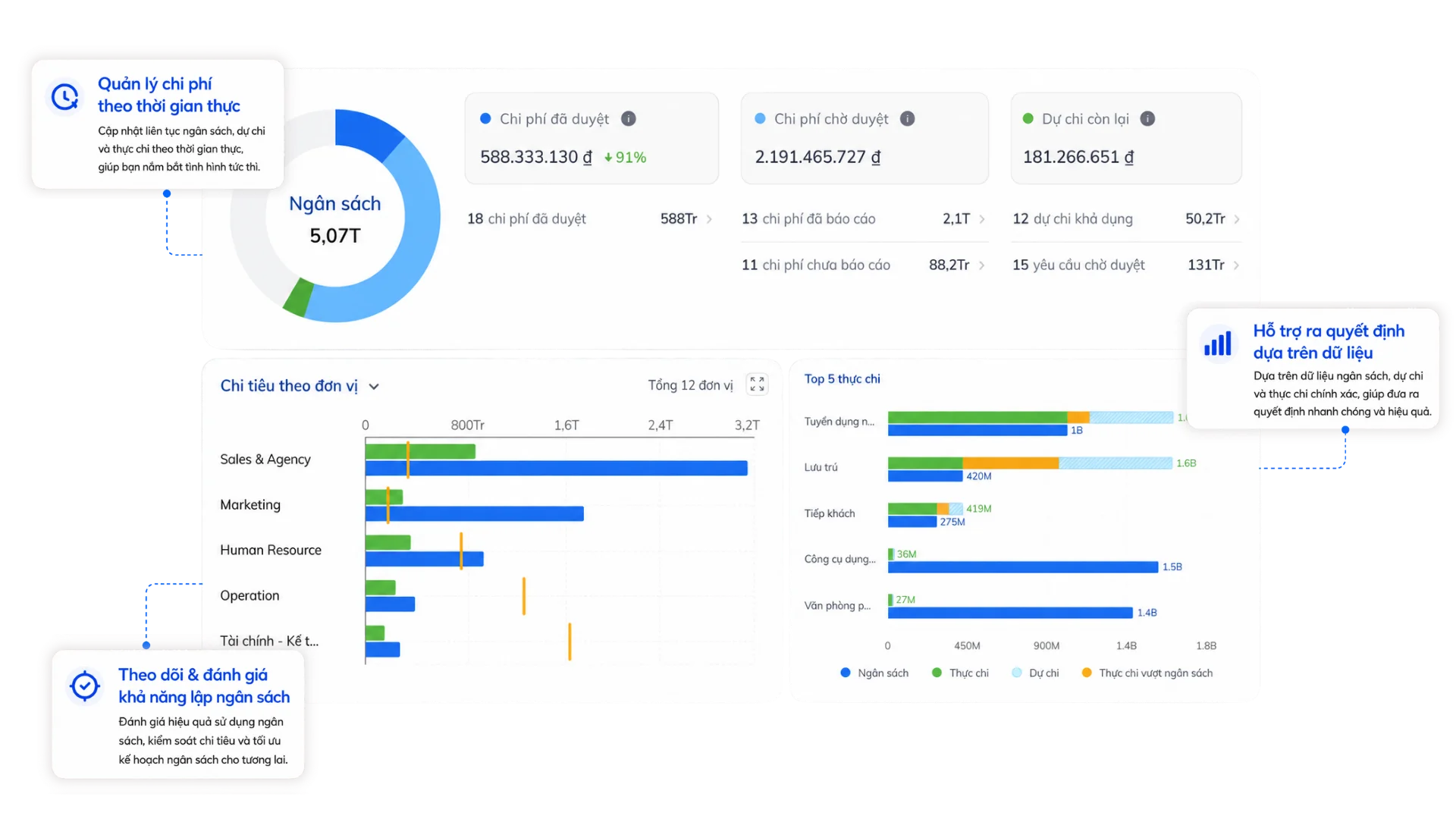
As the number of expense requests increases, maintaining three layers of control—email, spreadsheets, and manual checks—becomes resource-intensive and inconsistent. This is also the time when many businesses are considering digitizing their expense management processes with specialized systems such as Bizzi Travel & Expense, Technology helps standardize forms, enforce policies, track approvals (audit trail), centralize documentation, and assist in detecting exceptions throughout the process. However, technology only plays a supporting role in enforcement and control; contextual assessment, evidence verification, and final conclusions still need to be performed by humans.
What features does expense management software offer, and what are its limitations?
Expense management software can standardize expense requests, enforce policies, centralize documentation, and alert to exceptions, but it cannot automatically conclude that someone has committed fraud. Technology helps businesses implement control measures consistently, but assessing context, verifying evidence, and making final decisions still require the expertise of accountants, approvers, or internal auditors.
For businesses with a large number of expense requests or multi-level approval processes, handling them via email and spreadsheets often results in scattered data, difficulty in tracing, and time-consuming reconciliation. In such cases, a cost and task management solutions It can serve as a centralized platform to connect the entire process from expenditure request, advance payment, reimbursement to payment and document archiving.
Normalize data right from the start.
One of the reasons why expense fraud Another error that is difficult to detect is that each department uses a different form.
The cost management system helps standardize all requests according to a unified template, in which the applicant needs to fully declare information fields such as:
- purpose of the expenditure;
- type of expense;
- department or project;
- supplier;
- amount of money;
- Attached documents.
Data standardization helps reduce information gaps and provides a foundation for future comparison and analysis.
Implement policies and approval procedures.
Instead of relying on managers to memorize spending rules, the system can assist in enforcing rules already established by the business, such as:
- Check spending limits by job title or expense category;
- Link the expenditure to the budget or project;
- Automatically redirect to the correct approval route based on value or risk level;
- Please request additional information if your application is incomplete.
This is how policies are applied consistently across the entire company, instead of each department handling them based on its own experience.
According to official documents, Bizzi Travel & Expense It supports the digitalization of processes for requesting expenses, advances, reimbursements, budget allocation, establishing conditional approval flows, storing processing history (audit trail), data reconciliation, and synchronization with accounting systems to the extent announced by the platform. These features help businesses implement more effective control processes, but do not replace the role of human assessment.
Supports exception detection and data tracing.
Once the transaction is recorded on the same system, the business can easily:
- Compare the expenditure request, invoices, payment transactions, and budget;
- Detect requests that show signs of duplication;
- Track edit and approval history (audit trail);
- Compile reports by employee, department, project, or supplier;
- Monitor exceptional transactions for post-audit purposes.
For example, the system might alert you to two reimbursement requests using the same invoice number. However, this It's just a signal that needs further testing.. Accountants still need to verify whether it's a duplicate payment request, a valid transaction adjustment, or simply an entry error before making a decision on how to process it.
It is important to note that Data analysis (Analytics) It only helps detect anomalies; it cannot draw conclusions on its own. Expense Reimbursement Fraud good Employee Expense Fraud.
No matter how much technology helps, what else do humans need to do?
| Technology can provide support. | Humans still have to do it. |
| Check for limits and required data fields. | Assess the context of the expenditure. |
| Support for detecting duplicate or exception requests | Verify transactions and documents. |
| Save edit and approval history (audit trail) | Consider the responsibilities of the parties involved. |
| Consolidate exception reports and dashboards. | Decision to escalate the process (escalation) |
| Compare expenditure requests, invoices, transactions, and budgets. | Evaluate the evidence and draw conclusions. |
As we can see, technology helps businesses reduce manual workload, increase traceability, and enforce policies more consistently. However, No software can automatically identify if an employee has committed fraud.. The final decision should always be made based on a comprehensive assessment of the documentation, the purpose of the transaction, the context in which it occurred, and the relevant evidence.
Move on to the next section: Before investing in or upgrading a cost management system, businesses should begin by reviewing their current processes to identify missing control points. The checklist below will help CFOs and the finance department quickly assess the maturity level of their cost management processes.
Checklist for a quick review of the costing process in a business.
Begin by examining policies, authority, evidence, data reconciliation, and exception handling mechanisms throughout the entire cost cycle. The checklist below is not a mandatory standard for all businesses, but rather a self-assessment tool to help identify priority areas for improvement to reduce risk. expense fraud, Inflating expenses and Refund fraud.
| Review criteria | Have | Not yet |
| The categories of eligible and ineligible expenses have been clearly defined. | ☐ | ☐ |
| Limits have been set based on expense type or job title. | ☐ | ☐ |
| The type of documentation required for each expenditure has been specified. | ☐ | ☐ |
| The proposer and the approver are separated independently. | ☐ | ☐ |
| Compare with advances, statements, or payment transactions when necessary. | ☐ | ☐ |
| There is a mechanism to check for duplicate payment or reimbursement requests. | ☐ | ☐ |
| A complete history of edits and approvals (audit trail) is saved. | ☐ | ☐ |
| There are reports of exceptional transactions by employee or department. | ☐ | ☐ |
| There is someone responsible for monitoring and handling red flags. | ☐ | ☐ |
| There is an escalation path in place when an anomaly is detected. | ☐ | ☐ |
If the business still has many criteria at the level... “"Not yet"”, However, that does not mean the process exists. expense fraud, However, this shows that the control system may still have gaps that need improvement. Standardizing policies, increasing traceability, and digitizing approval steps will help reduce the risk of missed exceptions and support more effective control as transaction volumes increase.
Frequently Asked Questions (FAQ)
Is an invalid invoice considered a fraudulent invoice?
No. Invoices containing errors or failing to meet the requirements for use may result from operational errors or procedural violations. Only when there is additional evidence showing that the person intentionally falsified, modified, or used the document for personal gain can the element of fraud be considered.
Is exceeding the budget always considered fraud?
No. Exceeding the spending limit may arise from actual business needs or exceptional circumstances authorized by the company. This is a matter that requires explanation and review according to internal policy, and should not be automatically considered as such. expense fraud.
Can expense management software detect fraud?
Software It can help detect unusual transactions or data patterns., Examples include duplicate reimbursement requests, exceeding limits, or missing documentation. However, determining whether an act constitutes fraud still requires human assessment based on documentation, context, and relevant evidence.
What should a business do when it discovers an unusual expense claim?
Businesses should temporarily maintain a verification status rather than jumping to conclusions. Compare the expenditure request with invoices, payment transactions, budgets, advances, and related documents; and request clarification from the requester if necessary. In cases of systemic irregularities or those involving multiple individuals, refer the matter to internal auditors or a competent department for independent assessment.
Conclude
Cost fraud is an act that requires intent., Therefore, a erroneous document, an overspending, or an unusual transaction could be a cause for concern. There is not enough evidence to conclude that fraud occurred. if not fully verified. Instead of focusing on individual incidents, businesses should build a control system based on five core elements: Clear policies, appropriate approval processes, sufficient evidence, continuous data monitoring, and human evaluation..
When the number of expenditure requests is large, data is scattered across multiple systems, approval flows are multi-level, or duplicate checking and approval tracking become difficult, businesses may consider digitizing the process by Bizzi Expense Pay To standardize cost management, enforce policies, and support the consistent detection of exceptions, in cases where there is suspicion of legal violations, significant tax implications, or the need for independent investigation, businesses should collaborate with internal auditors, legal departments, or tax experts to assess and handle the matter in accordance with regulations.
To experience Bizzi's solutions for free and receive one-on-one consultation from a financial expert, register to schedule an appointment here: https://bizzi.vn/dang-ky-dung-thu/