


An efficient order receiving and processing procedure not only ensures goods reach partners on time but also determines the speed of cash flow to the business. However, maintaining a manual system with numerous data entry, manual invoice generation, and bank reconciliation operations creates a significant risk of document errors. This article will systematize the five standard process steps and analyze how automation (RPA/AI) can be applied to comprehensively upgrade the Order-to-Cash (O2C) cycle.
>> See more documents on Intelligent Automation in Order-to-Cash (O2C) Processes here
What is an order processing system in the Order-to-Cash (O2C) cycle?
The Order Processing System is a continuous chain of activities from the receipt of a purchase request to successful delivery. From a financial management perspective, it is the starting point of the entire Order-to-Cash (O2C) cycle, directly impacting revenue recognition and debt collection.
While the sales department might consider "closing the deal" to be complete, for accounting and the CFO, the process is only truly finished when cash flow is accurately recorded, matches invoices, and is fully reflected in the books. This explains why an order processing system is not just an operational tool, but also a "control point" for the entire flow of the business.
In the context of businesses with increasingly complex distribution systems, establishing a standardized process is essential to minimize errors and accelerate cash flow. In fact, most businesses today operate according to a closed five-step process.
Standard order receiving and processing procedures at the company.
A standard order processing procedure typically includes five main steps; however, the real value lies in identifying bottlenecks in manual operations – where the business's cash flow is slowing down.
In the first step, businesses receive orders and perform credit limit checks. Sales orders (SOs) typically come from various sources such as email, Zalo, or retail system portals. However, in a manual model, accountants or sales administrators must re-enter all the data into the ERP system. This is not only time-consuming but also prone to errors in SKU codes or unit prices. Furthermore, credit limit checks are primarily based on manual comparisons, lacking real-time accuracy.
In the second step, the warehouse department confirms inventory and proceeds with shipping. A common problem is that inventory data often lags behind reality, leading to the risk of inaccurate shipping or discrepancies in cost of goods sold accounting. This directly impacts financial reporting and profit margins.

In the delivery and invoicing process, after completing the delivery, the accountant will issue an electronic invoice based on the delivery documents. However, when operating manually, invoices are often issued at the end of the month, increasing the risk of violating regulations. time of invoice according to Decree 123/2020/ND-CP (amended and supplemented by Decree 70/2025/ND-CP) and current guidelines such as Circular 32/2025/TT-BTCIncorrect invoicing timing can lead to transactions being deemed non-compliant, resulting in the risk of administrative penalties and affecting the validity of tax return data. This is a common legal risk for businesses that still maintain manual processing procedures or lack real-time data connectivity.
The next step is cash application reconciliation – one of the most complex. When a customer makes a transfer, the accountant must download the bank statement and check each line to determine which order the money belongs to. This can take several days, leading to situations where the money has arrived but hasn't been recorded (unapplied cash).
Finally, there's debt management and debt reminders. In the traditional model, debt tracking is often fragmented, relying on Excel files and the accountant's memory. This makes it easy for businesses to miss overdue debts, increasing the average number of days to collect payments.DSO).
These bottlenecks not only reduce operational efficiency but also directly slow down cash flow. This is why businesses are starting to shift towards automation.
How does the Bizzi solution optimize the order processing system?
Instead of relying on manual operations, Bizzi's solution applies RPA (Robotic Process Automation) and AI technology to comprehensively digitize the order processing system, from data reception to reconciliation and debt recording.
At the order processing stage, Bizzi Bot can automatically log into retail portals or read emails to collect order data. AI technology using NLP automatically maps the partner's product codes to the internal SKU codes in the ERP system. This completely eliminates manual data entry while ensuring near-perfect accuracy.
In the invoice issuance process, the system integrates directly with the electronic invoicing platform. As soon as delivery is confirmed, the invoice will be automatically issued, ensuring compliance with legal regulations and reducing the pressure of work piling up at the end of the period.
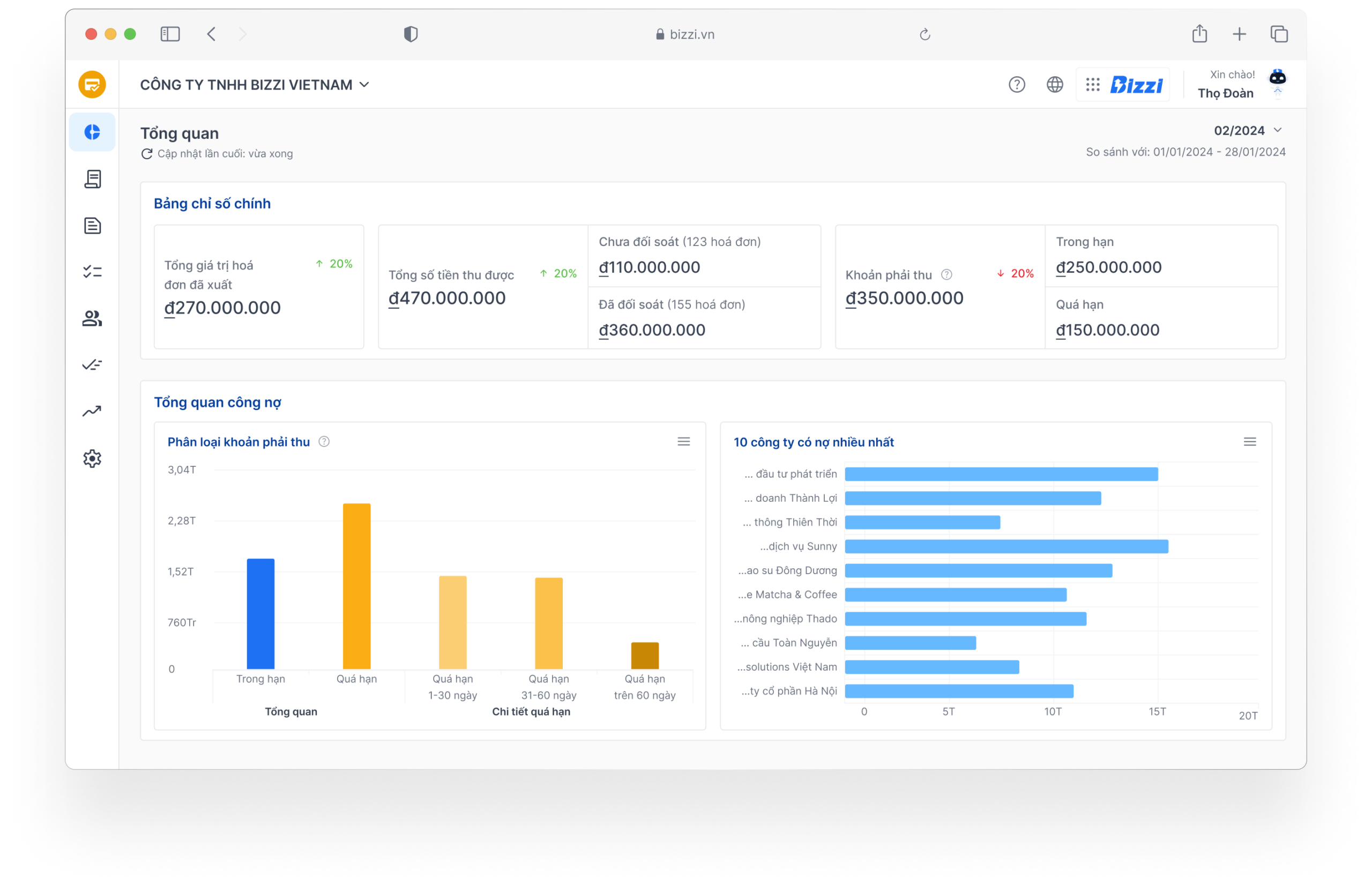
For payment reconciliation and accounts receivable management, Bizzi ARM brings about a significant change. Through Host-to-Host API connectivity with banks, the system can automatically identify incoming funds and write off debts in real time. No more manually tracking each transaction or accumulating unapplied cash.
In parallel, the system also allows for the creation of automated debt reminder scenarios via email or Zalo at specific time intervals. This enables businesses to proactively manage accounts receivable and shorten collection cycles.
More importantly, the application of automation is changing the role of accountants. Instead of performing repetitive data entry tasks, accountants are shifting to roles of exception control and data analysis – a significant step forward in modern financial management.
When automation is integrated throughout the O2C cycle, financial efficiency will be clearly reflected in management indicators.
Reference document: Reducing 80% order processing time (PO-SO) here
Comparison table of management efficiency between Manual and Automated Order Processing
Automating the Order-to-Cash (O2C) process offers significant advantages over manual processing, reducing costs and order processing time, increasing accuracy to nearly 100%, and enhancing customer experience through faster processing speeds.In contrast, manual methods are prone to errors, delays, and high management costs.
| Governance criteria | Traditional (Manual) process | Automated process (Bizzi RPA/AI) |
| SO input productivity | Manually entering 100% can easily lead to errors in SKU codes and unit prices. | AI automatically maps and directly pushes data to the ERP system with an accuracy of >99%. |
| Debt Clearing & Reconciliation (Cash Application) | Download the end-of-month statement and manually check each transaction. | Automatic debt settlement in real time via bank connection. |
| Closing date | 7–10 business days | Reduced to approximately 3 days thanks to automated accounting. |
| Accounts Receivable (AR) Management | Distributed, dependent on Excel and memory. | Intuitive dashboard, automatic debt reminders. |
Frequently Asked Questions about the O2C Order Processing Procedure
The O2C (Order-to-Cash) order processing procedure is a series of steps from order placement and delivery to payment collection. Frequently asked questions revolve around this process. Optimizing speed, reducing manual errors, managing customer credit, and automating processes with technology to increase cash flow..
How does automating the order processing system impact the DSO (Demand on Sales) metric?
Automation helps shorten order processing and invoice issuance times. When combined with automated debt collection and reminders, businesses can collect payments faster, significantly reducing the average number of days to collect (DSO).
How does Bizzi's AI solve the problem of mismatched product codes (SKUs)?
The system uses NLP technology to learn and automatically map product codes from partners (such as Co.op Mart, WinMart) to internal SKU codes. This eliminates discrepancies caused by manual data entry.
Does the software automatically record accounting entries in the ERP system?
Yes. RPA systems can automatically generate general ledger entries (GL entries) related to revenue, discounts, and accounts receivable, supporting a faster and more accurate closing process for accounting records.
Conclude
An efficient order processing and handling system is not just an operational challenge, but also a financial leverage that helps businesses accelerate cash flow and reduce the risk of errors. When steps in the O2C cycle still rely on manual operations, businesses will have to sacrifice time, costs, and accuracy.
Implementing an automated order processing system, such as Bizzi's solution, allows businesses to transition from a "manual processing" model to an "automated processing" model. This not only optimizes accounting performance but also enhances financial control capabilities at the CFO level.
In an increasingly competitive environment, businesses that better manage their cash flow will have a significant advantage. And that journey always begins with standardizing and automating order processing procedures.
To receive advice on effective corporate financial management solutions, schedule an appointment with Bizzi here: https://bizzi.vn/dat-lich-demo/