


Businesses can authorize employees to pay for goods and services on behalf of the company, but the accounting method depends on whether the company has advanced the money or the employee pays first and is then reimbursed. To ensure legal validity, the settlement documents must include all invoices/receipts, especially in cases where non-cash payments are required. This article will detail both the accounting and the latest tax conditions updated for 2026.
Before accounting, it is necessary to determine whether the employee is receiving an "advance payment" or a "payment on behalf of another employee".“

There are two situations that need to be distinguished: businesses giving employees money before purchasing goods, and employees paying with their own money upfront and then being reimbursed by the business later.
Case 1: The company transfers or delivers the money to the employee in advance.
This is a situation where a company disburses cash or transfers funds from its company bank account to an employee before the actual purchase or payment for services takes place.
In terms of cash flow, the company's money has actually left the company's fund or bank account and transferred to employees for physical holding or personal account management. Employees are holding the money to perform specific assigned tasks.
From an accounting standpoint, this is an account Advances and reimbursements. Circular 99/2025/TT-BTC continues to stipulate... Account 141 – Advances To reflect the advances made by businesses to employees and the process of settling these advances, accountants need to track the recipients and each advance payment.
Case 2: The employee used personal funds to make the payment in advance.
In this situation, the company has not yet disbursed the money. The employee uses their own personal funds to pay the seller directly. After the employee makes a valid payment and receives an invoice in the company's name, the company has an obligation to reimburse the money.
This type of transaction is completely different from advances (it's important to avoid assuming that all employee expenses are automatically recorded in account 141). Businesses need to reflect the corresponding expenses and assets and record a separate payable amount to the employee.
| Situation | Cash flow | The nature of accounting | Account group to consider
|
|---|---|---|---|
| The company provides an advance payment. | Company → Employee → Supplier | Advance | TK 141 |
| Prepaid staff | Employee → Supplier, then company → Employee | Amount the business must repay | Appropriate payables |
Accounting treatment when a company advances money to employees in advance.
When a business provides advance payments to employees for purchases or expense payments, the funds are tracked through account 141 until the employee settles the accounts.
Accounting entry when making an advance payment.
Debit Account 141 – Advances
There is account 111/112
This amount is not yet considered an expense at the time of transfer to the employee because the company is still awaiting documentation confirming the use of the funds.
When employees submit settlement documents
Depending on the nature of the goods or services, such as purchasing stationery, paying for services, or buying tools and equipment, the accounting entry will be:
Debit the appropriate inventory/asset/expense account (e.g., 152, 153, 242, 642…)
Debit the VAT account that is eligible for deduction – if conditions are met.
There is account number 141.
Handling excess or deficit advance payments.
- Pay exactly the amount of the advance payment: Account 141 balance will be automatically closed.
- The staff member returned the change: Debit account 111/112 and credit account 141.
- The actual expenses exceeded the amount advanced, and the company had to pay the difference. Debit the corresponding expense/asset accounts for the excess expenditure, Credit accounts 111/112.
Accounting when an employee pays upfront and the company reimburses them later.
When an employee uses personal funds to pay for expenses that the company had not previously provided, the accountant needs to correctly record the expense/asset and the obligation to reimburse the employee.
When recording invoices and amounts payable to employees
As soon as we receive a complete and valid payment settlement document, accounts payable Record the information:
Debit the appropriate asset/expense account.
Debit the VAT account that is eligible for deduction – if conditions are met.
Account 3388 – Other payables and liabilities
Businesses need to base their detailed accounts on the accounting system and policies currently in use. Circular 99 still stipulates accounts 338/3388 for other payables and liabilities besides those already reflected in specialized payable accounts.
When the company refunds employees
Based on Payment Request, The company will process the refund:
Debit accounts payable to employees (e.g., Account 3388)
Account 112 is available (Bank transfer preferred to meet tax requirements).
What documents are needed for an employee to process payments on behalf of the company?
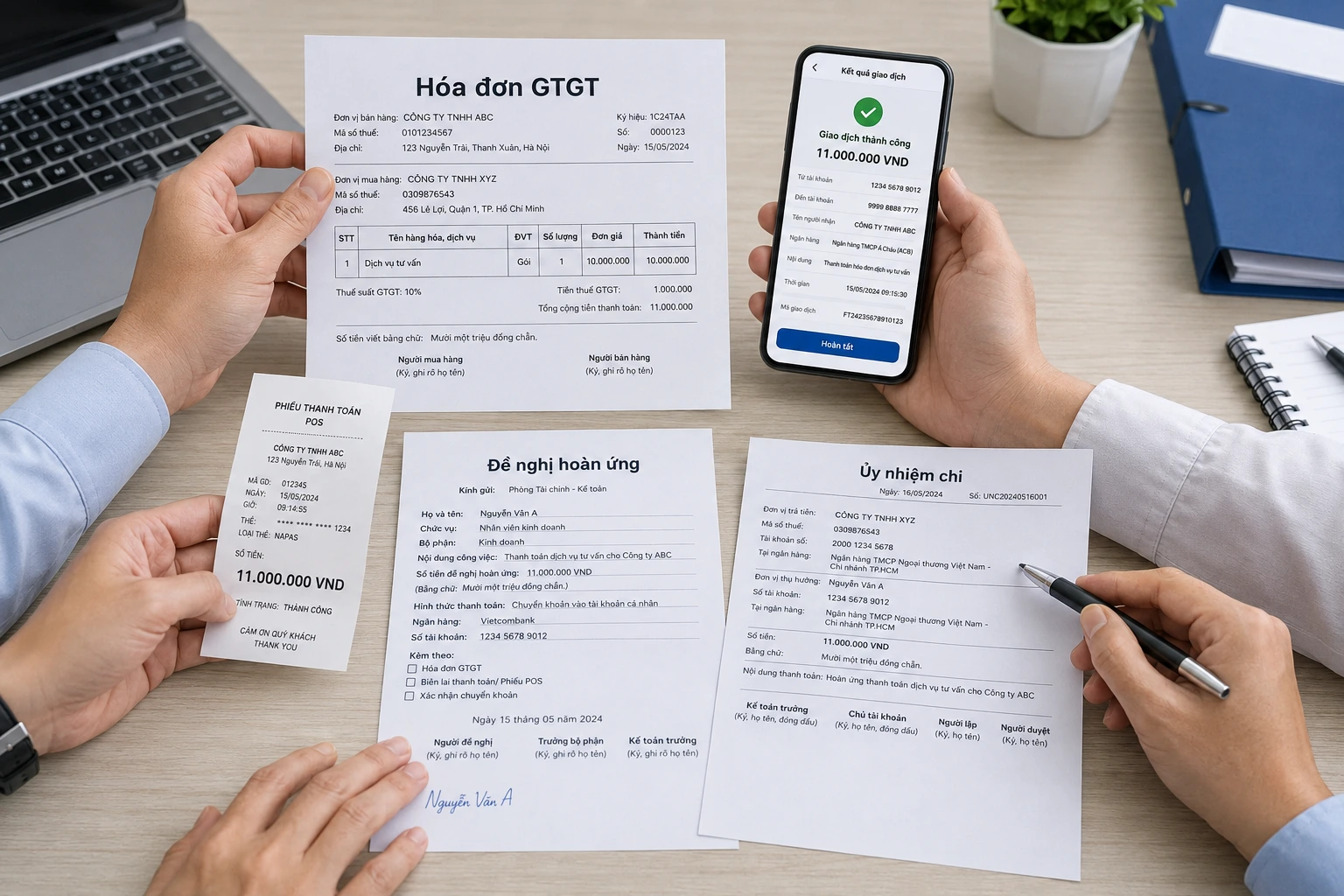
The documentation needs more than just invoices; in cases where cashless payments are required, proof must also be provided demonstrating that the employee was authorized to make the payment, and the flow of funds from the employee to the seller, and then from the company back to the employee.
- Purchase invoice/document: Transactions must serve business operations; verify the buyer's information (name, address, company tax code) and the amount must be verifiable.
- Basis for assigning or authorizing the employee: This could be a financial regulation, an internal regulation, or a company decision.
- Employee payment voucher for the supplier: Bank transactions or appropriate electronic payment documents proving the transfer of personal funds to the seller.
- Documents proving company reimbursement to employees: A cash flow trace must be established: Business → Transaction employee has been paid by the employee.
4 points to compare on a set of documents
- Buyer.
- Seller.
- The payer.
- The person who received the refund from the company.
Amounts from 5 million VND: conditions for VAT deduction.

For goods and services that are required to have certain information. non-cash payment voucher, Businesses can still authorize employees to make payments, but they must meet the conditions regarding authorization and the flow of repayment cash.
How should employees pay suppliers?
Employees are required to avoid using cash when mandated by law (transactions of 5 million VND or more). Personal bank payment documents must be verifiable and prevent transfers to the wrong recipient.
How does the company reimburse its employees?
The reimbursement must also meet the corresponding conditions by being made via bank transfer (not cash). The transfer details should help identify the reimbursement for the disbursed payment transaction.
Can multiple invoices under 5 million VND on the same day be exempt from this condition?
No. In the case of purchasing goods or services from a taxpayer with a value of less than 5 million VND but making multiple purchases on the same day with a total value of 5 million VND or more, tax deductions are only allowed if there is non-cash payment documentation.
Conditions for employee payments to be considered deductible expenses.
Regarding corporate income tax, businesses need to provide proof of expenses incurred for business operations, have valid documentation, and meet the non-cash payment requirements for cases falling within the thresholds stipulated in Circular 20/2026/TT-BTC.
Applications with a minimum balance of 5 million VND or more.
- Legitimate invoice/document.
- Regulations/decisions allow employees to make payments.
- Documents proving employee payment using non-cash methods.
- Documents showing that the company reimburses employees using non-cash methods.
In cases where the business has not yet paid at the time the expense is recorded.
At the time of expense recognition, if the business has not yet transferred the refund because the payment deadline has not arrived, the expense can still be included as a deductible expense. However, if there is no non-cash payment document by the payment deadline, the expense and VAT must be adjusted downwards accordingly.
For example, accounting allows employees to handle payments from start to finish.
Example 1. The company advances 10 million VND.
Employee A was approved for an advance payment to purchase equipment and supplies.
- 1. Advance payment: Debit Account 141 / Credit Account 112 (10,000,000 VND).
- 2. The employee pays the supplier.
- 3. Settlement of 8 million: Debit Expense/Asset and VAT Account / Credit Account 141 (8,000,000 VND).
- 4. There are 2 million left over.
- 5. Refund to the company: Debit Account 111/112 / Credit Account 141 (2,000,000 VND).
Example 2. An employee pays a bill of 12 million VND.
Employee A was authorized to purchase equipment and supplies for the company worth 12 million VND and pay using their personal account. The invoice bore the company's information. After the employee submitted all the necessary documents, the company transferred the refund.
- 1. The company has a policy/authorization for employee A.
- 2. Employee A made a personal bank transfer of 12,000,000 VND to the seller.
- 3. The accountant receives a valid invoice.
- 4. Recording the payable: Debit Expense Account, Debit VAT Account / Credit Account 3388 (VND 12,000,000).
- 5. Business refunds: Debit Account 3388 / Credit Account 112 (VND 12,000,000).
Example 3. The employee processed the payment in advance, but the paperwork was incomplete.
A transaction may generate an accounting obligation but does not automatically qualify for VAT deduction or be a deductible expense. For example, if an employee pays a 6 million VND invoice in cash, the accountant will still record the asset and liability (Debit Account 153, Credit Account 3388) because the transaction actually occurred. However, taxly, the entire expense and VAT will be disallowed due to a violation of the payment conditions.
6 common mistakes when accounting for payments made by employees.
- Use account 141 even if the business hasn't advanced the money yet: Recording a credit entry to account 141 when there is no debit balance for advances distorts the nature of the account.
- There is only an invoice, but no basis for delivery/authorization: Tax authorities may disallow expenses because the cash flow does not go directly from the business to the seller.
- The cashier will process the payment in cash when the transaction requires cashless payment.
- The company provides cash refunds to employees in cases where non-cash payment documentation is required.
- The funds are going to people who don't match the transaction profile.
- Using the old guidelines from Circular 200 without checking the 2026 accounting regulations.
Checklist for processing before the accountant records the transaction and reimburses the employee.
- Determine whether the company has advanced the money or not.
- Identify the employees who have been authorized to receive payment.
- Check the invoice/receipt.
- Verify the transaction value.
- Check the payment method.
- Compare the payer – seller – amount.
- Refunds will be processed using appropriate methods and records will be kept.
Frequently asked questions
Is it permissible for employees to use their personal accounts to pay company bills?
Yes, provided the invoice contains company information, has a payment authorization policy/decision, and the company reimburses the employee via bank transfer for invoices of 5 million VND or more.
Should the cashier use account 141 or account 3388?
Account 141 is appropriate when the business has already paid the employee in advance; when the employee pays in advance using personal funds, the obligation to pay should be recorded according to the nature of the transaction (like Account 3388) and the accounting system applied by the business. Do not choose an account simply because the transaction was performed by an employee.
Can VAT be deducted for invoices over 5 million VND paid by employees using their personal accounts?
Yes, but with certain conditions: the employee must transfer the money to the seller using non-cash methods, the business must provide written authorization, and the business must also transfer the refund to the employee's bank account.
Is it mandatory to create a separate power of attorney for each payment?
It is not mandatory to create a separate authorization form for each instance if the company already has clear regulations in its Financial Regulations or Internal Expenditure Regulations regarding the mechanism for authorizing payment on behalf of employees.
As the number of payments made through employees increases, the issue is no longer about a single transaction but about tracking the proposer, approver, documentation, reimbursement status, and payment flow. Application Bizzi Expense cost management solution This will be a strategic move for the business, helping to proactively select and tightly control options. B2B payment methods The most modern approach to optimize cash flow efficiency.
Conclude
Allowing employees to make payments on behalf of the company is not difficult from a professional standpoint, but it is only truly secure when the company has a clear authorization mechanism and a complete set of documents that can be verified throughout. From the payment request/approval, the basis for employee authorization, valid invoices, proof of employee payment, to the company's reimbursement documents, the documents need to be closely linked to prove that the correct person made the payment, for the correct purpose, the correct amount, and the correct cash flow. If any of these links are missing, the company may face difficulties in explaining, verifying, or determining the conditions for recognizing expenses and deducting taxes.
With Bizzi Expense Pay – a comprehensive enterprise expense payment and management solution – businesses can digitize the entire process from expense request → approval/authorization → payment → document collection → reimbursement → reconciliation on a centralized system. The solution standardizes records for employee payments, tracks approvals and documents for each transaction, and reduces reliance on Excel, email, and manual verification. This allows the Finance and Accounting department to control expenses more transparently, easily access records when needed, and build spending processes that better meet payment authorization and internal control requirements.
Register here to receive consultation and experience solutions from Bizzi: Bizzi Expense Pay