


Authorizing employees to pay bills exceeding 5 million VND is a common practice but carries significant tax risks. Without a robust system of supporting documents, businesses are vulnerable to rejection of VAT deductions and disallowance of expenses during corporate income tax settlements. The following content will provide a detailed analysis of current legal regulations, guidance on preparing a complete set of documents, and the development of an optimal internal control process to minimize risks for businesses.
When purchasing goods for production and business purposes arises, businesses can authorize employees to make advance payments via personal accounts, followed by cashless reimbursement. However, tax and auditing authorities will not assess the legality of the transaction based solely on a single document, such as an "authorization letter." Instead, the Finance and Accounting department must comprehensively review and verify four core elements: approval authority, the actual nature of the purchase (Commercial), proof of payment, and the reimbursement process. It should be noted that the deduction of Value Added Tax (VAT) and the accounting of deductible expenses for Corporate Income Tax (CIT) are two independent checks governed by different legal regulations. To help businesses build a safe operating environment, this article will delve into everything from legal regulations and required documentation to common mistakes, and detailed risk control processes and checklists.
Can a business be authorized to make payments of 5 million VND or more?
Businesses are fully permitted to use a payment authorization mechanism for expenses of 5 million VND or more; however, this must strictly adhere to conditions regarding cash flow and legal documentation to avoid the risk of disbursement.
In practice, it is common for employees to proactively pay for expenses such as travel allowances, entertainment costs, office supplies, tools and equipment purchases, or software registration fees. To be approved by the regulatory authority, all these transactions must be organized into a single, closed-loop chain:
Business → Employee → Supplier → Business reimburses employee
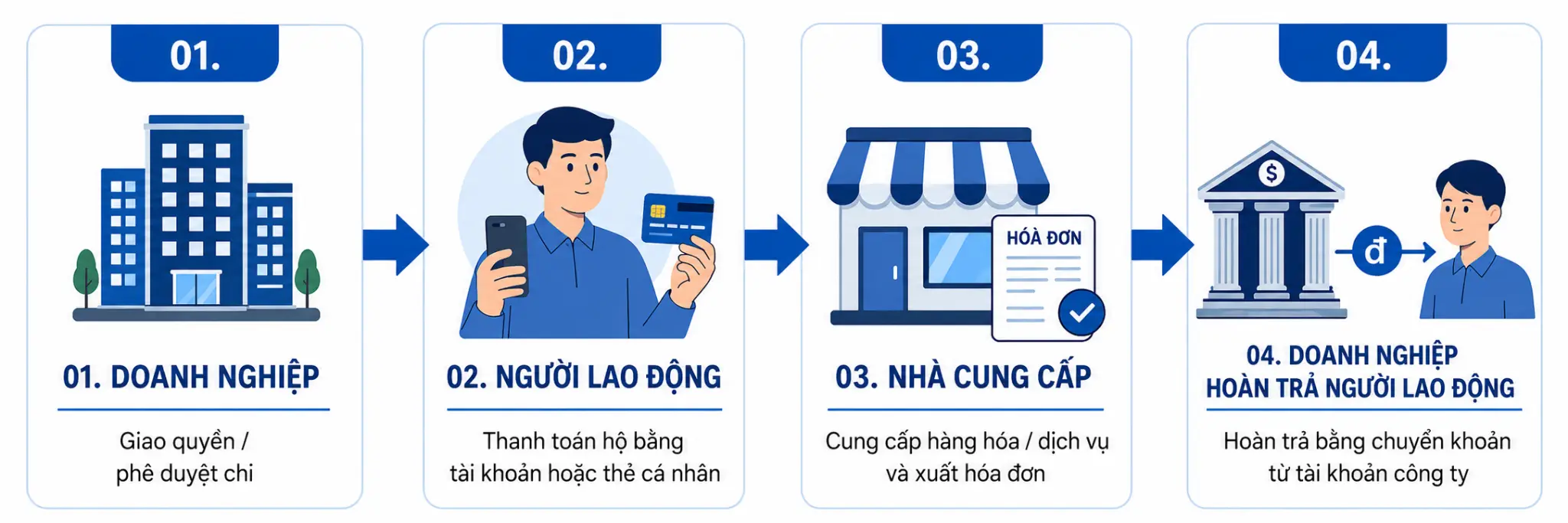
When operating this supply chain, the Accounting department needs to identify and clarify the following three core aspects:
- Who is authorized to make payments? Employees who directly interact with suppliers must be permanent employees of the company and have been legally authorized through internal regulations or specific appointment or assignment decisions.
- What payment methods are available? Both employee payments to suppliers and employee reimbursements by businesses must meet cashless standards when the transaction value reaches or exceeds a specified threshold.
- What documents are needed to prove the transaction? The documentation system must demonstrate a close and unbroken link between purchase invoices, personal payment receipts, and reimbursement transfer orders from the company account.
The person making the direct payment to the supplier is essentially just an intermediary entity representing the business in fulfilling its payment obligations. The most important thing the Finance and Accounting department needs to prove to the tax authorities is not simply the existence of the "authorization letter," but the authenticity and transparency of the entire transaction chain. If any link in the chain lacks supporting documentation, the entire expenditure of the business risks being disallowed.
Businesses can learn more about the structure and specific transaction models in commercial operations through the article on B2B payment methods.
What conditions must be met to authorize payments exceeding 5 million VND?
To ensure legal compliance and establish a safe environment for spending, businesses need to set up a comprehensive verification mechanism based on four main pillars: Authorization, Transaction Authenticity (Purchase/Commercial), Payment Proof, and Reimbursement Procedure. This is a scientific approach to internal control, not a set of separate legal conditions.
What legal basis allows employees to make payments on behalf of the company?
Any expenditure made by an employee on behalf of the organization must be based on valid internal legal documentation. This documentation includes:
- The company's financial regulations: The document clearly specifies the limits, categories of expenses that can be authorized for payment, and the positions with the authority to carry out such authorization.
- Internal spending regulations: Detailed instructions on the proposal, approval, and reimbursement process for each specific type of expense.
- Decision of the Board of Directors: These are situational decisions such as decisions to send someone on a business trip or decisions to approve procurement projects.
- Authorization or task assignment document: Clearly define the scope of authorization, the maximum amount, and the timeframe for completing the transaction.
The chief accountant or controller needs to ask the key question: Did the employee making the transaction have the proper authority to approve that type of expense, and was the expenditure within the scope of their written authorization?
How should employees pay their suppliers?
When an employee (authorized person) conducts transactions with a supplier, the payment flow must be clearly documented and fully traceable. Specifically, the following information must be detailed on the documentation:
- Payer: This matches the authorized employee information in the internal document.
- Recipient (Payee): It matches the supplier information on the value-added tax invoice.
- Payment amount (Amount): Matches the value recorded on the invoice (including VAT).
- Transaction details: Clearly state the payment is for the specific invoice or order.
- Payment evidence: Personal cards, e-wallets, or transfers from employees' personal accounts must be accompanied by clear electronic receipts or bank statements.
Businesses need to focus on demonstrating the source of funds and the strong connection between payment documents, rather than simply listing payment methods.
What should businesses keep in mind when reimbursing employees?

After employees have completed the payment process with suppliers, the business will proceed with the reimbursement step. At this stage, the business needs to pay attention to the following important control principles:
- Direct link: The reimbursement must have a direct and clear relationship to the original expense incurred by the employee on behalf of the company. The reimbursement amount must not differ from the invoice and previous payment proof.
- Required refund method: Businesses are required to use the company's bank account to transfer funds to employees' personal accounts. Cash refunds for invoices of 5 million VND or more are strictly prohibited to avoid the risk of the tax authorities disallowing the expense when calculating corporate income tax.
- Refund time: This should be done after the accounting department has fully checked, verified, and approved all supporting documents to minimize the risk of loss.
To better understand how to set limits and manage cash advances scientifically, businesses can refer to additional guidelines on... Advances and reimbursements in businesses.
What documents are required for a payment authorization form for amounts exceeding 5 million VND?
To ensure safety during tax audits and inspections, businesses need to prepare a comprehensive set of supporting documents. This set of documents must help the accounting department clearly demonstrate four key issues: who authorized the expenditure, which purchase transactions were actually carried out, to whom the money was paid, and how much the business has reimbursed.
What evidence proves that the employee is authorized to make payments?
In terms of authority and internal approval, the file must contain complete documentation proving the employee's authorization to perform the task:
- The company's financial regulations or internal spending rules may contain provisions allowing for payment authorization.
- Decisions to send employees on business trips or assign tasks must include approved spending limits.
- A purchase request or expenditure proposal must be approved and signed by the competent authority before the transaction occurs.
It is important to distinguish between "Policy authority" and "Transaction approval." The fact that financial regulations allow employees to make purchases on behalf of others does not mean that the specific purchase has been approved by the internal authority. Therefore, the documentation must include proof of the specific transaction approval.
What invoices and documents prove the actual purchase?
To prove the existence of a real economic event, a business needs to collect all relevant commercial documents related to the purchase:
- Value-added tax invoice: A valid electronic invoice must clearly state the name, address, and tax identification number of the business (buyer) and the information of the supplier (seller).
- Economic Contract or Purchase Order (Contract/PO): For transactions that are complex or of high value.
- Goods delivery and receipt record or service acceptance record: Confirm that goods have been delivered or services have been completed as agreed.
- Documents proving the business purpose: Supporting documents demonstrating that this purchase directly serves the business operations of the enterprise (e.g., event programs, work plans, work performance reports).
What documents prove that the employee has made the payment?
Employee payments to suppliers must be verified by clear documentation, with consistent information between invoices, recipients, and amounts.
- Deposit slip or transfer order: Bank statement or electronic money transfer receipt from the employee's personal account to the supplier's account.
- Supplier's payment receipt: An electronic receipt or written confirmation from the seller acknowledging receipt of full payment from the payment agent.
- POS receipt: In cases where employees use personal payment cards directly at the store.
The core comparative relationship that needs clarification is: Invoice ↔ Recipient ↔ Amount ↔ Actual Transaction.
What documents prove that the business has made the payment?
The final link to complete the cashless cash flow chain is proof of reimbursement from the company's account to the employee:
- Summary of Expense Claim Requests: The staff will compile a detailed list of expenses paid on behalf of others, along with supporting original documents.
- Approval of reimbursement by the competent authority: The Chief Accountant and Director must sign the payment request form for approval.
- Business payment authorization or transfer order: The bank documents clearly show that the company's source account transferred the reimbursement to the correct personal account of the employee who made the payment.
Businesses need to carefully manage this process to completely eliminate risks such as refunding the wrong recipient, refunding the same invoice multiple times, or the refund amount not matching the original document.
Four-layer payment document reconciliation table
The documentation system in the payment authorization file should be organized and checked according to the following four-layer verification model to ensure absolute confidentiality and security:
| Comparative class | Core test questions | Required documents |
|---|---|---|
| Authority | Who authorized this expenditure? | Financial regulations, assignment decisions, and approved expenditure proposals. |
| Commerce | What actual purchases were made? | VAT invoices, contracts, handover records, service acceptance certificates. |
| Payment | To whom did the employee pay and how much? | Personal bank transfer statement, card swipe receipt, seller's confirmation. |
| Reimbursement | What expenses did the company reimburse, and how? | Request for reimbursement, non-cash payment authorization from company account. |
How does authorizing payments exceeding 5 million VND affect VAT and corporate income tax?
Tax treatment for authorized expenditures exceeding 5 million VND requires absolute separation between two taxes: Value Added Tax (VAT) and Corporate Income Tax (CIT). Accountants cannot generally assess an expenditure as "valid" or "invalid" but must perform two separate checks based on their respective legal grounds.
Analysis of the tax impact on authorized payment transactions exceeding 5 million VND.
| Evaluation criteria | Value Added Tax (VAT) | Corporate Income Tax (CIT) |
|---|---|---|
| Purpose of evaluation | Determine the conditions for deducting input VAT on purchase invoices. | Determine whether an expense is considered a deductible expense when calculating taxable income. |
| The legal basis is closely followed. | Current Value Added Tax Law; Article 26 of Decree No. 181/2025/ND-CP and amendments in Decree No. 144/2026/ND-CP. | Current Corporate Income Tax Law; Decree No. 320/2025/ND-CP; and guidance in Circular No. 20/2026/TT-BTC. |
| Documentation requirements | There must be a VAT invoice with the company's information; and non-cash payment documents from the employee to the seller and from the company to the employee. | In addition to invoices and non-cash payment documents, a written authorization, expenditure regulations, and documentation proving the expenditure serves the business's production and operation activities are mandatory. |
| Consequences of doing it right | Businesses are entitled to deduct the full amount of input VAT shown on purchase invoices of 5 million VND or more. | The entire transaction value (excluding deductible VAT) is accounted for as a deductible expense when settling taxes. |
| Consequences when mistakes occur | The tax authorities will revoke the right to deduct input VAT from that invoice, resulting in tax arrears and penalties for late payment. | The expense was disallowed as a deductible expense, increasing taxable income and consequently increasing the actual corporate income tax liability. |
Accountants should note that Circular No. 20/2026/TT-BTC is a crucial legal basis for reviewing corporate income tax settlement documents. Meanwhile, the review of conditions for VAT deduction must strictly comply with Article 26 of Decree No. 181/2025/ND-CP and the latest amendments and supplements in effect as of the date of publication of this article.
What errors can make authorized payments risky?
In practice, businesses often encounter gaps in their documentation systems due to manual paperwork. Below is a summary of operational weaknesses that can easily lead to risks of tax authority rejection or internal financial losses:
| Operational Failure Point | The problem that arose in practice. | The legal and administrative consequences need to be assessed. |
|---|---|---|
| The authority to approve is unclear. | Transactions occur without prior approval or by individuals who do not have the proper authority to approve them. | Internal control risk; the expenditure may not be approved by the Board of Directors or its reasonableness may be questioned. |
| The recipient's information does not match. | The name of the recipient on the employee's personal bank transfer statement does not match the name of the supplier on the invoice. | Traceability risk: Tax authorities have the right to suspect that money is not being transferred to the correct supplier. |
| The invoice does not match the payment document. | The amount on the invoice differs from the amount the employee actually spent, or the transfer details are unrelated to the invoice. | Evidence risk; a breakdown in the document reconciliation chain leading to the rejection of the invoice. |
| Refunds that do not match the stated expenses. | The company reimburses employees in a general manner, without creating clear reconciliation statements for each invoice. | Reconciliation risk; accountants face difficulties in explaining the cash flow from reimbursements to auditing authorities. |
| Spending exceeding the prescribed limit. | Employees spend money beyond the permitted financial limits without exceptional approval. | Risks include cost control issues, wasting company budget, and violating internal spending regulations. |
| Double reimbursement | An employee submits an invoice or expense receipt twice to request reimbursement through different payment installments. | Direct financial loss; reflects a serious loophole in the Accounting department's control of duplicate invoices. |
Where should businesses control authorized payments?
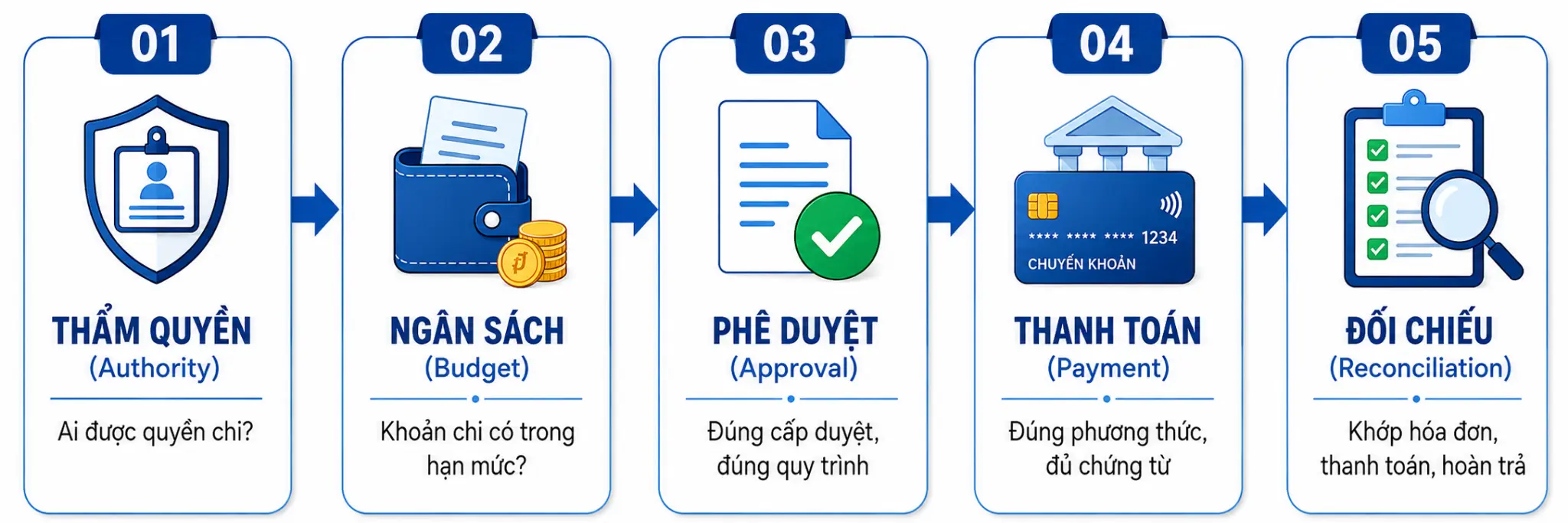
To minimize tax risks and financial losses, businesses need to establish a robust internal control system. Tax risk management must go hand in hand with operational control; tax compliance cannot replace a company's internal control system. This system should operate through five key checkpoints throughout: Authority → Budget → Approval → Payment → Reconciliation.
Who should propose, approve, and review the expenditure?
Businesses should apply the principle of Segregation of Duties (SoD) and the Maker-Checker model in expense management:
- Requester: Employees who have shopping needs prepare a spending proposal.
- Approver: The direct manager or department director reviews the necessity of the expenditure and approves it within the allocated budget.
- Payer: The employee is authorized to make payments on behalf of the supplier.
- Reviewer/Reconciler: The Accounting Department checks the legality of the documentation, executes the refund transfer order, and records the transaction in the accounting books.
This clearly defined delegation model helps prevent misuse of public funds or improper spending right from the proposal stage. Businesses can learn more about how to build this mechanism in the article about... internal control framework.
How do I link invoices, payments, and refunds?
To create an irrefutable chain of evidence before the tax authorities, the Accounting department must ensure complete payment traceability. This chain of evidence is established as follows:
VAT invoice → Employee's proof of payment → Refund request form → Company payment authorization
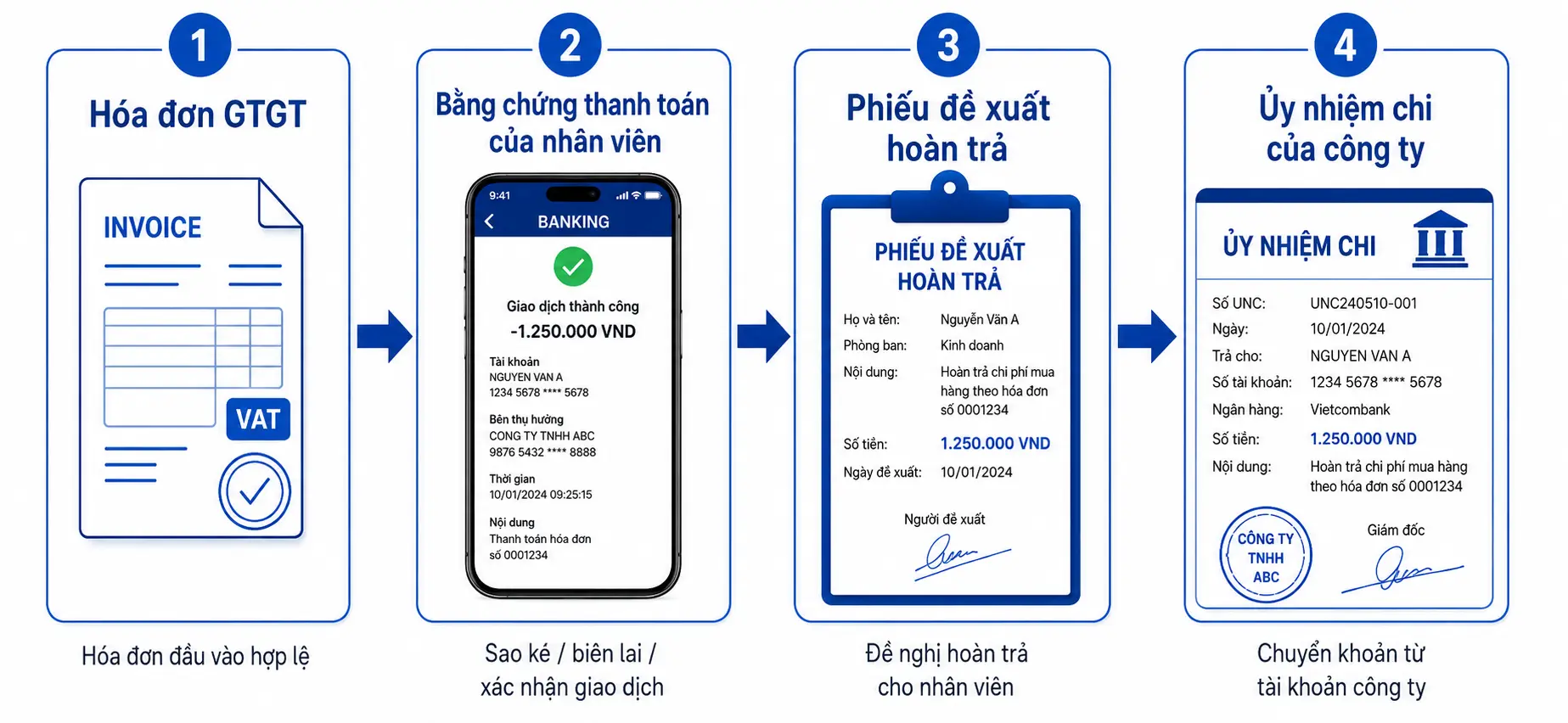
When reviewing any reimbursement transaction, the Chief Accountant must always answer the question: From the funds the company has transferred as reimbursement, can we accurately trace back the authorized employee, their actual payment transaction to the supplier, the valid purchase invoice, and the corresponding internal approval? If the answer is yes and the information matches perfectly, the company's control system is functioning satisfactorily.
To optimize this control capability, businesses should also consider the concept of Audit Trail in Finance To understand how to track cash flow scientifically.
Important note regarding internal spending limits:
The 5 million VND threshold for cashless payments as stipulated by tax laws is entirely different from the internal expenditure approval limit within a business. Businesses should not use the 5 million VND mark as the sole standard for granting approval authority. Instead, the internal approval limit for each management level should be set flexibly based on the nature of the expense, the departmental budget, personnel rank, and the organization's overall risk management policy. For example, an employee might only be allowed to independently approve entertainment expenses under 2 million VND, but could be authorized to pay up to 10 million VND for technology equipment purchases with prior approval from the department director.
How should the authorization process go from request to reimbursement?
A standardized expenditure management process should be designed as a closed loop, following sequential steps from the moment the need arises to the completion of accounting reconciliation:
Proposal → Budget Review → Approval → Authorization → Payment Officer → Document Collection → Reimbursement Request → Accounting Verification → Reimbursement Transfer → Closing Reconciliation
What should the cashier check before processing the payment?
Before processing any payment transactions, staff and direct managers need to review the following factors:
- Business purpose: Does the expenditure actually serve the overall operations of the company?
- Remaining budget: Does the department or project still have sufficient budget for this purchase?
- Internal Approval: Has the application form been signed and approved by the competent authority?
- Authority: Was the employee who processed the payment actually authorized to do so?
- Vendor information: Is the seller reputable and capable of issuing a valid VAT invoice?
- Expected amount: Does the estimated transaction value exceed the prescribed limit?
>> This pre-transaction review helps businesses proactively prevent unplanned expenses. Refer to the guide on building a system for more information. expense approval process To standardize the input checkpoint process.
What documents need to be collected after payment?

Immediately after the payment transaction to the supplier is completed, the responsible staff member must collect and hand over the following documents to the Accounting department for timely record-keeping:
- Original electronic value-added tax invoice (issued to the company email or sent as a valid XML/PDF file).
- Bank statements or transaction records proving that the funds have been successfully transferred.
- The name of the beneficiary on the personal transfer document must match the seller's information on the invoice.
- A payment receipt or electronic payment slip with confirmation from the supplier.
What verification is needed before processing the refund from Finance?
Upon receiving an Expense Claim from an employee, the Finance and Accounting department is required to cross-check the relevant documents:
- Compare Initial proposal approval ↔ Actual purchase invoice ↔ Proof of payment ↔ Proposed refund amount.
- Verify the legal validity of the invoice on the General Department of Taxation's system.
- If any discrepancies are found regarding the amount, recipient information, or missing authorized signatures, the accountant must initiate the exception review process and suspend the refund until a clear explanation is provided.
When should a business digitize this process?
Manual management methods using paper documents and Excel spreadsheets will reveal significant limitations as the business expands. Businesses should consider digitally transforming their payment authorization and reimbursement processes when the following four warning signs appear:
- Transaction frequency is increasing rapidly: The sheer volume of invoices paid by employees on behalf of others each month is overwhelming the Accounting department.
- The approval system is complex: The expenditure approval process involves multiple levels of management and numerous branches, leading to delays and the loss of documents.
- Distributed document storage: Difficulties exist in collecting, verifying the validity of, and centrally storing electronic invoices and transfer documents from employees.
- Reconciliation and reimbursement process is lengthy: Manual reconciliation is time-consuming, prone to errors, and causes delays in refunds, leading to financial difficulties for employees.
As the number of expenses paid by employees increases, the real challenge is no longer simply maintaining a complete set of individual paper records, but rather the ability to manage the entire process from expense request and limit approval to automated reimbursement. This is when businesses need to evaluate and implement centralized expense management solutions to synchronize the process.
Solution Bizzi Expense This is a powerful tool that helps businesses automate this entire process. The system supports cost management, real-time budget control, digitizes the spending proposal approval flow, tightly manages advances/reimbursements, and optimizes the operational efficiency of the Accounting department.
Businesses can learn more about how to optimize operations in the article about Manage expenses with Bizzi Expense.
Checklist for reviewing payment authorizations over 5 million VND.
To assist the Finance and Accounting department in self-checking the safety of authorized expenditures, businesses can apply the following three-tiered review checklist:
First layer: Legal compliance
- [ ] Has the company issued internal financial regulations or expenditure regulations that clearly stipulate the mechanism for authorizing employees to make payments on behalf of others?
- [ ] Do you have the original VAT invoice with the correct and complete information including the company's name, address, and tax code?
- [ ] Has the employee paid the supplier via bank transfer or personal card (not cash)?
- [ ] Has the company reimbursed the employee via cashless transfer from the company's bank account?
- [ ] Have the conditions for VAT deduction and the conditions for deductible expenses in corporate income tax settlement been separated and tested independently?
Second layer: Internal control (Control)
- [ ] Is the actual expenditure incurred within the approved budget of the department/project?
- [ ] Does the person approving the expenditure and reimbursement proposals have the proper financial authority within the company's hierarchical structure?
- [ ] Were any signs of conflicts of interest or misuse of internal spending regulations detected?
- [ ] Have separate approval reports been prepared for cases of exceeding spending limits or exceptional expenditures?
Third layer: Traceability
- [ ] Does the seller's information on the VAT invoice completely match the recipient's information on the employee's personal bank transfer statement?
- [ ] Does the refund amount on the company's transfer order match the payment request summary and the attached original invoices?
- [ ] Has the electronic invoice been marked with the status "Refunded" in the accounting system to prevent the risk of employees requesting a second refund (duplicate refund)?
- [ ] From any bank refund document, can an accountant quickly trace back to the personal transfer document, the input VAT invoice, and the approved expenditure proposal?
Frequently Asked Questions about Authorizing Payments Over 5 Million
Can employees use their personal accounts to make payments?
Have. Employees are fully permitted to use their personal accounts, personal credit cards, or other personal electronic payment methods to pay suppliers on their behalf. This transaction is approved by the tax authorities as a valid cashless payment, provided that the company subsequently reimburses the employee via cashless bank transfer from the company's account to the employee's personal account.
Is it mandatory to create a separate authorization letter for each expenditure?
Optional. Businesses do not need to create a separate "authorization document" for each small transaction. Instead, they can stipulate this authorization mechanism generally in their Financial Regulations, Internal Spending Regulations, or by issuing a Decision on sending personnel on business trips or a Decision assigning personnel to perform procurement tasks. As long as these documents clearly define the scope of work, spending limits, and are signed and approved by the legal representative or authorized person.
Even with a written authorization, what if the cashier handles the payment?
The costs and input VAT will be disallowed. Even if the business has prepared all the necessary authorization documents or internal regulations, if an employee pays the supplier directly in cash for invoices of 5 million VND or more, that transaction violates the regulations on non-cash payment documents. Therefore, the business will be denied input VAT deduction and will not be able to include this expense as a deductible cost when settling corporate income tax.
Can the company pay employees in cash?
Absolutely not. For invoices of 5 million VND or more that are paid by employees on behalf of the company, businesses are required to reimburse the employees by transferring the money from the company's bank account to the employee's personal account. If the business uses cash to reimburse (advance) directly to the employee, the cashless payment chain will be broken, and this expenditure will be immediately disallowed by the tax authorities during an audit.
How should multiple invoices under 5 million VND on the same day be handled?
Businesses need to pay special attention to regulations regarding the purchase of goods and services from the same supplier on the same day. If a business makes multiple purchases under 5 million VND from the same supplier on the same day, but the total value of all invoices combined is 5 million VND or more (including VAT), then all these invoices must be paid using non-cash methods. Therefore, if employees pay these invoices with personal cash, the business will still be subject to tax and expense deductions according to regulations.
What if the tax records are complete but the internal approval is incorrect?
Even if a company's documentation fully meets tax law requirements (including invoices, financial regulations, and matching transfer documents), but violates internal approval procedures (for example, employees exceeding spending limits without prior approval, or approving expenses outside the manager's authority), the expenditure may still be accepted from a tax perspective. However, the company will face serious internal governance risks, potentially leading to asset losses, budget waste, and loss of control over cash flow.
How can I avoid paying twice for the same expense?
To prevent the risk of double reimbursement, businesses need to implement the following control measures simultaneously:
- Implement a centralized electronic invoice storage and reconciliation system, automatically checking the status of the invoice code (UUID/tax authority code) as soon as an employee submits a refund request.
- Establish a policy requiring employees to attach the original electronic invoice file (XML format) and a screenshot of their personal transfer document to the approval system.
- Utilizing modern technological solutions such as Bizzi Expense The system will automatically cross-reference and immediately alert you if it detects that an invoice has previously been used to create a reimbursement request or payment.
Conclude
Authorizing payments exceeding 5 million VND requires not only proper authority but also ensuring that the payment method, approval, and documentation are verifiable throughout. As the number of transactions increases, manual management can easily lead to missing documentation, discrepancies in reimbursements, and difficulties in tracing cash flow. This is also when businesses can shift from a "pay first - check later" model to a mechanism for controlling expenses from the outset with Bizzi Expense Pay – a business payment and expense management solution.
Bizzi Expense Pay helps businesses connect the expense request process → approval → credit limit/payment method allocation → payment → document collection → reconciliation into a centralized management workflow. This allows businesses to clearly control who is authorized to spend, how much they can spend, what the expenditure serves, and which documents need to be supplemented after the transaction, while reducing reliance on employees using personal funds for reimbursement.
Register here to receive consultation and experience solutions from Bizzi: Bizzi Expense Pay