
The process of preparing financial statements begins with closing the accounting period, selecting the correct accounting method, and reconciling the books; the forms are created after this data has been agreed upon. Even a balanced financial statement can be flawed if revenue is recorded in the wrong period, liabilities are offset, or cash flow is derived directly from profit.
To expedite the process while maintaining control over the data, accountants need a list of input documents, designated personnel for each item, and pre-signing checks. The following procedure applies to the preparation of corporate financial statements; the specific forms and submission obligations must comply with the regulations, accounting period, and type of entity.
Choose the correct period and accounting method before obtaining the form.
The year of submission does not determine the accounting treatment of the report. Please specify the start and end dates of the fiscal year and the chosen mode. Reports for 2025 submitted in 2026 will not automatically be converted to Circular 99 simply because the submission date falls into a new year.
Financial statements provide information about assets, liabilities, equity, operating results, and cash flow. Managers use this information to assess efficiency, solvency, and capital needs; regulatory authorities, investors, and lenders use it for their own purposes. The data in the reports must be based on audited accounting records and documents.
| Case | It needs to be determined | Points of confusion |
|---|---|---|
| Businesses apply the corporate accounting system according to Circular 99/2025/TT-BTC. | The circular takes effect from January 1, 2026, and applies to fiscal years beginning on or after this date. | Do not use the 2026 form to replace the names on reports from the previous fiscal year. |
| Small and medium-sized enterprises | Check the applicable regulations, such as Circular 133; if Circular 99 is chosen, apply it consistently for at least one accounting year and process comparative information when converting. | Circular 99 replaces Circular 200 within the scope of its implementing provisions; it does not require all businesses currently applying Circular 133 to immediately switch to Circular 99. |
| Micro-enterprises are governed by Circular 58/2026/TT-BTC. | Circular 58 takes effect from July 1, 2026, and applies to fiscal years beginning on or after July 1, 2026; it also specifies the method for calculating corporate income tax. | It is not the case that all micro-enterprises are exempt from reporting, nor is it the case that forms can be changed within a fiscal year based solely on the effective date. |
| Credit institutions or entities with specialized regulations | Compare industry guidelines and specific requirements for preparation, auditing, publication, or submission. | Do not apply the standard business form and process exactly as is. |
If a conversion is required, the accountant needs to check the opening balances, the classification of indicators, and comparative data. Simply renaming columns or report codes in an old file does not replace the conversion process. Record the decision to apply and the processing method so that reviewers can verify it.
What does a financial report consist of, and where does the data come from?
For businesses applying Circular 99 and meeting the going concern assumption, the annual financial reporting set includes four reports: B01-DN, B02-DN, B03-DN, and B09-DN. Changes in equity capital are information that must be presented according to the relevant requirements; this does not mean that a separate, independent fifth report is mandatory for every business.
| Report | The question has been answered. | Sources and key tests |
|---|---|---|
| B01-DN – Financial Statement | At the end of the period, what does the business have and what sources of funding does it receive? | Account balances, details of liabilities, inventory, assets, and payables; total assets must equal liabilities plus equity. |
| B02-DN – Business Performance Report | During the period, how does the business generate revenue, incur expenses, and determine profit/loss? | Record revenue, cost of goods sold, expenses, and adjustments; check the recording period, deductions, and corporate income tax. |
| B03-DN – Cash Flow Statement | How does money increase or decrease from business, investment, and finance? | Cash data and analytical tables are based on a standardized methodology; profits are not simply copied to cash flow statements. |
| B09-DN – Explanatory notes to the financial statements | On what policies, details, and conditions are aggregate numbers formed? | Accounting policies, detailed statements, and information requiring explanation; the explanatory notes must match the main report. |
Account balances (B01) reflect a specific point in time, while B02 and B03 reflect developments during the period. Therefore, when comparing, both the time period and the unit of measurement must be checked. Account balance tables help summarize accounting data but do not automatically provide all the necessary explanations, contract conditions, or cash flow classifications.
With Circular 133, use the corresponding forms and requirements of that regime; do not apply the B01-DN code from Circular 99 to the DNN report. For micro-enterprises under Circular 58, Article 10 stipulates two reports, B01-DNSN and B02-DNSN, for businesses paying corporate income tax on taxable income. In cases where corporate income tax is paid as a percentage of revenue, there are separate regulations regarding whether or not these reports are mandatory for submission and whether or not they are required for management purposes. The correct tax method and regime should be considered, not just the size of the enterprise.
This scope is defined in Articles 10 and 12. Circular 58/2026/TT-BTC. If the unit has more complex transactions or management requirements, assess the permitted mode and apply it consistently. The list of reports to be generated should be determined according to that mode.
Distinguish between individual reports, aggregate reports, consolidated reports, and management reports.
Separate reports reflect the scope of a single business; reports with subsidiaries require processing data across the entire enterprise and internal transactions as per regulations. Consolidated reports have the specific scope and exclusion entries of the group. Do not mechanically add up the assets and revenues of the companies and consider that as a consolidated report.
Management reports can be divided by month, department, project, or product to support operations. They supplement financial statements but do not replace the mandatory set of reports. Mid-year reports are also not simply annual reports with a relabel: the period, full/summary format, and preparation obligations must comply with the requirements applicable to the entity.

How to prepare a financial report in 8 steps that can be verified.
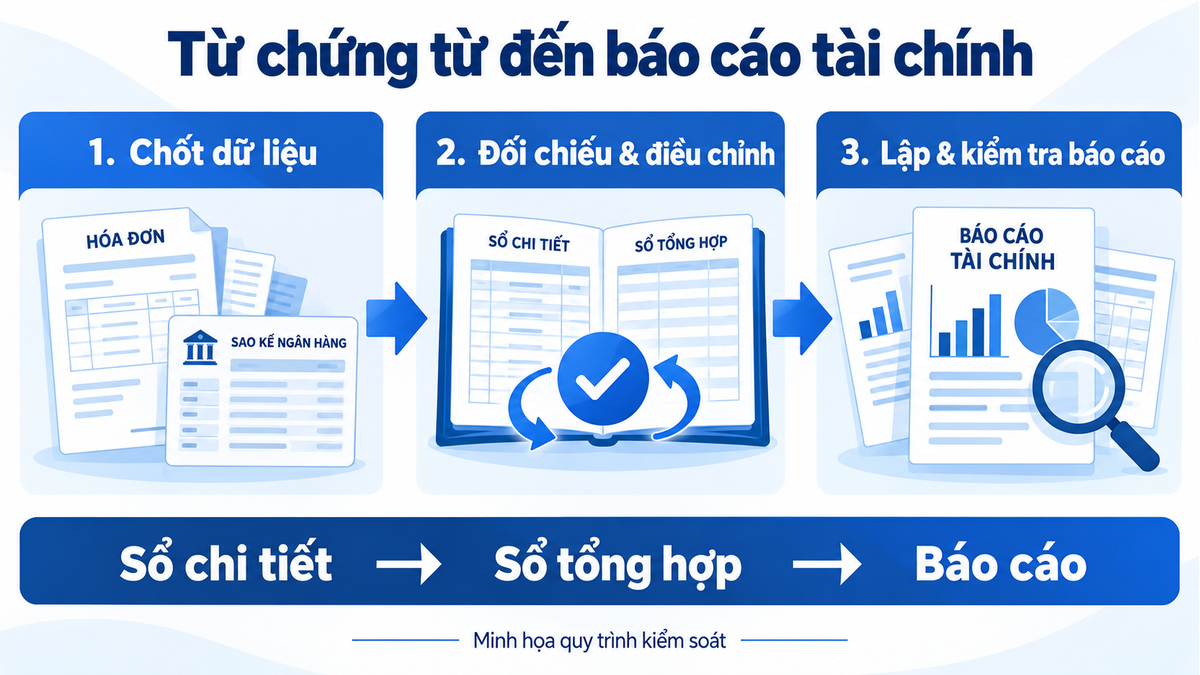
Each step requires an output and an accountability mechanism; only move to formmaking after any material deviations have been addressed. Businesses can adjust schedules and assignments according to their size. Regularly preparing and cross-checking documents reduces the need to search for documents or correct figures close to the submission deadline.
Step 1. Finalize the period, scope, and list of documents.
Confirm the reporting period, accounting method, currency, scope of subsidiaries, and audit requirements, if any. Schedule the receipt of documents from purchasing, sales, inventory, human resources, and related departments; specify the person handing over the documents and the deadline for internal processing.
The input list typically includes invoices, contracts, delivery/acceptance records, receipts, bank statements, payrolls, asset records, allocation tables, inventory records, and debt confirmations. Mark documents that are available, missing, or in dispute. A valid invoice does not prove that the entire value is recorded as an expense in the current period.
Output: The list of records is organized by category, and there is a backlog of records that are being processed. Documents are linked to transactions in the ledger so that reviewers can retrieve records, even if the documents were received via email.
Step 2. Complete the transaction recording within the correct period.
Compare the supporting documents with the actual transaction, the delivery or acceptance date, and the applicable accounting policies. Verify ending revenue, goods received without invoices, advance payments, prepaid expenses, and unsettled advances. Transactions close to the closing date should be reviewed both before and after that date.
For example, paying for a service in a later period does not mean the entire expense is a current period expense. Conversely, an obligation that has already arisen needs to be evaluated based on the recognition basis, even if the payment documentation is incomplete. Accountants need to clearly record the recognition basis and track the required documentation, while also assessing the impact of the incomplete payment on the financial statements.
Output: The journals and detailed records are updated, with each unprocessed item having a reason and a plan to be considered by the competent authority.
Step 3. Reconcile cash, accounts payable, inventory, and assets.
Reconcile cash with inventory, and bank deposits with statements; identify bank fees, funds in transit, or transactions that are under-recorded. For accounts payable, check each customer, supplier, contract, and payment deadline. Track debit and credit balances separately for each entity to ensure proper classification and presentation in reports.
The warehouse needs to reconcile the quantity and value in the records with the physical inventory, and handle shortages, surpluses, and slow-moving goods based on appropriate documentation. Fixed assets must match the asset register, including the date of commissioning and depreciation. For accounts receivable, confirmation and handling of discrepancies can be organized accordingly. debt reconciliation statement, instead of just confirming some sums with unknown objects.
Output: The reconciliation statement should include discrepancies, their causes, accounting entries or processing records, and the approver. Discrepancies with unclear causes require further reconciliation before a processing entry is decided.
Step 4. Prepare adjusting entries and end-of-period spreadsheets.
Review the allocation of prepaid expenses, depreciation, accrued expenses, provisions, and monetary items denominated in foreign currency according to the conditions of each transaction. Each spreadsheet should include the beginning balance, increases/decreases during the period, recognition amount, ending balance, and reference documents.
Do not set aside a reserve rate or use a single exchange rate for all items simply because the software allows it. Verify the basis, policies, and requirements of the applicable regime. If using estimates, record the data and assumptions so that they can be explained.
Corporate income tax requires a separate reconciliation statement between accounting profit and the tax base. Expenses that do not meet the conditions for deduction when calculating corporate income tax are not automatically removed from accounting expenses. When interest expenses or related-party transaction expenses arise, the corresponding tax conditions should be reviewed instead of applying a general adjustment for all businesses.
Output: The adjusted spreadsheet includes checked journal entries and an explanation of the impact on the report.
Step 5. Transfer, close the books, and check the trial balance.
Perform closing entries in accordance with the company's accounting system and procedures. Review the total debit/credit transactions, beginning balances, ending balances, and reconcile them with the detailed ledger. Examine accounts with unusual balances, manual entries made near the end of the period, intermediate accounts, or long-standing outstanding accounts.
A balance sheet doesn't prove that every transaction was correct: mistakenly recording both accounts or omitting a transaction can still produce a balance sheet. Reviewers need to check the nature, recording period, and completeness, not just look at the total debits equaling the total credits.
Output: The locked data includes version numbers, closing times, and approvers. If errors are discovered after closing, make adjustments with a traceable record and then recreate the affected reports.
Step 6. Prepare each report and finalize the explanatory notes.
Create a linked account table, detailing the balances for each reporting item. For accounts with multiple entries or balances on both sides, a detailed analysis is necessary before classifying them as short-term/long-term or assets/liabilities. Do not include the net balance directly in a single item simply to reduce the number of operations.
Table B02 is prepared from revenue, income, and expenses for the correct period; Table B01 from classified balances; Table B03 from cash flow data and adjustments to suit the preparation method. Table B09 explains policies, item details, transactions, and information to be disclosed. Profit, cash, liabilities, and equity must be linked across the tables.
If creating in Excel, you need to control linked tables, formulas, and manually entered cells. Instructions Prepare financial reports in Excel and check data linkage. This helps in practicing the tools; the template file must still comply with the company's regulations and not replace the business performance assessment.
Output: The complete set of forms includes comparative data and explanations; each key indicator can be traced back to a ledger or spreadsheet.
Step 7. Cross-check and approve
The reviewer compares the figures on the report with the locked ledger and supporting tables. They also check business information, units of measurement, period, form, opening balance, and comparison figures; these errors can render the report unusable even if the additions are correct.
Analyze changes in revenue, cost of goods sold, expenses, accounts receivable, and inventory compared to the previous period. Provide explanations when figures change significantly, but do not assume all changes are errors. Distinguish between changes due to business operations and errors in classification or recording.
Output: The checklist is signed/reviewed and a list of issues addressed is provided. The audited entity must allocate time for the audit and address any necessary adjustments before finalizing the required documentation.
Step 8. Sign, submit, and save the correct version.
Only sign after the final approved version has been finalized. Verify the preparer, chief accountant or accounting manager, and legal representative as per applicable regulations. When submitting electronically, compare the submitted file with the signed/approved version; do not use a file exported before the final revision.
Save the report, explanatory notes, audit report (if any), spreadsheets, ledger data, and system notification upon receipt of the application. The file upload status is not sufficient to conclude that the application has been accepted.
Output: The records can identify who approved which document was submitted, when, and the outcome of its acceptance.
When you need to review submitted documents or compare them with the published information, please Search for financial reports by source, period, and version. before using the data.
For example, checking profit, cash, and accounts receivable.
Profit did not equal the amount of money collected during the period. A simple hypothetical example helps detect errors in recording revenue based on cash receipts or creating direct cash flows from the income statement.
Assume the business starts the period with 50 million VND in cash and 50 million VND in equity, with no debt. During the period, it provided services and recorded revenue of 100 million VND, receiving 60 million VND; service expenses for the period were 70 million VND and have been fully paid. To illustrate the relationship between the three statements, for example, ignore taxes, depreciation, and all other transactions.
| Content | Calculation, million VND | Check |
|---|---|---|
| Pre-tax profit as assumed | 100 − 70 = 30 | This reflects revenue and expenses, not cash remaining. |
| Ending accounts receivable | 100 − 60 = 40 | Customer details and acceptance records are required. |
| Net operating cash flow | 60 − 70 = −10 | The business is profitable. |
| Ending balance | 50 − 10 = 40 | Match the opening balance plus cash flow. |
| Assets and liabilities at the end of the period | Cash 40 + Accounts Receivable 40 = Capital 50 + Profit 30 = 80 | Assets = Liabilities 0 + Equity 80. |
If the report shows an ending balance of 80 million VND simply because profit was added to the beginning balance, the outstanding receivables need to be checked. If receivables are zero while the customer has only paid 60 million VND, review the records and reconcile with the customer. In the actual situation, taxes, prepayments, payables, and other transactions must be added before drawing any conclusions.
When assessing the ability to pay based on accounts receivable and inventory, it is necessary to link the report to the cash flow schedule. How to calculate and manage working capital It helps to distinguish short-term assets from real cash that can be used for payment.
Checklist and troubleshooting guide for common errors
Verify the information in the report, first in the ledger, then in the supporting documents. When discrepancies are found, correct them at the source and repeat the affected tables; do not adjust the total cell on the report alone to make the numbers match.
| Token | Inspection location | How to handle it |
|---|---|---|
| Total assets are different from total capital. | Beginning balance, linking of items, classification of debit/credit balances, addition formula. | Reverse the difference; do not transfer the difference to any single account. |
| Accounts payable on form B01 differ from the detailed ledger. | Details for each item, upfront payment, term classification, and offsetting. | Separate the discrepancies correctly and handle the discrepancies with the counterparty. |
| The ending balance on B03 is different from B01. | The scope includes cash/cash equivalents, business/investment/financing flows, exchange rate effects, and non-cash transactions. | Compare each transaction; do not treat non-cash transactions as income or expenses. |
| Profit and equity are not linked. | Transfer, profit distribution, capital contribution, other adjustments, and explanatory notes. | Create a table showing the changes according to each cause, and do not consider every capital increase as a profit. |
| Other explanations besides the main report. | Unit of measurement, period, file version, and detailed table. | Update the system synchronously after adjustments, and double-check the comparison numbers. |
| The ledger and reports balance, but there are unusual revenue/expense figures. | Documents related to closing dates, internal transactions, duplicate entries, or omissions. | Testing for functionality and completeness; numerical balance does not replace substantive testing. |
Before finalizing, check the following principles: honesty and reasonableness; consistency; comparability; appropriate classification; no arbitrary offsetting; consideration of going concern capability; and sufficient disclosure of material information. For each criterion, the reviewer should compare the recording and presentation of material items.
If there are signs of cessation of operations or inability to continue business, the basis for preparing the report and disclosures needs to be assessed. Dissolution, bankruptcy, or transformation does not automatically exempt the preparation of financial statements: Circular 99 requires the preparation of reports at the time of reorganization or termination, depending on the circumstances. The assessment of assets, liabilities, and the going concern assumption needs to be handled separately.

What should you check regarding the submission deadline, signatures, and electronic documents?
For businesses applying Circular 99, Article 25 stipulates that annual financial statements must be submitted to the competent authority no later than 90 days from the end of the fiscal year. Do not apply a March 31st deadline to all fiscal years, or grant state-owned enterprises a default of 120 days. Mid-year reporting deadlines and specialized obligations must be examined separately.
The parent company or corporation needs to establish a schedule for receiving reports from its subsidiaries to allow sufficient time for consolidation/aggregation. Internal schedules should generally be earlier than the final submission deadline; the number of days for contingencies depends on transaction volume, audit requirements, and approval schedules. Businesses applying different reporting systems need to determine the submission deadline according to the corresponding regulations and clearly state this deadline in the closing schedule.
For micro-enterprises required to prepare and submit tax returns according to Article 10 of Circular 58, the deadline is 90 days from the end of the accounting year. The scope of obligations depends on the corporate income tax calculation method and the conditions mentioned above. Being newly established, not generating revenue, or having few invoices does not automatically create a general exemption.

The control procedure when submitting documents through the electronic portal.
The interface, format, and method of submitting documents may change. When submitting to the tax authority, access the official portal as instructed by the tax authority for businesses. Before uploading files, check the document type, reporting period, and template set that the system accepts.
- Prepare the approved version: Select the correct business, period, mode, and version of the report; prepare the explanatory notes and supporting documents as required.
- Check the exported file: Compare the criteria in the XML or required format with the reviewed version; check the entity name, tax code, and comparison number.
- Select the correct profile on the portal: Confirm the report type and period, then upload the file and handle any format errors. Don't just change the file extension.
- Signed and sent by the authorized person: Verify the digital signature, the authorization of the sender, and the final document set before submitting.
- View results and save evidence: Record the transaction code, submission time, receipt/acceptance notification, or request for additional information. If rejected, identify the reason and resend the correct version, keeping a record of all submissions.
Submitting to an agency does not automatically fulfill all obligations regarding recipients, auditors, or disclosures. Accountants should maintain a list of recipients applicable to the entity, responsible persons, and the results for each recipient. The records must be sufficient for reconciliation between signed copies, submitted copies, and final ledger data.
Acts of incorrect filing, late submission, or failure to fulfill obligations may be subject to penalties as applicable. When assessing a violation, it is necessary to identify the act, the subject, and the valid penalty document; a simplified penalty schedule should not be used to draw conclusions for all cases.
Work faster with controlled data and the right tools.
The software helps to aggregate and link data; however, the responsibility for checking business processes, procedures, and approvals remains with the company. Excel may be suitable when the number of transactions and editors is small, with clear table linking and cross-checking. When there are many entities, multiple versions, or multiple users entering data, it is necessary to evaluate the accounting software and closing procedures with access control, edit history, and traceability from transaction indicators.
Before choosing a tool, test it with a real dataset: two-party accounts payable, prepayments, non-cash transactions, and post-closing adjusting entries. Review the report, notes, and comparative information after adjusting the data. When evaluating a tool, prioritize its ability to retrieve accurate data, cross-check data, and generate a complete set of reports according to the applicable reporting mode.
After completing the financial statements, businesses can analyze actual costs versus planned costs, cost of goods sold fluctuations, and profit margins. Evaluating individual departments, products, or projects requires detailed records and supporting management reports; the total figures in the financial statements alone do not adequately explain the reasons for cost overruns. Analysis by department, product, or project should be tracked separately and compared with the total figures in the financial statements.
At the beginning of the process, scattered purchase documents cause accountants to waste time searching for invoices, checking for duplicate transactions, and resolving discrepancies with inventory or purchasing. This step can be improved before replacing the entire reporting system: standardizing receiving channels, data references, the person handling discrepancies, and the timing of handover to the accounting ledger.
Do input invoices need to be standardized before the closing date? Bizzi assists in collecting, verifying, and reconciling invoices with purchase orders and receipts in the accounts payable process. Businesses need to confirm the data source, reconciliation rules, and how to connect with the accounting system during implementation. Accountants then continue to check transactions, prepare, and sign financial statements on the accounting system according to applicable regulations.
Frequently Asked Questions When Preparing Financial Statements
Can newly established companies or those without revenue omit financial statements?
There is no general exemption simply because a business is newly established or has not yet generated revenue. The first accounting period, applicable regime, and specific regulations must be determined. The business may still have capital contributions, deposits, expenses, or liabilities that need to be recognized. For micro-enterprises, further examination of the tax calculation method and scope under Article 10 of Circular 58 is required.
If a company is established in December, is it required to prepare a report for that year immediately?
It is necessary to compare the regulations regarding the first accounting period and the possibility of combining periods when legal conditions are met; do not automatically assume exemption or always require a separate set of documents based solely on the establishment month. Record the basis for determining the period and agree with the accounting manager before preparing and submitting the documents.
Can the figures from the HTKK system be used instead of accounting ledgers?
No. The filing tool or file is the output of the aggregation process. The data must be based on verified documents and accounting records; the filing tool does not replace the assessment and recognition of the business's revenue, expenses, and assets.
Are the weighing report and file acceptance system sufficient to draw a correct conclusion?
Not yet. The arithmetic balance and formatting validity do not exclude errors in recording periods, accounts, missing transactions, or missing explanations. Content verification must be completed, signatures must be made by authorized persons, and evidence of the review must be retained.
Where should I correct errors after submitting my application?
First, identify the cause and impact on the relevant ledgers, reports, explanations, and tax obligations. Make adjustments according to applicable regulations, prepare and re-approve the necessary documents, and then proceed with submitting the corresponding supplementary or replacement documents. Keep both the old and new versions and explain the adjustments; do not just modify a single total cell in the submitted file.