


In 2026, there will not be a single warehouse receipt template that suits all businesses. Businesses applying the accounting regime according to Circular 99/2025/TT-BTC use Warehouse Receipt Vouchers. Form No. 01-VT; Micro-enterprises can choose the method according to Circular 58/2026/TT-BTC from July 1, 2026; small and medium-sized enterprises currently applying Circular 133/2016/TT-BTC should continue to refer to the template of this method. The template according to Circular 200/2014/TT-BTC should be retained for reference to records under the application period of Circular 200.
1. Download the 2026 warehouse receipt template: select the correct mode before downloading.
Before selecting a file, it's important to determine which accounting system the business is using and when the current fiscal year begins. While all files share the code 01-VT, the template used must be consistent with the company's actual accounting system.
| Case | It should be compared. | Note |
|---|---|---|
| Businesses applying corporate accounting systems; fiscal year beginning on or after January 1, 2026. | Form 01-VT according to Circular 99 | Circular 99 replaces Circular 200 within this scope of application. |
| Micro-enterprises that choose to apply the accounting regime according to Circular 58 for the fiscal year will be subject to application from July 1, 2026. | Form 01-VT according to Circular 58 | TT58 is a separate scheme for micro-enterprises; please check the selected scheme for your unit. |
| Small and medium-sized enterprises are applying Circular 133. | Form 01-VT according to Circular 133 | Do not switch templates mid-year just because another regulation has recently changed its wording. |
| The records belong to the accounting period applying Circular 200 or the fiscal year that began before the transition to Circular 99. | Form 01-VT according to Circular 200 | Used for searching, completing, or comparing records belonging to the previous period/suitable for carryover. |
2. Warehouse receipt form 01-VT according to Circulars 99, 58, 133 and 200
2.1. Warehouse Receipt Form 01-VT according to Circular 99/2025/TT-BTC
Circular 99 provides guidance on the accounting regime for enterprises and applies to fiscal years beginning on or after January 1, 2026. In the system of forms and documents in Appendix I, the Warehouse Receipt bears the number 01-VT.
You can obtain Form 01-VT according to Circular 99 from Bizzi's document repository. If you need to review other forms in the same group (materials, currency, or sales), please see List of sample accounting documents according to Circular 99.
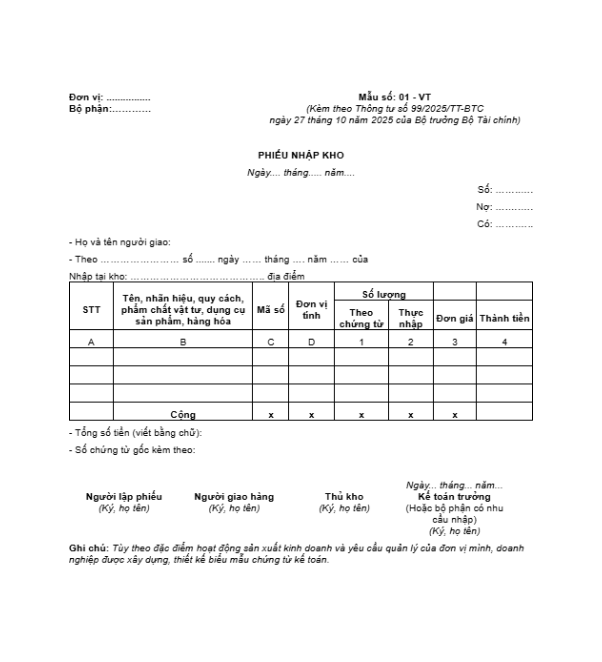
Receive form 01-VT according to Circular 99.
Bizzi's documentation page provides templates via a document registration form. Before using them, it is recommended to add your organization's information and check the applicable documentation regulations.
2.2. Warehouse Receipt Form 01-VT according to Circular 58/2026/TT-BTC
Circular 58 provides guidance on accounting procedures for micro-enterprises, effective from July 1, 2026. The warehouse receipt in this system is also... Form No. 01-VT. Micro-enterprises should base their decision on the accounting system they have chosen to determine whether to use Circular 58, Circular 133, or the enterprise accounting system according to Circular 99; they should not change the form simply because Circular 58 has a more recent issuance date.
If a Word or Excel file according to Circular 58 is needed, the form should be taken from the issued document or a source that has been compared with the original template. Do not use a file named "TT58" without first checking the template number, columns, and confirmation section.
2.3. Warehouse Receipt Form 01-VT according to Circular 133/2016/TT-BTC
Circular 133 provides guidance on the accounting regime for small and medium-sized enterprises. If the enterprise is currently applying Circular 133, Form 01-VT under this regime remains a suitable basis for preparing warehouse receipts. If the enterprise chooses to switch to the enterprise accounting regime, it must comply with the regulations on consistent selection and application throughout the fiscal year.

2.4. Warehouse Receipt Form 01-VT according to Circular 200/2014/TT-BTC
Circular 99 has replaced Circular 200 for fiscal years beginning on or after January 1, 2026. However, the Circular 200 file is still necessary when businesses look up or complete records for accounting periods that have applied Circular 200. For example, a business with a fiscal year from October 1, 2025 to September 30, 2026 does not switch to Circular 99 mid-term simply because it is approaching January 1, 2026.

3. How to fill out warehouse receipt form 01-VT: 5 parts to check
The presentation may vary between different accounting systems and internal forms, but when preparing vouchers, sufficient data should be retained to identify the issue. Import procedures, goods received, value, and responsibilities of those involved..
| Part | Need to record/check | Points where mistakes are likely to occur. |
|---|---|---|
| Ticket information | Unit, department, voucher number, date of issue, and warehouse/location of entry. | Using duplicate receipt numbers or recording the wrong date for warehousing. |
| Source of import | The consignor, the reason for import, and relevant documents such as invoices, import orders, or purchase orders, if any. | Not maintaining a record of transactions makes it difficult for accountants to trace back the work. |
| Product information | Name, brand/specification, code number, and unit of measurement | The item code or unit of measurement differs from the purchasing/inventory data. |
| Quantity | Quantity as per documentation and quantity actually received. | Modify the entered amount to match the amount on the document, even if there is a discrepancy. |
| Value and validation | Unit price, amount, total amount, and signature/approval according to the unit's regulations and procedures. | Lack of basis for pricing or unclear hierarchical signing. |

The instructions above are sufficient for a quick check before using the file. If you need a more in-depth look at the process of creating, circulating, and coordinating between accounting and warehouse management, please refer to the relevant section. What is a warehouse receipt and how to manage warehouse receipts?.
4. The quantity stated on the documents differs from the actual quantity received: how should this be handled?
This is a case where the difference needs to be preserved for verification, rather than making the two figures match on paper. For example, if the delivery document shows 100 products but the warehouse received 97 products, the actual quantity received should reflect 97 products if that is the actual quantity received into the warehouse.
- Record the actual quantity received based on the verification results. Do not alter actual quantities simply to match invoices or delivery documents.
- Identify the source of the discrepancy. Check for missing items, damaged goods, incorrect specifications, wrong deliveries, or incorrect data on the documents.
- Save evidence of the processing. Depending on the situation, a delivery receipt, inspection report, confirmation with the supplier, or additional return/receipt documentation may be required.
- Pre-payment verification. If the transaction involves purchase orders and supplier invoices, the actual amount received should be used as data to check for discrepancies before payment.
If your business is managing orders using spreadsheets, you can refer to the following: Excel order form template and how to link the purchase order (PO) with delivery data.. As the number of documents increases, Three-way verification of Purchase Order (PO) – Warehouse Receipt – Invoice This helps to clearly identify the discrepancies that need to be addressed before payment.
5. Is it possible to amend or supplement Form 01-VT according to Circular 99?
It is possible, but it should not be modified arbitrarily. According to Article 9 of Circular 99, businesses should refer to the system of forms in Appendix I. When it is necessary to design additional forms or modify and supplement forms to suit operations and management requirements, the documents must still meet the requirements of the Accounting Law, and the business needs to have an Accounting Regulation or equivalent document as a basis for implementation.
6. Old templates in the file: for reference only, not applicable by default in the current regulations.
The images and files below are retained for businesses to compare with records from the previous period. The legal status of the corresponding accounting system has changed, so the old files should not be used as the current template if the entity has switched to the new system.
6.1. Template according to Circular 107/2017/TT-BTC
Circular 107 on accounting regulations for administrative and non-business entities has expired as of January 1, 2025. Units within this scope are currently implementing Circular 24/2024/TT-BTC. The Circular 107 file below should only be used for reading or comparing records from the period when Circular 107 was in effect.

6.2. Template according to Circular 88/2021/TT-BTC
Circular 152/2025/TT-BTC takes effect from January 1, 2026, and replaces Circular 88/2021/TT-BTC on accounting guidelines for household businesses and individual businesses. Therefore, the Circular 88 file below should only be used to look up documents from the previous period.

6.3. Template according to Circular 24/2017/TT-BTC for cooperatives
Circular 71/2024/TT-BTC applies to fiscal years beginning on or after January 1, 2025, and replaces Circular 24/2017/TT-BTC. According to Circular 71, cooperatives can proactively develop their own forms and documents; if they do not develop them themselves, they must apply the sample forms guided in Appendix II of Circular 71.

To avoid using the wrong form, this section does not provide a download file for Circular 24. For cooperatives, please compare Circular 71/2024 with the form currently being used by the unit.
7. Checklist before signing and recording the warehouse receipt.
- Correct accounting practices: Determine TT99, TT58, TT133, or other specific regime before selecting the sample.
- Applicable during the correct period: When switching from Circular 200 to Circular 99 or to another regime, check the start date of the fiscal year.
- The correct items received: The item code, unit of measurement, receiving warehouse, and actual quantity received must reflect the inspection results.
- Keep the source documents: Invoices, import orders, purchase orders, delivery notes, inspection reports, or other records must be traceable according to the business operation.
- Clearly define responsibilities: The person who prepares, delivers, receives, the accountant, and the person who approves the transaction shall follow the accounting system and internal regulations of the unit.
- Don't ignore the differences: If the purchase order (PO), warehouse receipt, and invoice do not match, verification is required before proceeding with payment processing.
With the document prepared, the business can refer to it for further information. Methods for managing and storing accounting documents. To standardize the process of receiving, checking, and searching for documents.
8. Frequently Asked Questions about the 2026 Warehouse Receipt Form
What is the latest warehouse receipt form for 2026?
The choice should not be based solely on the "latest" criterion. Businesses applying Circular 99 should use Form 01-VT according to Circular 99; micro-enterprises that chose Circular 58 should use Form 01-VT according to Circular 58; and small and medium-sized enterprises currently applying Circular 133 should use Form 01-VT according to Circular 133. The form must be consistent with the accounting system and the period of application of the entity.
Are micro-enterprises required to switch to Circular 58 from July 1, 2026?
It shouldn't be assumed that way. Circular 58 is the accounting regime for micro-enterprises, effective from July 1, 2026, but businesses need to determine their chosen accounting regime and apply it consistently according to regulations. Micro-enterprises already applying a different, suitable regime should not arbitrarily change their forms mid-term simply because Circular 58 has just been issued.
Will Circular 200 still be used for warehouse receipt forms in 2026?
Circular 99 replaces Circular 200 for fiscal years beginning on or after January 1, 2026. The Circular 200 form remains useful for checking records for the period under Circular 200 or for fiscal years that began before the transition to Circular 99.
Should small and medium-sized enterprises (SMEs) use Circular 133 or Circular 99?
Small and medium-sized enterprises (SMEs) can apply Circular 133; if they choose the enterprise accounting system instead of Circular 133, they must comply with the regulations on selection, notification, and consistent application throughout the fiscal year. Once the system has been determined, the warehouse receipt form must follow the corresponding template.
Do Excel and Word files alter the legal validity of a warehouse receipt?
File format is not the determining factor in accounting practices. What matters is that the content of documents, forms, and the procedures for preparation, signing, and archiving comply with applicable regulations and the unit's rules. When downloading Excel/Word files from other sources, it's advisable to compare them with the original template before use.
Can businesses add columns to Form 01-VT according to Circular 99?
The form may be designed, modified, or supplemented to meet the requirements of the Accounting Law and based on accounting regulations or equivalent documents. Essential information for verification and reconciliation of transactions should not be omitted.
9. When the warehouse receipt needs to be compared with the purchase order (PO) and invoice.
A properly prepared warehouse receipt only addresses the recording of the actual goods entering the warehouse. In purchasing transactions, before payment, the accountant also needs to verify what the business ordered, what the warehouse actually received, and what the supplier invoiced.
According to the feature set that Bizzi is announcing, the invoice processing solution supports... Three-way reconciliation of Invoice – Purchase Order – Warehouse Receipt, This solution handles relationships between one or more purchase orders (POs), invoices, and delivery receipts, and detects discrepancies so that accounting can focus on checking exceptions. This solution does not replace the business's own goods inspection or purchase approval process.

When manual matching begins to have more exceptions
Businesses can continue using existing warehouse receipts and inventory processes; when matching purchase orders, goods received, and invoices is time-consuming, they can evaluate automation solutions at the pre-payment control step.
See Bizzi's invoice and document matching solution. Schedule a demo