


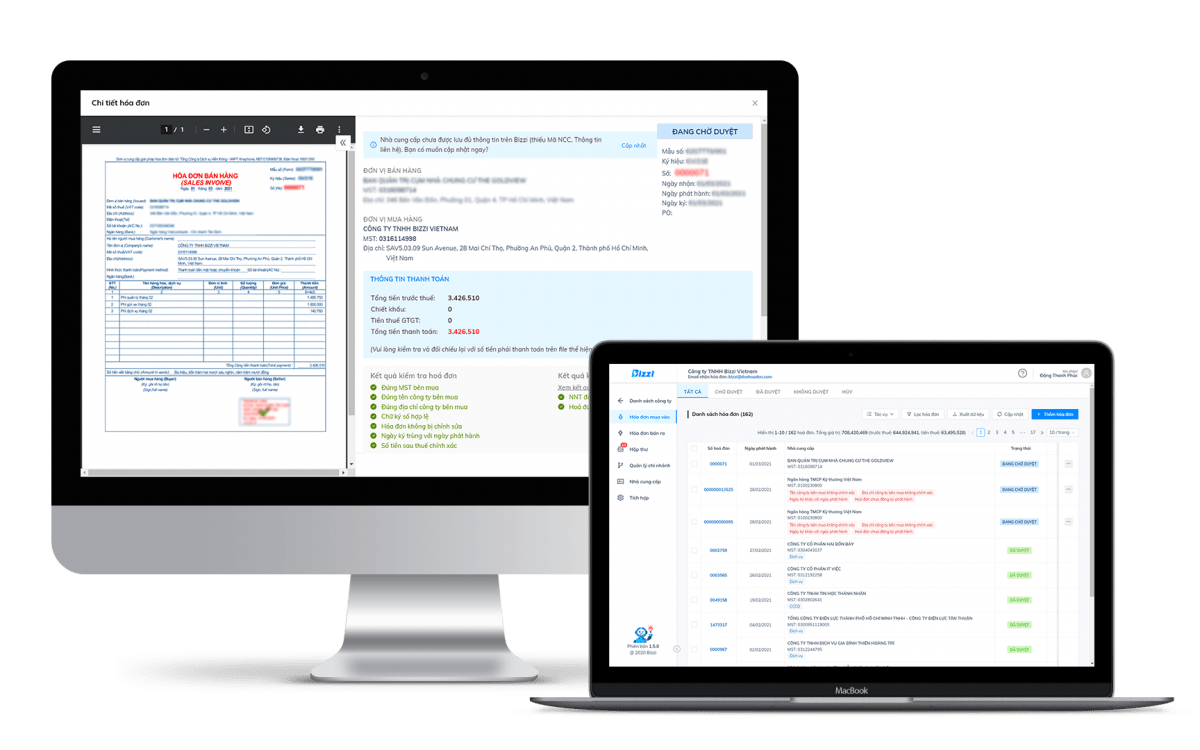
Handle input invoices Manual invoice processing is creating a financial "blind spot" that many businesses haven't realized. As the volume of invoices increases with size, accounting departments face pressure to input data, reconcile, and verify compliance, while risks of duplicate payments, invalid invoices, or data discrepancies persist. It's still quietly accumulating. From the CFO's perspective, this isn't just an operational issue, but a direct risk to cash flow and costs.
This article by Bizzi will clarify what invoice processing is and analyze how invoice processing automation solutions help businesses control costs and optimize the entire Accounts Payable process.
What is the Invoice Processing flow?
Invoice processing is a series of operations within Accounts Payable (AP), including receiving invoices, extracting data, reconciling documents, checking compliance, and recording transactions in the accounting/ERP system for payment processing.
In reality, many businesses still view this as "accounting data entry." However, from a CFO's perspective, invoice processing is actually... The final control point before cash outflow from the business.Any mistakes at this stage can translate into financial losses or tax risks.
When processes are not standardized, businesses find it difficult to accurately track budget usage against planned budgets (budget vs. actual). This leads to uncontrolled cost overruns, while late or incorrect payments damage credibility with suppliers. Therefore, invoice processing needs to be viewed as a key component. cost control systemIt's not just about accounting operations.
In this context, platforms like Bizzi act as an intermediate automation layer in the financial process, helping businesses automatically receive invoices, extract and standardize input data. Through real-time validity checks and three-way reconciliation (Invoice – Purchase Order – Retail Price), the system ensures all data is "cleaned" before being recorded in the ERP system.
As a result, CFOs no longer need to manually process each document while still ensuring the accuracy of financial data, creating a reliable foundation for tracking accounts receivable and cash flow planning on core systems.
When the volume of invoices exceeds the capacity for manual processing, switching to automation is no longer an option but a necessity.
How Invoice Processing Automation works
Invoice processing automation (IPA) This involves applying AI-OCR and RPA to automatically extract data, check its validity, and synchronize invoices into the accounting system without manual data entry.
Unlike traditional OCR which only goes as far as "reading text," modern systems have advanced further. IDP (Intelligent Document Processing) – that is, understanding the semantics of the document. This allows the system not only to identify data but also to check the logic, detect anomalies, and issue warnings.
The greatest value of IPA lies in its ability to scale processing without increasing staff. During peak periods, businesses can process thousands of invoices per day while maintaining high accuracy. This is the foundation for achieving success. straight-through processing (STP) – a state where the invoice can pass through the system without manual intervention.
A simple comparison reveals the stark difference:
| Criteria | Handmade | Automation |
| Processing time | 10–15 minutes per invoice | < 10 seconds |
| Data entry error | High | ~0% |
| Reconciliation | Manual Excel | Automatic |
| Tax audit | Manual lookup | Real-time API |
| Storage | Fragmentation | Cloud-centric |
In practice, Bizzi uses AI-OCR to extract invoice data, then standardizes it according to the company's accounting structure. As a result, processing time is significantly reduced, and accountants no longer have to "type data," but instead take on a control role.
However, the greatest benefit of automation lies not only in speed, but in its ability to mitigate financial risks.
Financial risks in manual invoice processing.
Manual invoice processing carries the risk of receiving invalid invoices, duplicate payments, or payments to the wrong recipients, leading to expense disallowances and tax penalties.
The danger is that these risks don't appear immediately but accumulate over time. When tax authorities or auditors conduct an inspection, businesses may suffer double losses: losing payments to suppliers and facing back taxes and penalties.
In many cases, the cause is not a major error, but simply a failure to check the supplier's status or to detect duplicate invoices. This is precisely the "loophole" that manual processes struggle to control.
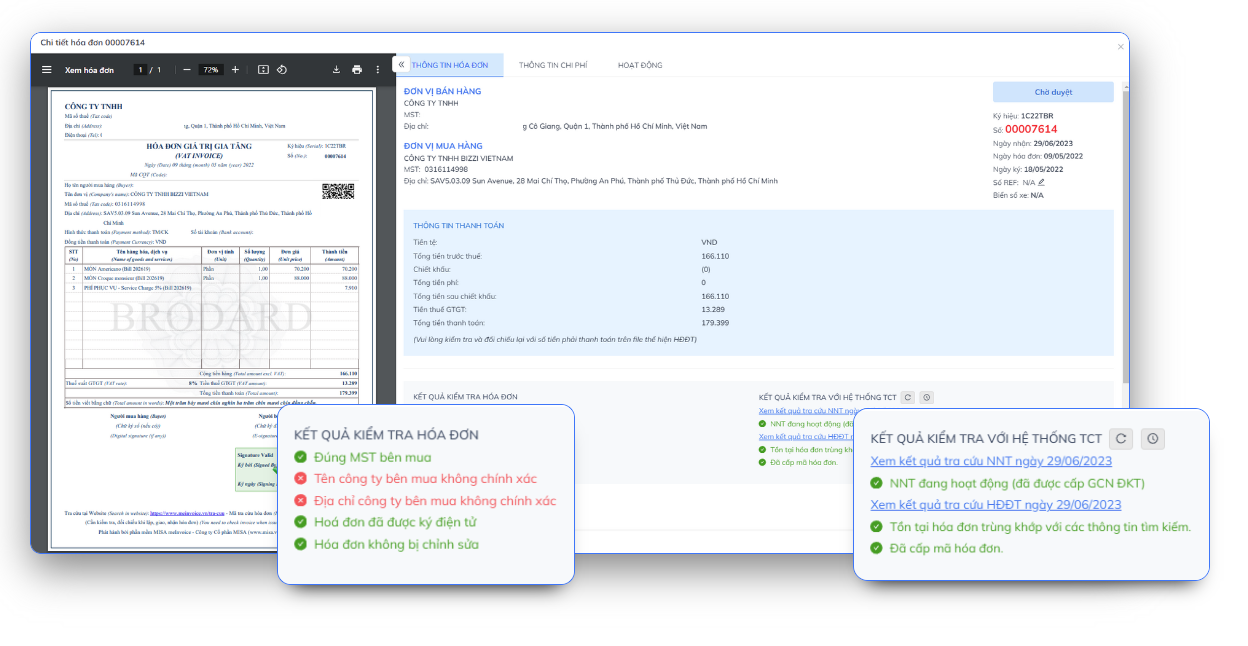
Automation solutions like Bizzi help mitigate risk by checking tax identification numbers in real time and immediately alerting when unusual invoices are detected. This allows risky documents to be blocked before they enter the accounting system.
To move forward, businesses need a stronger layer of control: document reconciliation.
Optimize 3-Way Matching and 5-Way Matching with AI-powered invoice processing.
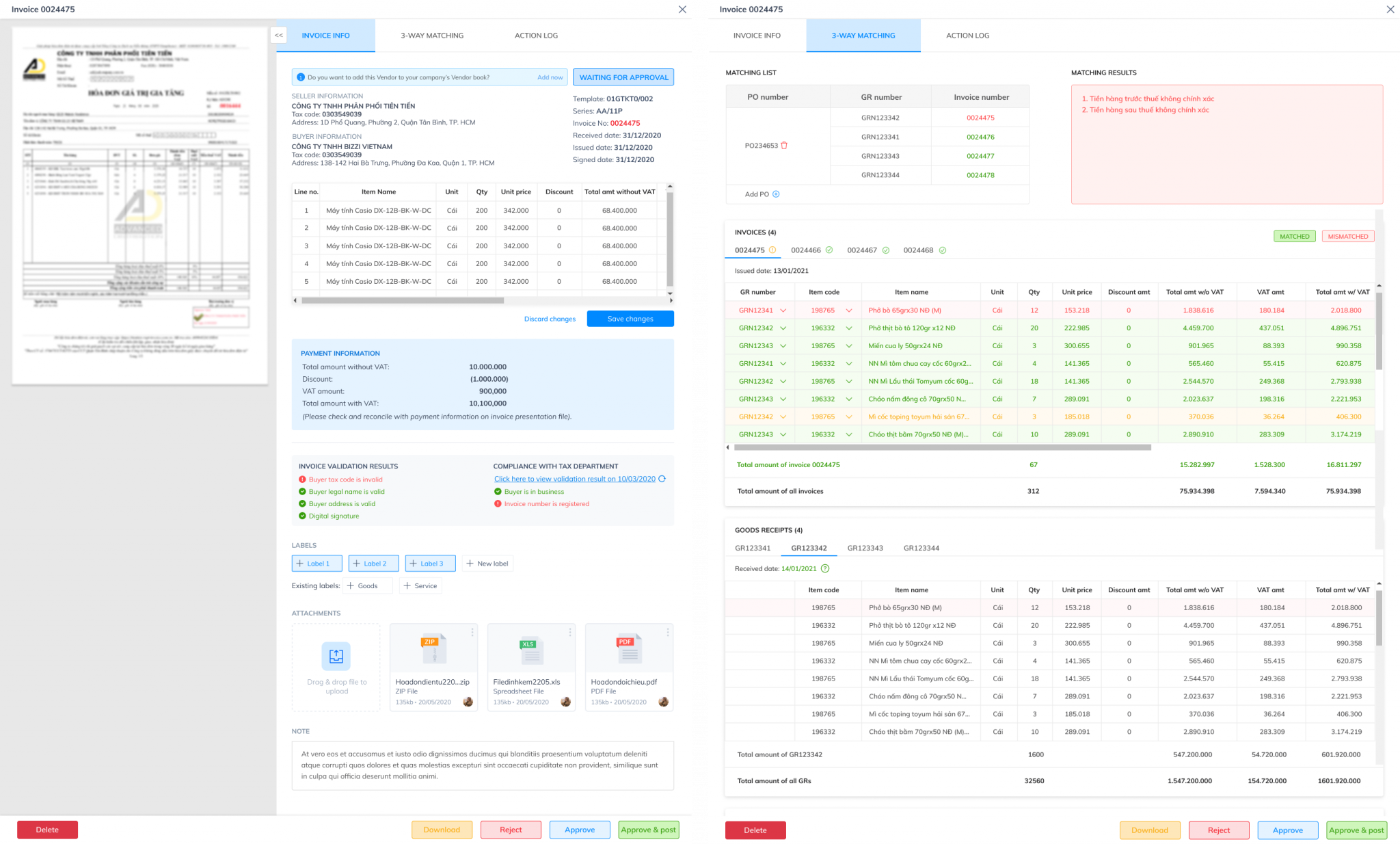
3-way matching This is a reconciliation mechanism between invoices, purchase orders (PO), and goods receipt notes (GR) to ensure that businesses only pay for what they have actually purchased and received. In addition to the above documents, Bizzi can assist in processing a wider range of documents such as contracts, delivery notes, customs declarations, etc.
In an automated system, reconciliation is not limited to the total value but is performed at the line-item level. This allows the system to detect small discrepancies in quantity or unit price – factors that could lead to budget losses if overlooked.
For the CFO, this is a direct control layer that helps prevent "price variance"—a situation where the price on the invoice doesn't match the contract or order.
Bizzi supports data mapping between suppliers and internal systems, then automatically matches quantities and unit prices. When the data matches, the payment process continues; if there is a discrepancy, the system will hold the data for verification.
As a result, businesses shift from post-audit control to pre-payment control.
Criteria for selecting automation solutions
An effective invoice processing automation solution needs to ensure data accuracy, ERP integration capabilities, and compliance with domestic legal regulations.
In reality, many businesses face risks when choosing international software that is not compatible with the Vietnamese tax system. This makes invoice verification and compliance difficult, reducing the effectiveness of the investment.
From a CFO's perspective, the selection decision should be based on ROI and TCO, rather than just a technology demo. A good system must have flexible integration capabilities (Open API), bidirectional data synchronization, and create a single source of truth.
Bizzi meets these criteria through its ability to connect with multiple ERP systems and standardize data from the input stage, reducing the risk of errors and increasing processing speed.
Frequently Asked Questions about Invoice Processing
Handling erroneous electronic invoices (according to Circular 32/2025/TT-BTCCommon situations include errors in the tax identification number (MST), amount, tax rate, or the need to cancel/adjust already sent invoices.
Can invoice processing automation replace AP accounting?
No. Invoice processing automation only eliminates repetitive tasks like data entry and basic verification, while the AP accountant takes on a different role. data controller and risk controllerIn the long term, productivity will increase, but it will require higher analytical skills and a deeper understanding of the process.
What is the accuracy rate of AI-OCR?
With standard electronic invoices (XML/PDF), AI-OCR can achieve approximately 99.91 TP3T. field-level accuracy, especially in fields such as MST, invoice number, and total amount.
How can I detect duplicate payments?
The system automatically matches important fields such as invoice number, tax identification number, issue date, and payment value to detect duplicates. When a duplicate payment is detected, the workflow will Block payment or proceed to review.This helps avoid financial losses and disputes with suppliers.
Is it possible to integrate with an in-house ERP system?
Yes. Enterprise-standard systems typically support Open APIs or SFTP/flat files, allowing for flexible integration with internal ERP systems. However, the biggest risk lies in mapping master data (vendor, tax code, GL coding) – if not standardized beforehand, synchronized data can still be inaccurate.
Expense invoice storage How is it calculated?
According to accounting regulations, invoices need to be stored for a minimum of 10 years; with the SaaS model, this cost is usually included in the service package. The CFO should factor this into the cost. TCO (Total Cost of Ownership)Instead of just looking at the initial license cost, this helps avoid underestimating long-term costs.
Does Invoice Processing Automation help improve DPO/DSO?
Yes, but the main impact is on DPO (Days Payable Outstanding). When the processing is fast and accurate, businesses can pay on time, avoid penalties, and take advantage of early payment discounts; thereby improving their negotiating position with suppliers.
Conclude
Invoice processing is no longer a standalone operational task but has become a multifaceted process. cost control and cash flow pillars In a business, when handled manually, this process is prone to errors, tax risks, and financial losses that are difficult for the CFO to control.
Solution invoice processing and loading It helps transform the entire process from data entry to control: automatically extracting data, reconciling documents, checking compliance, and synchronizing with ERP. More importantly, it helps businesses establish a control mechanism before money is spent.
In this context, Bizzi acts as a platform connecting the entire process from invoicing to payment, helping CFOs optimize operations while enhancing the reliability of financial data. This is not just a technology investment, but also a strategic move to protect profits and cash flow in the long term.
To receive advice on effective corporate financial management solutions, schedule an appointment with Bizzi here: https://bizzi.vn/dat-lich-demo/