



An advance payment is a sum of money a business pays to employees in advance to perform approved work, while reimbursement is the process of settling the advance payment with valid documentation to record the expense and close the advance. These are two transactions that occur frequently in most businesses, especially with travel expenses, purchases, client entertainment, or project costs.
However, in reality, many businesses still manage employee advance payments using Excel spreadsheets, emails, or paper documents, leading to slow approvals, overdue advances, missing invoices, time-consuming reconciliation processes, and difficulties in controlling cash flow. In the context of increasing demands for financial transparency and cost management, standardizing and digitizing the entire process from request, approval, disbursement to reimbursement and settlement will not only reduce operational risks but also enhance real-time budget control.
In this article, Bizzi will help you understand what advances and reimbursements are, how to build an effective advance process for employees, the KPIs CFOs should monitor, and digital solutions to help the finance department control expenses more tightly before, during, and after the expense occurs.
What is an advance payment in business?
An advance payment is a sum of money that a business pays in advance to an employee or department to perform an approved task, but this amount is not considered an expense until it is reimbursed with valid documentation.
In business operations, not all expenses can be paid immediately after they are incurred. To ensure that work proceeds on schedule, businesses often... advance A sum of money given to employees or departments before undertaking a task. This money can serve various purposes such as travel expenses, purchasing supplies, entertaining guests, organizing events, paying project costs, or other incidental operating expenses.
The important point to understand is: An advance payment does not equate to a fee.. Essentially, this is money that the company provides to employees for approved purposes and must be tracked until the final settlement is complete. Only when employees submit complete invoices and supporting documents, and the expenditure complies with internal policies and relevant regulations, can the company record it as an expense.
From an accounting and financial management perspective, advances are typically tracked as follows: advance payments pending settlement or intercompany receivables For those receiving advances, this helps the Finance and Accounting Department control the disbursed funds, the outstanding advance balance, and the settlement responsibilities of each individual or department.
If advances are delayed and not repaid, businesses face several risks:
- Cash flow is dispersed., It is difficult to determine the actual amount of money that was used for the business operations.
- Expenses are recorded late or in the wrong period., This affects management reports and financial statements.
- Outstanding advances have increased significantly., This makes it difficult to reconcile internal accounts payable and assess the effectiveness of budget utilization.
- Increased risk of missing or lost invoices., This causes businesses to spend a lot of time processing accounts during settlements, audits, or post-audits.
For CFOs and Finance Managers, the outstanding balance of advances not only reflects the amount of money disbursed to employees but also serves as an indicator of the quality of cost control. When a business has multiple departments, projects, or employees who frequently travel, managing advances using spreadsheets or emails can easily lead to a lack of transparency regarding processing status, difficulty in tracking settlement deadlines, and the need for numerous manual reconciliation steps.
Modern cost management platforms such as Bizzi Expense It is designed to digitize the entire lifecycle of advances, from creating requests, establishing approval flows, tracking status, managing balances to reconciliation and settlement. This allows businesses to control disbursed funds by employee, department, or project from the moment they are disbursed, instead of only reviewing them at the end of the period.
Until an advance payment is reimbursed, the finance department is unsure whether that amount qualifies as a legitimate expense or whether a portion needs to be recovered. Therefore, clarifying the concept of reimbursement is the next step.
What is reimbursement and why is the expense recognized?
Reimbursement is the process by which employees settle an advance payment using valid invoices, receipts, or other supporting documents so that the business can record the expense, recover the excess amount, or make additional payments.
If an advance payment is a step where a business provides funds before an expense is incurred, then... reimbursement This stage verifies how the funds have been used. It helps the Finance and Accounting department check the validity of the expenditure, compare it with the approved proposal, and decide whether the funds are eligible to be recorded as expenses.
In the reimbursement process, employees need to submit all required documents, such as electronic invoices, receipts, airline tickets, hotel bookings, expense statements, etc., Standard business trip procedures or other relevant documents. At the same time, the accountant will compare the original purpose of the expenditure, the amount advanced, and the actual amount used to handle any discrepancies.
Depending on the settlement results, the advance payment usually falls into one of the following categories:
| Situation | How to handle it |
| Pay exactly the amount of the advance payment. | The advance payment will be closed after all supporting documents have been verified. |
| The amount spent was less than the advance payment. | The employee will refund the remaining amount according to company policy. |
| Spend more than the advance payment. | Businesses will make additional payments if the expense is legitimate, in accordance with policy, and has been approved. |
| Missing documents | Processing may be temporarily suspended, additional documents may be requested, or expenses may not be recorded until sufficient evidence is available. |
| Misuse of funds | Explanation and handling will be carried out according to internal regulations; the expenditure may not be approved or the employee may have to reimburse it. |
In reality, many businesses struggle not because the reimbursement process is too complicated, but because... scattered data. Advance requests, approvals, invoices, payment vouchers, and accounting data are often stored in multiple systems or sent via email, chat, and Excel files. This causes the Finance team to spend a significant amount of time compiling, cross-referencing, and tracking the status of each advance payment.
To reduce manual workload, many businesses are choosing to digitize their reimbursement processes using cost management solutions such as Bizzi Expense. The system allows linking advance payment requests with reimbursement records, collecting electronic documents, supporting OCR for extracting invoice data, reconciling with actual expenses, and storing the entire processing history on a single platform. This enables the Finance team to track settlement progress, detect missing or incorrect information in records earlier, and shorten the time required to close advance payments and record expenses.
After understanding the two concepts, businesses need to clearly distinguish between advances and reimbursements in order to design appropriate control points for each stage of the cost management process.
What is the difference between an advance payment and a reimbursement?
An advance payment is when a company disburses money upfront, while reimbursement is the final settlement after the employee has spent the money and submitted supporting documents.

Although often mentioned together in the cost management process, advance and reimbursement They perform two completely different roles. Advance payments focus on: Provide funding to carry out the work., while reimbursement is the step Check, verify, and record actual expenses. after the work is completed.
Clearly distinguishing between these two concepts helps businesses design the right control points at each stage. If only the advance payment process is well managed but the repayment is not tracked, businesses will find it difficult to know whether the disbursed funds are being used for the intended purpose and within the budget. Conversely, if only post-disbursement settlement is focused on while lacking pre-disbursement control, the risk of spending outside of policy or exceeding the budget will increase significantly.
| Criteria | Advance | Refund |
| Time | Before actual costs are incurred | After actual costs are incurred |
| Nature | Advance payments need to be tracked. | Settlement of advanced funds |
| Target | Help employees have a source of funding for their work. | Provide proof of legitimate expenses and pay the advance deposit. |
| Main document | Request for reimbursement of travel expenses (advance payment), approval, payment voucher, or transfer document. | Invoices, receipts, advance payment statements, expense reports |
| Main risks | Advances held for too long, misuse of funds, exceeding budget. | Lack of documentation, expenses not eligible for recognition, slow reconciliation. |
| KPIs to track | Outstanding Advances (open advance balance), Advance Aging (advance account age) | On-time Settlement Rate, Rejected Document Rate |
From a financial management perspective, these two phases also require different control methods. advance, Therefore, businesses need to focus on reviewing budgets, limits, purposes of use, and obtaining approvals before funds are disbursed. Meanwhile, reimbursement This requires a process of collecting supporting documents, reconciling with advanced funds, verifying the validity of expenses, and updating accounting data.
This is also why many businesses are shifting from fragmented management models using email and spreadsheets to expense management platforms such as Bizzi Expense. Instead of treating advances and reimbursements as two independent transactions, the system connects the entire lifecycle of an expenditure on a single data stream: from advance request, approval, disbursement, document collection, reimbursement to reconciliation and tracking. This helps the Finance team track the status of each advance in real time, reduce outstanding advance balances, and increase accessibility during audits or post-audits.
This difference shows that the advance payment process cannot simply stop at the point of disbursing the money. Businesses need a complete workflow to track advances until they are fully settled.
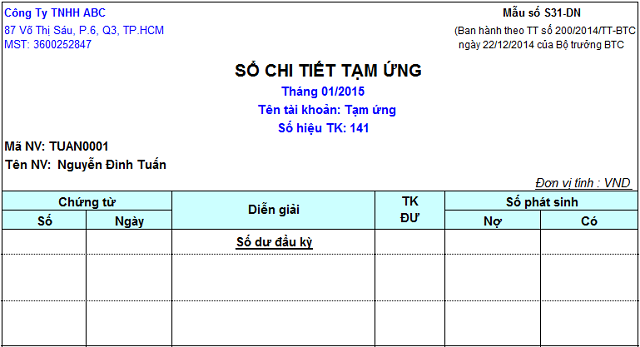
What steps should the process for providing advances to employees include?
A process for employee advances should consist of seven steps: creating a request, budget review, approval, disbursement or allocation of funds, tracking the advance, reimbursement with supporting documents, and reconciliation to close the advance.
An efficient advance payment process not only ensures employees have sufficient resources to perform their tasks but also guarantees the business has control over cash flow, budget, and documentation from the outset. Instead of handling each step separately, businesses should standardize the entire process into a unified flow to minimize pending advances, missing documentation, or delayed settlements.
1. The employee creates the advance payment request.
The process begins when an employee submits a request for an advance payment to cover assigned or planned work. The request file should include the following information:
- Purpose of expenditure.
- The amount requested as an advance payment.
- Usage period and repayment deadline.
- Department, project or cost center relate to.
- Documents or supporting evidence if required by the business.
Standardizing data right from the start significantly reduces the time spent exchanging additional information in later stages.
2. Review policies and budgets
After receiving the request, the Finance team or system needs to check whether the expenditure complies with internal regulations. The check typically includes:
- Does the expenditure fall under the category of items eligible for advance payment?.
- The policy limit has been exceeded.
- The department or project budget is sufficient.
- Does the applicant have any overdue advances that have not yet been settled?.
This is the class Pre-spend control This helps to mitigate risks from the outset, rather than dealing with them after the money has already been spent.
3. Approval Management
Approval should not be based solely on subjective judgment but rather on clear criteria such as:
- The value of the advance payment.
- Type of expense.
- Employee rank.
- Department or project.
- The level of risk associated with the expenditure.
Establish approval workflow Multiple levels of approval help businesses ensure both speed of processing and maintain transparency and accountability throughout the approval process.
4. Disbursement or allocation of spending limits
After approval, the business proceeds to allocate funds in accordance with its financial management policy. Depending on the operating model, the disbursement method may be:
- Transfer the funds to the employee's account.
- Pay in cash.
- Assign a spending limit.
- Use a business card or Bizzi Expense Pay with business cards, virtual cards, or other suitable payment methods.
Choosing the right payment method not only makes it convenient for employees to perform their work but also facilitates the connection of payment data with expense requests and supporting documents in subsequent steps.
5. Monitor open advances.
This step is often overlooked but has a significant impact on the ability to control cash flow. The finance team needs to continuously monitor information such as:
- The person receiving the advance payment.
- The amount advanced.
- Disbursement date.
- Repayment deadline.
- Document submission status.
- Advance Aging.
This data helps businesses detect overdue advances or those at risk of becoming long-term internal debt early on.
6. Reimbursement Staff
After completing the work, the employee will reimburse the company according to regulations by submitting the following:
- Electronic invoice or valid supporting document.
- Receipts, booking confirmations, airline tickets, and hotel invoices, if available.
- Expense report or expense report.
- The remaining amount will be used if expenses are lower than the amount advanced.
Submitting documents on time helps accountants shorten the settlement period and record expenses correctly.
7. Reconciliation and closing of advances by the accountant.
In the final step, the accountant performs a reconciliation between:
- The advance payment request has been approved.
- The funds have been disbursed.
- Actual costs incurred.
- Supporting documents.
- Any amount to be recovered or additional payment to be made (if any).
Once all data matches and the records meet the requirements, the advance payment is closed, the expense is recognized in the correct accounting period, and updated in the management report.
For businesses with multiple advances each month, handling the entire process via email or Excel often creates repetitive tasks and makes it difficult to track the status. Bizzi Expense It helps digitize the entire workflow, from proposal creation, budget review, approval workflow setup, advance payment management, document collection to reconciliation and audit trail storage. When combined with Bizzi Expense Pay, Furthermore, businesses can directly connect payment data with expense requests and reimbursement records, significantly reducing manual reconciliation and increasing real-time cost control.
Once the process is clearly broken down into steps, businesses can accurately identify which bottlenecks are causing advances to be delayed, overdue, or out of control, and develop appropriate improvement plans.
Common mistakes that cause delays and difficulties in controlling the advance payment process.
The advance payment process is often delayed not because of a single step, but because the request, approval, documentation, and reconciliation are not all part of the same data stream.
Many businesses attribute the lengthy advance payment process to employees submitting applications late or accountants being overwhelmed with work. However, in reality, the majority of bottlenecks stem from data being scattered across multiple tools: advance requests are sent via email, approvals are made through chat applications, documents are stored separately, and reconciliation is done using Excel at the end of the month.
When each department only sees a portion of the process, the Finance team finds it difficult to track the status of each advance payment, while the CFO also lacks real-time data to assess how cash flow is being used.
| Stage | Common errors | Affect |
| Suggestion | The purpose of the expenditure is unclear, and it is not linked to any department or cost center. | It is difficult to audit the budget and determine the source of funding. |
| Approve | Checking emails or chats, there's a lack of information about limits and policies. | Easy to approve wrong regulations or exceed the budget. |
| Disbursement | Pay before approval is complete. | Increased risk of misuse, difficulty in controlling accountability. |
| Monitor | Manage using Excel or multiple separate files. | Overdue advances are easily overlooked, and it's difficult to track outstanding balances. |
| Refund | Employees submit documents late or are missing invoices. | Delayed settlement increases accounting and tax risks, affecting deadlines for closing. |
| Reconciliation | There is a discrepancy between the amount advanced, the actual expenses, and the amount reimbursed. | Processing takes a long time at the end of the month, and data discrepancies are likely to occur. |
Notably, these errors often have a chain reaction. For example, if the request for an advance payment is not linked to... cost center Whether the project is underway or not, accountants will face difficulties in budget reconciliation from the outset. If documents are submitted late, advances remain pending, distorting expense reports and impacting cash flow planning.
For businesses with many expenses... per diem management, With project or procurement costs arising daily, the lack of a centralized tracking system also makes it difficult for the Finance team to answer important management questions such as:
- How many advances are there that remain unsettled?
- Which payments are overdue?
- Which department has the largest outstanding advance payment balance?
- How many expenses have been paid but lack sufficient documentation?
This is information that manual spreadsheets struggle to update accurately in real time. These errors demonstrate that optimizing the advance payment process needs to start with policies and control points from the outset, before even considering software implementation.
See more content about
How to optimize the employee advance payment process.
Businesses can optimize their advance payment process by standardizing advance payment conditions, linking advances to budgets, digitizing approvals, tracking aging, automating documentation, and reconciling advance payments in real time.
An efficient process is not simply about shortening disbursement time, but also about helping businesses control cash flow throughout the entire process, from request to full settlement of the advance payment. Below are six groups of solutions that many finance teams apply when standardizing the advance payment process.
Standardize the conditions for receiving advances.
All advances should be evaluated using the same set of criteria instead of being processed on a case-by-case basis. Internal regulations need to clearly state this:
- What types of expenses are eligible for advance payment?.
- The individual or position entitled to request an advance payment.
- Maximum advance payment amount varies by role or expense category.
- The repayment deadline is after the work is completed.
- Cases where advance payments were refused.
- The condition is that further advances will not be granted if there are still outstanding overdue or unsettled debts.
Standardizing the conditions from the outset helps reduce conflicts between employees, managers, and the finance department, and lays the groundwork for automating subsequent approval processes.
Link advances to the budget and cost center.
An advance payment only truly has administrative value when it's linked to a specific budget. Instead of just recording the amount and recipient, each request should be linked to:
- Department.
- Project.
- Business trip.
- Type of expense.
- Expense code or cost center.
- Remaining budget.
This management approach allows CFOs to monitor budget usage in real time instead of waiting until the end of the period to compile reports.
In Bizzi Expense, Businesses can set budgets according to cost center, This system allows for real-time cost updates for departments or projects, along with alerts when requests exceed limits or are no longer available. This enables the Finance team to control expenses before they are disbursed, rather than dealing with them after costs have been incurred.
Set up browsing flows based on risk level.
Not all advances require the same approval process. Designing workflows based on risk levels helps businesses maintain control while avoiding business slowdowns.
| Type of advance payment | Suggested browsing flow |
| A small amount, in accordance with policy. | One level of approval |
| A large sum of money | Multiple levels of approval |
| Exceeding budget | Special approval required. |
| Off-policy expenses | Explanation required before approval. |
| Advance payment for work | In line with work requirements or approved expenditure plans. |
Modern cost management platforms such as Bizzi Expense allows businesses to configure Approval Workflow by amount, department, job title, budget, or expense type, instead of processing manually via email and messaging apps.
Monitor aging and SLA reimbursement.
Once the funds are disbursed, the management focus shifts to monitoring the outstanding advances.
Businesses should clearly define the following:
- After how many days from the completion of the work must the advance payment be reimbursed?.
- When will the system send a reminder notification?.
- After how long will the overdue payment be reported to the direct manager?.
- Can employees with overdue payments continue to receive advances?.
- Report Advance Aging To whom is it sent and how often?.
The setup SLA (Service Level Agreement) This process of reimbursing advances helps reduce outstanding advance balances and improve the speed of closing the accounting period.
Automating reimbursement vouchers
Collecting documentation is always one of the most time-consuming tasks for the finance team. Instead of requiring employees to send invoices through multiple channels, businesses should digitize the entire process.
The steps that can be automated include:
- Collect electronic invoices.
- Scan your receipt directly on your mobile device.
- Check the invoice information.
- Attach the relevant documents to the correct advance payment.
- Categorize cost groups.
- Warning: Documents are missing, duplicated, or invalid.
According to ability Bizzi Expense, Employees can create requests and submit documents directly through the mobile app, while the system assists in collecting and verifying invoices and forwarding files to the correct approver. This significantly reduces the time spent compiling documents and minimizes the risk of lost files.
Automatic reconciliation between advance payments and actual expenses.
The final step in closing an advance payment is to reconcile all related data. Instead of doing this manually at the end of the month, businesses should continuously reconcile data between:
- The amount has been advanced.
- Actual costs incurred.
- Invoices and supporting documents are included.
- The amount of money the employee needs to repay.
- The amount the business needs to pay additionally.
- The closing status of each advance payment.
When request data, payments, documents, and accounting are connected on the same platform, the Finance team not only reduces data entry but also easily accesses processing history and tracks settlement progress in real time.
After optimizing the process, the CFO needs to see the results through specific operational metrics, rather than just relying on the feeling that the process has become "faster" or "less paperwork-intensive".
What KPIs should a CFO track to control cash advances?
CFOs should track advances as a financial performance indicator because outstanding advances represent capital tied up in debt and can obscure actual expenses. If businesses only look at the total expenses that have been accounted for, they may overlook the amount of money that has been disbursed but not yet settled, leading to discrepancies in cash flow assessment, budgeting, and capital utilization efficiency.
Instead of simply tracking the total amount of advances, CFOs should develop a set of KPIs that reflect the entire lifecycle of advances: from proposal creation, approval, disbursement to reimbursement and reconciliation. These metrics help identify bottlenecks in the process early, assess departmental compliance, and inform decisions to improve spending policies.
| KPI | Meaning | Use |
| Outstanding Advances | Total value of outstanding advances | Measure the amount of capital tied up and monitor its impact on the company's cash flow. |
| Advance Aging | The age of each open advance payment | Identify overdue accounts and prioritize their processing based on the length of time they have been outstanding or the level of risk involved. |
| On-time Settlement Rate | Rate of timely repayment | Assess the level of compliance with procedures by employees and each department. |
| perhaps Cycle Time | Average time from proposal creation to advance payment closing | Measure the efficiency of the entire process and identify steps that cause delays. |
| Exception Rate | The percentage of advances exceeding policy limits, exceeding budget limits, or lacking approval. | Evaluate the effectiveness of the pre-expenditure control mechanism and the level of compliance with internal regulations. |
| Rejected Document Rate | The percentage of documents returned or requiring additional information. | Measure the quality of reimbursement documentation, and thereby improve guidance and regulations regarding documentation. |
| Department of Exposure | Total advance payment by department, project, or cost center | Identify cost-generating "hot spots" and areas with high governance risks. |
In addition to the KPIs above, CFOs should also analyze trends over time instead of just looking at data at a single point in time. For example, if Advance Aging continuously increasing over several periods or On-time Settlement Rate A decrease in some departments could indicate problems with the approval, reimbursement, or documentation management processes. Conversely, when... perhaps Cycle Time shortened but Exception Rate While remaining at a low level, businesses have both improved processing speed and maintained effective control.
For these KPIs to truly support decision-making, data needs to be aggregated across multiple dimensions such as employees, departments, projects, expense types, or cost centers. This also forms the basis for Finance Managers to adjust advance limits, update reimbursement SLAs, or optimize the approval flow to reduce tied-up funds and improve budget efficiency.
KPIs only accurately reflect the situation when advance payment data is centrally managed. If information remains scattered across emails, Excel files, paper documents, and individual accounting systems, CFOs will struggle to get a complete picture of the value of outstanding advances, the age of advances, or the level of compliance of each department.
When should you switch from Excel to cash advance management software?
Businesses should switch from Excel to advance payment management software when the number of advances increases, many are overdue, reimbursement documents are inconsistent, and the finance department can no longer track processing status in real time. On a small scale, Excel can meet basic record-keeping needs. However, as a business expands, managing dozens or hundreds of advances simultaneously will make manual operations a bottleneck.
A common sign is that accountants have to spend a lot of time compiling data from various sources, constantly reminding staff to supplement documents or tracking down overdue advances. This not only increases the workload but also causes expense and cash flow data to be updated slowly, affecting the CFO's management reporting.
Businesses should consider switching to cash advance management software when one or more of the following signs appear:
- Many advances have not been repaid on time.
- Employees often travel for business or incur expenses on behalf of the company.
- Accountants must manually remind staff about reimbursement via email, text message, or phone.
- Documents are sent through multiple channels such as email, chat applications, and paper copies, making storage and reconciliation difficult.
- The manager approves the advance payment request without knowing the remaining budget or limit for the department or project.
- No report Advance Aging Follow up with the employee, department, or cost center to track overdue advances.
- Many advances are held up over the accounting period, affecting the accuracy of financial reporting.
- The end-of-month reconciliation process is time-consuming because it requires consolidating data from multiple Excel files.
- The CFO lacks a real-time dashboard showing the total outstanding advances, repayment progress, and compliance levels of each unit.
Switching to software not only replaces Excel with a more modern storage tool but also lays the foundation for standardizing the entire advance payment process. With requests, approvals, budgets, documentation, and settlements managed on a single system, businesses can track the status of each advance payment in real time, automatically receive repayment reminders, be alerted to overdue payments, and facilitate faster reconciliation at the end of the period.
For the CFO, the biggest benefit lies not only in reducing manual tasks but also in the ability to... Seeing the entire cash flow "tied up" in advances.. This is a crucial basis for controlling working capital, optimizing budgets, and making timely financial decisions.
Once a business exhibits these signs, investing in advance payment management software not only speeds up the process but also provides a foundation for controlling advance payments. before disbursement, during use, and after reimbursement., Instead of only discovering the problem during the end-of-month or end-of-period reconciliation.
How does Bizzi Expense Pay optimize the loan and repayment process?
Bizzi Expense Pay helps businesses digitize their advance payment and reimbursement processes by connecting payment requests, approvals, budgets, spending policies, invoices, settlements, and reconciliations within a single data stream. Instead of managing each step across multiple Excel files, emails, and paper documents, businesses can standardize the entire process, allowing the finance department to better control the lifecycle of each advance payment, from inception to final settlement.
The table below illustrates how Bizzi Expense Pay Support each need in the advance payment and reimbursement process:
| Optimal needs | Bizzi Expense support |
| Create a quick cash advance request. | Staff create proposals directly on the website or mobile app, Provide a complete declaration of the purpose of the expenditure, the amount, the department, the project, the cost center, and the repayment deadline. |
| Flexible approval | Establish Approval Workflow Based on rank, amount, department, expense type, or budget, managers can approve directly through the mobile app. |
| Budget control | Set up a budget by cost center, Department or project; the system updates usage levels in real time before approving the advance payment. |
| Over budget warning | Automatic alerts are triggered when requests exceed budget or when available funds are exhausted, helping to prevent unplanned expenses. |
| Set up spending policies | Configure spending policies by employee group, rank, or expense type; support policy compliance checks right from the proposal stage. |
| Advance management | Track all open advances, processing status, recipients, repayment deadlines, and change history all on one system. |
| Reimbursement of travel expenses | Assisting in the process of settling business trip expenses, comparing advanced payments with actual expenses, and handling discrepancies according to internal regulations. |
| Collect and verify invoices. | Automatically collect and verify expense invoices, support information recognition, and reduce manual data entry during reimbursement processes. |
| Cost reconciliation | It facilitates reconciliation between advance payment requests, disbursed funds, supporting documents, and actual expenses, helping to shorten the time required to settle advance payments. |
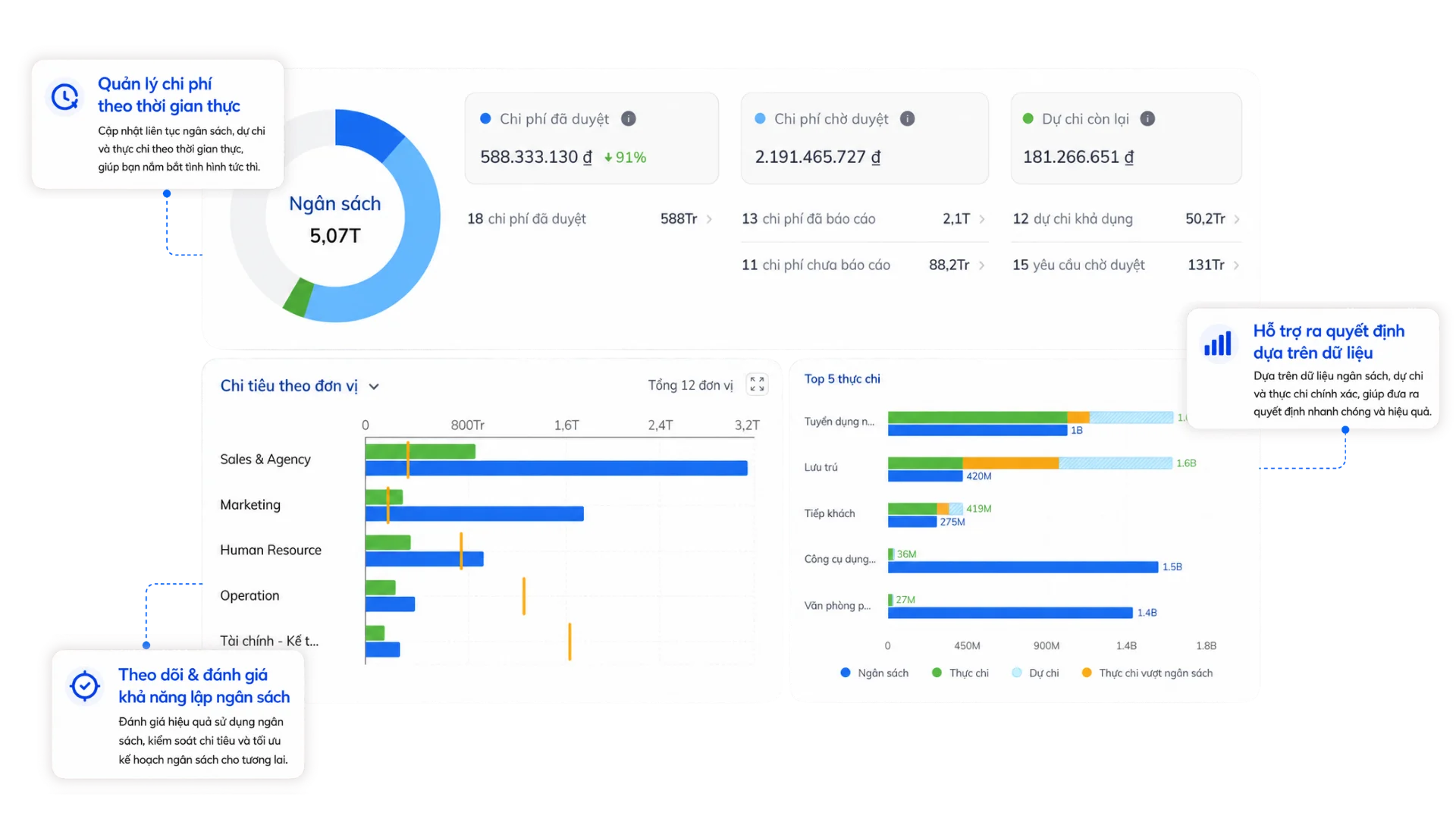
| Admin Dashboard | It provides reports across multiple dimensions such as department, project, expense type, budget, and advance payment status, enabling CFOs and Finance Managers to comprehensively monitor progress. |
Notably, Bizzi Expense Pay not only digitizes the advance payment request form but also helps Linking all data throughout the process.. Each advance payment can be linked to a budget, cost center, project, approver, and related documentation, thereby forming a whole. audit trail Fully equipped to support reconciliation, internal audit, and post-audit as needed.
For businesses with many employees who frequently travel for work or incur project expenses, creating, approving, and reimbursing requests directly on mobile devices significantly reduces processing time. Instead of waiting for documentation to be compiled at the end of the month, employees can update expenses immediately after they are incurred, while the finance department monitors the processing status in real time.
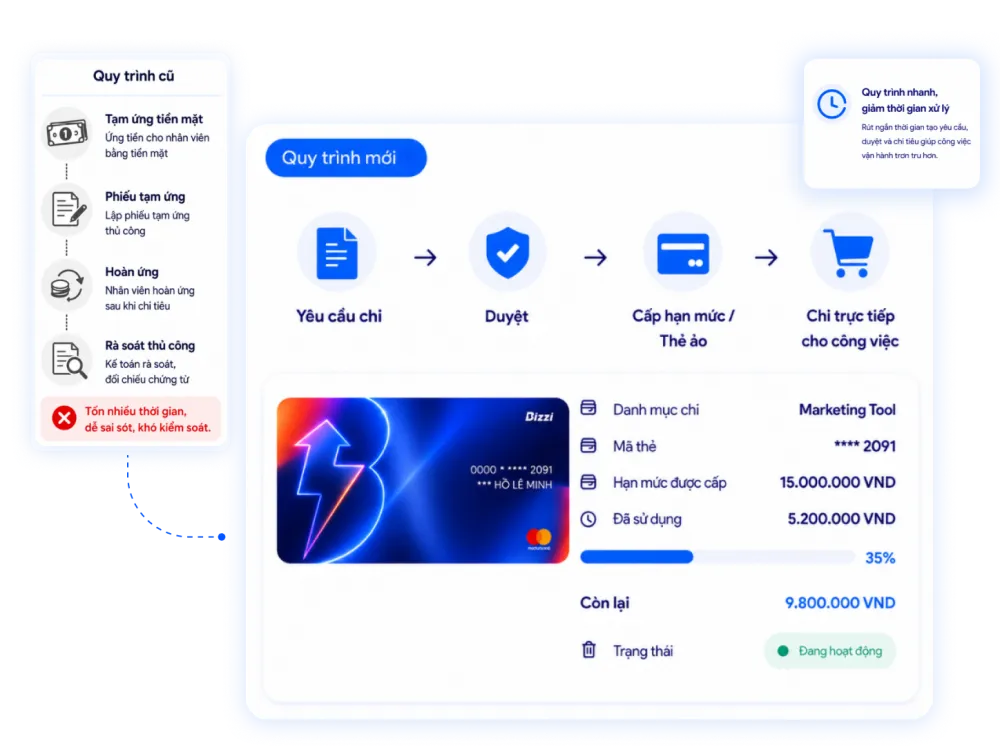
In addition, when a business needs to expand to a new model. pre-expenditure control, BBizzi Expense Pay This helps connect the approval process with the enterprise payment layer. Instead of simply providing cash or making transfers upfront, businesses can set appropriate spending limits, manage payments centrally, and synchronize transaction data with the settlement process, significantly reducing manual reconciliation between advances, documents, and actual payments.
If your business currently tracks advances using Excel and processes reimbursements via email or paper documents, the first step should be to standardize policies, limits, reimbursement SLAs, and approval flows. Then, Bizzi Expense Pay can help digitize the entire process, allowing the finance department to control advances, expenses, and documentation on a single platform, while managing corporate payments in a closed-loop process.
FAQ about advances and reimbursements
1. Are advances to employees considered expenses?
Are not. Advance payments are funds that a business pays in advance to employees or departments to perform approved work. These payments are only recognized as expenses when the employee fully repays the advance with valid invoices and supporting documents, and the accounting department verifies the amount according to regulations. During the period before final settlement, advance payments need to be tracked separately to avoid affecting the accuracy of financial statements and cash flow.
2. Can employees who haven't repaid an advance receive another one?
This depends on financial regulations and advance payment management policies of each enterprise. Generally, if employees have overdue advances, unpaid advances, or lack supporting documentation, businesses should limit granting new advances or require exceptional approval from the competent authority. This regulation helps reduce the backlog of advances and improves compliance with procedures.
3. What should the repayment period be?
There is no single timeline that applies to all businesses. The repayment deadline should be clearly stipulated in the internal regulations., Depending on the type of expense and the nature of the work. For business trip expenses, many businesses choose to calculate the timeframe from the date the business trip ends or the date the expense is incurred for convenience in settlement and closing the accounting period.
4. What should I do if I lose the receipt when getting a refund?
When invoices or documents are lost, how should accountants handle the situation? financial regulations of the enterprise and consider alternative documentation options (if accepted under internal policy and relevant regulations). In many cases, expenses lacking valid documentation may not be recognized as costs or may require further explanation before settlement.
See more content about Are business trip expenses subject to personal income tax? This
5. Should cash advances be replaced with cards or digital credit limits?
This is an increasingly common trend for businesses with frequent business travel expenses or operating costs. The use of Business cards, virtual cards, or digital spending limits. This can help reduce upfront payments, increase transaction transparency, and support budget-driven spending control. However, businesses still need to establish clear spending policies, approval flows, and reconciliation processes to ensure effective management.
6. How does the procedure for requesting an advance for business expenses differ from that for requesting an advance for purchasing goods?
Both processes begin with a request for an advance payment and end with reimbursement, but There are discrepancies between the records and the basis for settlement..
- Advance payment for business expenses. This is usually related to work requirements, travel schedules, travel expenses, accommodation, meals, and post-trip reports.
- Advance payment for purchases This typically involves purchase requests, quotations or supplier information, purchase documents, invoices, and delivery receipts (if applicable).
Clearly separating each type of process helps businesses apply the correct spending policies and corresponding documentation requirements.
7. Should the CFO review the advance payment report weekly or monthly?
For businesses with many advance payments, Real-time dashboard or weekly report This will help CFOs and Finance Managers detect overdue payments early, track advance aging, and address them promptly before they impact cash flow or the accounting period.
For small businesses with few advances, monthly reporting may still meet management needs. However, as the business expands, the frequency of monitoring should be increased to improve control.
8. What features should an advance payment management software have?
An effective advance payment management software should not only support the recording of advance payments but also cover the entire lifecycle of the advance payment. Businesses should prioritize solutions that can:
- Create and manage online advance payment requests.
- Set up approval flows based on hierarchy, expense value, or department.
- Control the budget and spending policies before disbursing funds.
- Collect, verify, and store electronic invoices and documents.
- Monitor Advance Aging and automatically reminds you to repay the loan.
- Reconcile the advance payment, actual expenses, and supporting documents.
- Provide dashboards by employee, department, project, or cost center to help CFOs and Finance Managers monitor advance payments in real time.
These features help businesses not only shorten processing time but also improve cost control, reduce outstanding advances, and enhance the quality of financial data.
Conclude
Optimizing the employee advance payment process not only shortens processing time but also creates a foundation for businesses to control cash flow, budgets, and expense data more transparently. An effective process should cover the entire lifecycle of the advance payment – from request, approval, disbursement, tracking, reimbursement to reconciliation and accounting recording – instead of focusing solely on the payment step.
As businesses expand, the number of advances and reimbursements generated daily also increases, making management using Excel, email, or paper documents increasingly ineffective, leading to slow approvals, backlogs, missing documentation, and difficulty in tracing transactions. At this point, digitizing the process not only reduces manual operations but also enhances pre-expenditure control, real-time tracking of processing status, and provides CFOs with a comprehensive view of outstanding funds.
Bizzi Expense This is a suitable solution for businesses that want to standardize and digitize the entire process of advances, reimbursements, and employee expense management on a unified platform. The system supports establishing spending policies, managing budgets by department or cost center, building automated approval flows, managing advances, collecting and verifying invoices, settling expenses, and reconciling data for accounting and management reporting. By combining these processes in a single system, businesses can improve spending control, reduce the risk of outstanding advances, and build a transparent financial data platform ready for auditing and decision-making.
To receive personalized solutions tailored specifically to your business, register here: https://bizzi.vn/dang-ky-dung-thu/