
Expenses incurred are the actual costs incurred during the course of a business's operations. This expense may have been included in the budget or it may have arisen unexpectedly. In professional discussions, "additional expenses" usually refers to anything extra beyond what was planned; it's important to clearly state this interpretation to avoid misapproval and duplicate reporting.
For proper control, track three numbers separately: actual costs incurred, amounts paid, and projected total costs upon completion. An unpaid amount may still need to be recorded in the accounting; conversely, prepayment does not mean the entire amount becomes an expense for the period.
How do unforeseen expenses differ from expenses already paid?
“"Expired," "outside budget," and "paid" describe different states. For example, the office rent for the month already used is a planned expense. Unexpected equipment repair costs could be an unplanned expense. Both may not be due for payment yet.
| Concept | The question needs to be answered. | Examples and test scores |
|---|---|---|
| Actual costs incurred | To what extent has the business utilized resources, received goods, or services? | Maintenance services have been received. The accountant will determine the nature, timing, and method of recording based on the actual records. |
| Unexpected expenses | Which items were not included in the approved plan or exceeded the projected amount? | Additional repair fees due to machine malfunction; the cause, amount, and approval authority need to be determined. |
| Payment has been made. | How much did the company pay, and on what date? | Pay several months' rent in advance; it's important to distinguish between cash outflows and expenses for each period. |
| Expenses recognized in the period | Which portion is included in this period's business results? | Purchases still in inventory, assets, and prepayments can be recognized and allocated according to their nature; the entire purchase price is not automatically considered a current period expense. |

Approved orders or proposals are data on commitments and plans. They do not, on their own, prove that goods have been received, services have been completed, or expenses have been recorded in the business results.
What types of expenses typically arise and how do they affect finances?
Materials, wages, utilities, advertising, transportation, work, and repairs can all arise during operation. What needs to be controlled is the purpose, quantity, unit price, timing, and results obtained, rather than viewing every additional expense as waste.
- Materials and transportation: Increases may occur due to increased production, price changes, or urgent deliveries. Compare both volume and unit price to distinguish legitimate cost increases from discrepancies that require adjustment.
- Labor: Overtime, additional hiring, or schedule adjustments. Verify working hours and output before concluding that costs have been exceeded.
- Operations and Sales: Utilities (electricity and water), service fees, advertising, and business trips. Link expenses to the department, usage period, and specific objectives.
- Issues and scope changes: Repair the machine, remake the product, and incorporate customer requirements. Separate the cause, identify the responsible party, and determine the recoverable or adjustable portion of the contract price.

Profits are affected when expenses are recorded in the business results.; The impact also depends on revenue and other factors. Cash flow is affected by the actual schedule of receipts and disbursements. Therefore, purchasing additional inventory, settling outstanding debts, and recording services this month can create three different impacts.
When analyzing profit margins, ROA, or ROE, accountants need to use data from the same period and consider related assets, capital, and revenue. It's impossible to conclude that efficiency has decreased simply from an increase in one expense without examining the underlying causes and the resulting business performance.
For example: the actual expenditure is 70 million VND, but the projected budget exceeds it by 5 million VND.
To determine if the budget is sufficient, you need to add the expenses already incurred to the remaining expenses. Simply subtracting the amount already paid from the budget will make the remaining balance appear larger than it actually is.
Let's assume an item has an approved budget. 100 million VND. As of the reporting date, the actual cost is 70 million, of which 45 million has been paid and 25 million remains to be paid. In addition to this actual amount, there is a 20 million commitment yet to be fulfilled and an estimated 15 million for which orders have not yet been placed.
| Tracking | Amount (million VND) | Use |
|---|---|---|
| Budget approved | 100 | The benchmark is for comparison purposes only and is not included in the cost forecast. |
| The issue has actually arisen. | 70 | This includes 45 paid and 25 unpaid. |
| Remaining commitments not yet fulfilled | 20 | Only include the portion that is not actually 70. |
| Remaining balances are not yet committed. | 15 | Estimate for the unordered portion of the work. |
| Estimated total cost of completion | 70 + 20 + 15 = 105 | Exceeding the budget by 5 million, equivalent to 5%. |
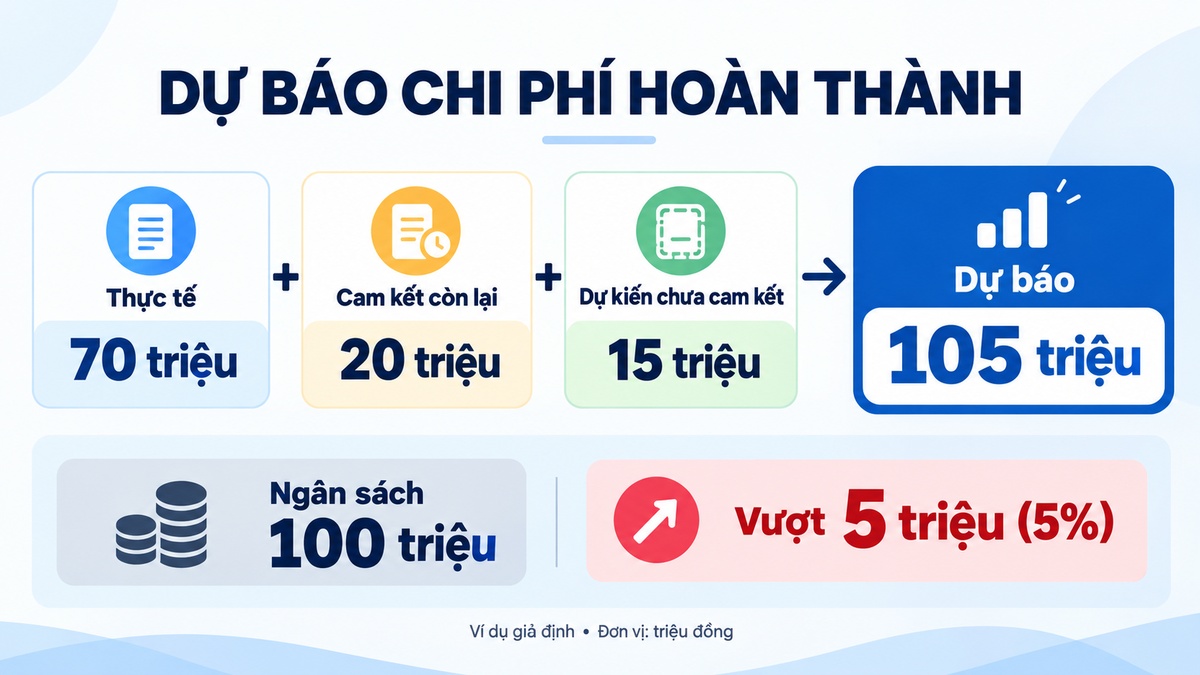
With this result, the person in charge needs to review the uncommitted 15 million, adjust the scope, or request additional budget before placing the order. If the overspending comes from a project with changes in schedule and scope, apply the following approach. project cost management To track each item and change separately.
What should be checked when recording incurred expenses?
Accounting determines the nature of the transaction and the recognition period from the actual goods and services and related documentation. The payment date or the date on the invoice is not the only basis for all cases.
The accrual basis principle in Accounting Standard No. 01 requires that transactions be reflected at the time they occur, rather than solely based on the receipt or disbursement of funds. The matching principle and recognition conditions also help to distinguish expenses in the period from assets or items requiring allocation. Reference can be made to part of Standard No. 01 in... Accounting documents published by the Ministry of Finance.
- Confirm the transaction: Received goods, used services, or completed a part of the work; verified against the contract, delivery, and acceptance procedures when appropriate.
- Determine the period and value: Clearly state the usage period, the completed portion, and the basis for payment; handle estimated costs or missing documents according to applicable accounting regulations.
- Proper classification based on nature: Production, sales, administrative, or financial expenses; and determine whether that amount falls under inventory, assets, prepaid, or current period expenses.
- Attach a tracking code: Department, project, contract, expense group, and responsible person. A transaction is recorded only once within the same tracking system.
- Verify and complete the documents: Verify the figures with the requesting party, supplier, accounts payable, and payments; record the basis for adjustments if discrepancies occur.
For example, if maintenance services were completed in March and their value can be determined, but payment is made in April, the transaction should be recorded in March. If the March invoice is only a prepayment for unused services, the handling would be different. A full invoice does not automatically prove that goods or services were actually received.
Address unplanned expenses before committing to spending.
Additional payments need to be described in terms of their cause, value, impact on output, and the authority responsible for making the decision. Approval after purchase only addresses the documentation and does not allow businesses to choose an option from the outset.
- Prepare a supplementary proposal: Record the items to be purchased, the reason for the change, the timeframe, the quoted price, and the risks if the transaction is not completed.
- Compare the options: Consider whether to repair or replace, buy immediately or in installments, adjust the scope or request additional budget. Compare quality, timeline, and related costs.
- Check your budget and payment schedule: Use the same period, scope, and tax base for comparison; separate the incurred costs, remaining commitments, and projected uncommitted funds.
- Submitted to the appropriate authority: The approver makes decisions based on limits, responsibilities, and internal regulations; and records the amount, conditions, and approved version.
- Follow-up after approval: Verify goods or services received, update actual figures, accounts payable and payment schedule; explain any end-of-period discrepancies.

In the event of an emergency, regulations should specify who has the authority to make decisions, temporary limits, required documentation, and reporting deadlines. The emergency nature of the event should not be used to excuse the omission of reasons and accountability.

If your business doesn't yet have a clear budget and spending limits, start with... spending and budgeting before setting up overspending alerts.
The tracking sheet needs to link each expense to the person responsible.
Each tracking entry should have a unique code, actual figures, and remaining work. A single "spent" column will not be sufficient when simultaneously tracking advances, accounts payable, and orders in progress.
| Data group | Information to be recorded | Confirmer |
|---|---|---|
| Identification and purpose | Transaction code, department/project, content, usage period, expense group. | The department made the request. |
| Plans and changes | Original budget, approved supplementary budget, reasons and basis for approval. | Budget owner and approver. |
| The reality and the rest | Values incurred, commitments not fulfilled, projections not committed; updated overall forecast. | The department responsible for coordinating accounting. |
| Payment and records | Paid, outstanding, payment deadline, document status, and record reference. | Accounting review, relevant department to provide additional information. |
| Action to be taken | The difference, the solution, the person in charge, the deadline, and the result. | The manager is responsible. |
Accounting verifies the nature and figures; the user department confirms the needs, volume, and results; management decides on priorities and approves changes. Purchasing, human resources, and related departments provide quotations, contracts, labor data, or performance records according to their responsibilities.
Review expenses weekly or by work milestone when they fluctuate significantly; reconcile with accounting records at the end of the period. Focus on discrepancies that affect budgets, outputs, and cash schedules; avoid reducing every item by a uniform rate that compromises operational efficiency.
Frequently Asked Questions about Additional Costs
Are unexpected expenses always considered unusual expenses?
No. Salaries, utilities, or recurring services also arise from normal operations. When referring to unplanned additional expenses, it should be clearly stated as "outside the budget" or "additional expense," along with a comparison point.
What are the additional costs associated with English language services?
In the context of incurred costs, "costs incurred" can be used. When referring to unforeseen or additional costs, it is necessary to add "unplanned" or "additional costs" depending on the context; do not use one translation for all cases.
If there is no invoice, can the incurred amount be disregarded?
It is necessary to verify the transaction, value, and existing records, determine the appropriate accounting treatment, and continue requesting supporting documents. Do not disregard the matter simply because payment has not been made or invoices have not been received; nor should you create your own figures without a basis.
Do debit and credit transactions represent cash outflows and cash receipts?
This conversion method cannot be applied to all accounts. Debit/Credit transactions describe the account's accounting entry; the increase or decrease depends on the specific account and transaction. Budget tracking tables should separate expense and payment statuses instead of using these two terms as column names for revenue and expenditure.
When it is necessary to link the budget with the expenditure request and approval.
When multiple departments submit requests, difficulties often lie in sharing budget limits, locating records, and updating actual figures. In such cases, businesses need to standardize expense codes, approval flows, and update responsibilities before selecting a tool.
Bizzi Expense Pay supports needs such as managing spending within limits, submitting and approving requests, tracking budgets, and generating spending reports. The scope of features, permissions, and data connectivity need to be confirmed according to the deployment configuration; the software does not replace accountants in deciding the nature of business transactions or tax conditions.
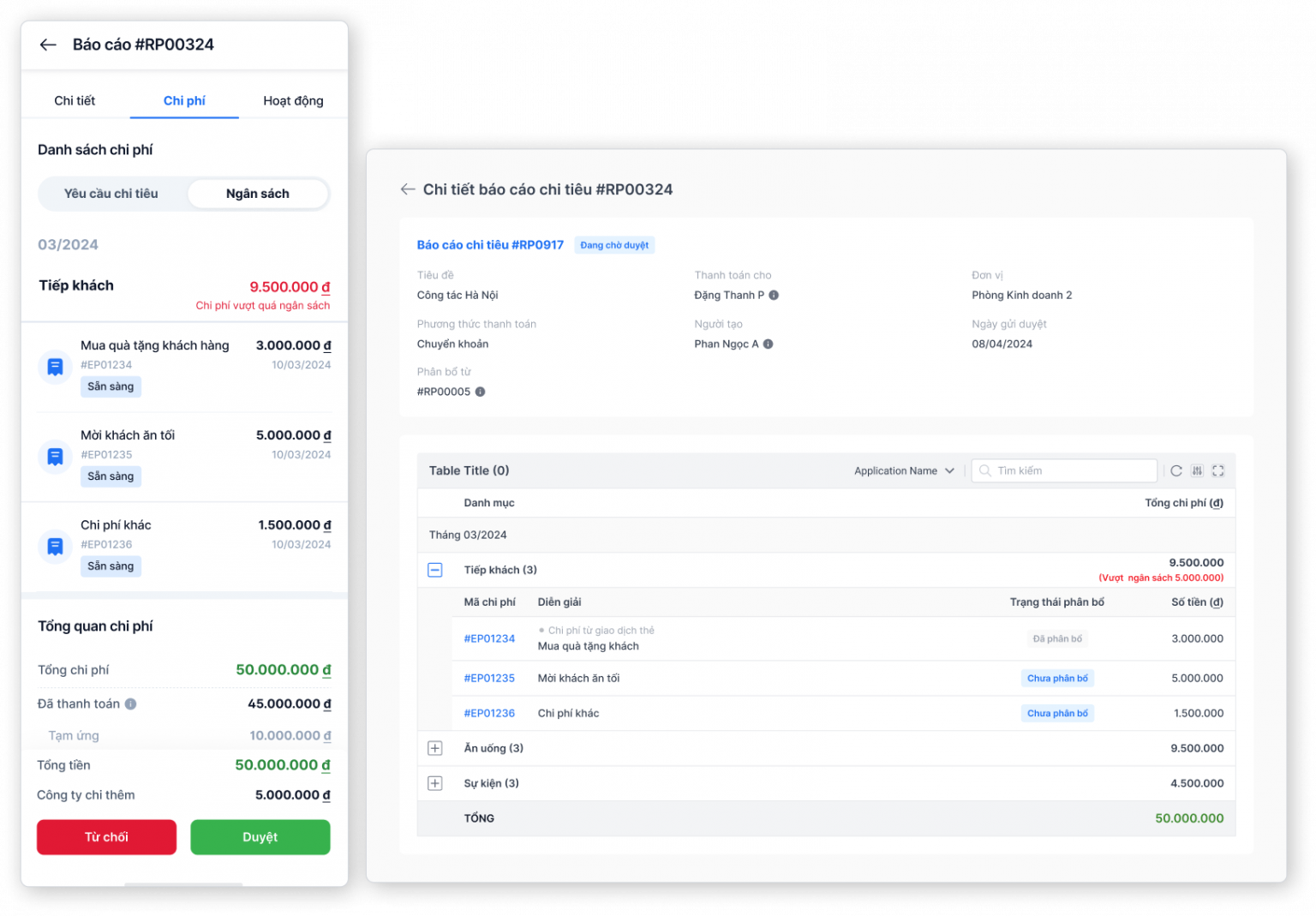
Do you need to manage expenses from proposal to actual reporting? We spoke with Bizzi about the approval process, limits, and expense data our business is currently using.