


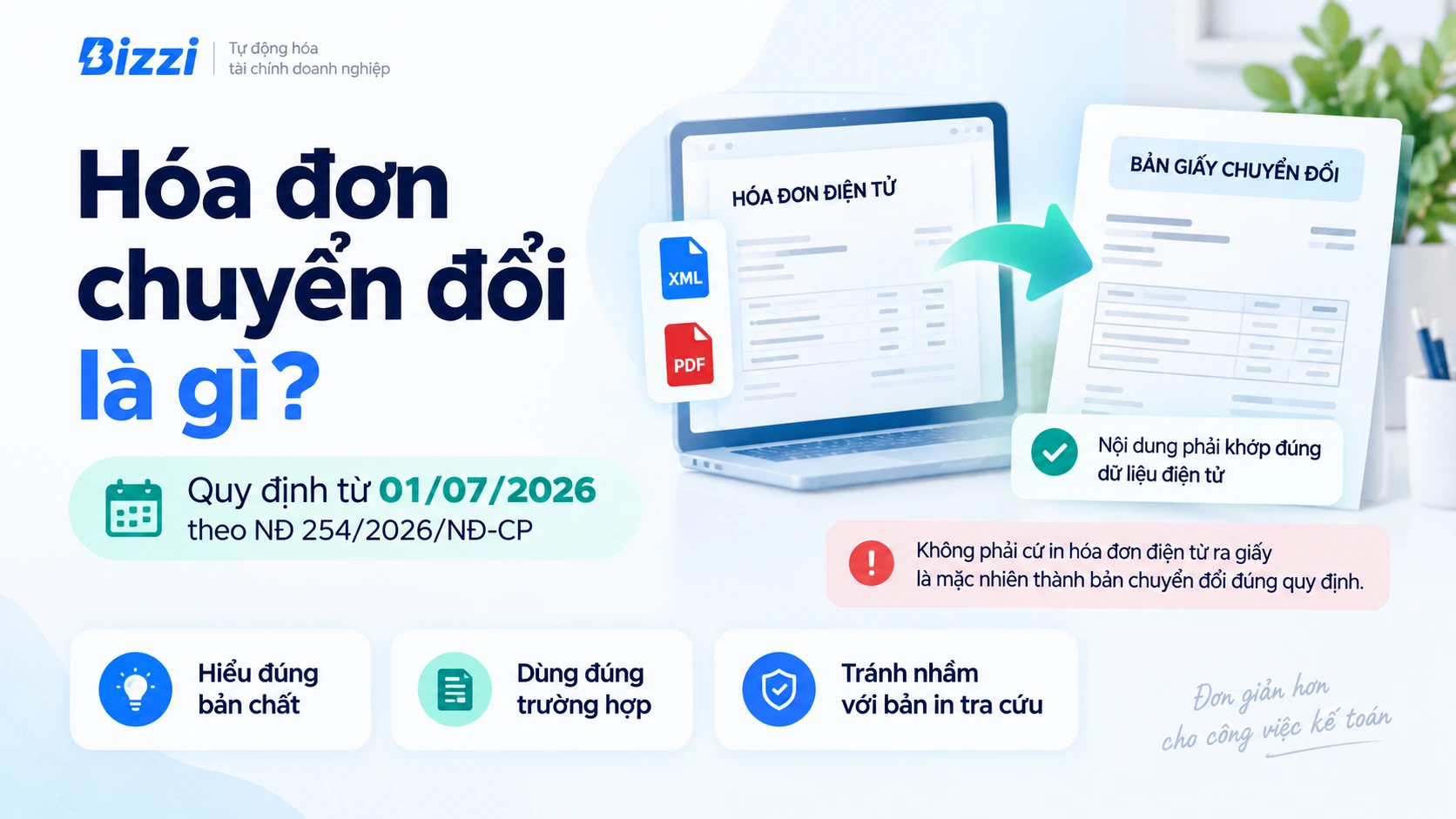
Conversion Invoice This is a paper copy created from a legally valid electronic invoice in cases permitted by law. From date 01/07/2026, Decree 254/2026/ND-CP clearly stipulates when electronic invoices can be converted to paper, what conditions must be met for the paper copy, and in which cases it cannot be used for transactions or payments.
What is a conversion invoice?
A converted invoice is The paper copy was converted from a legally valid electronic invoice.. The content on paper must match the electronic data, and the conversion must meet requirements for data retrieval, identification of the conversion, and the unit or person performing the conversion.
Therefore, accountants need to differentiate. conversion invoice with a printed PDF or a printout from a search screen. These two types of printouts may look similar, but they don't always have the same practical value.
Current regulations: Decree 254/2026/ND-CP, effective from July 1, 2026.
What are converted invoices used for, and when should they be converted to paper?
From July 1st, 2026, legally valid electronic invoices will be converted to paper invoices. two groups of cases: as required by competent authorities or according to economic and financial procedures for the purpose of record-keeping and monitoring.
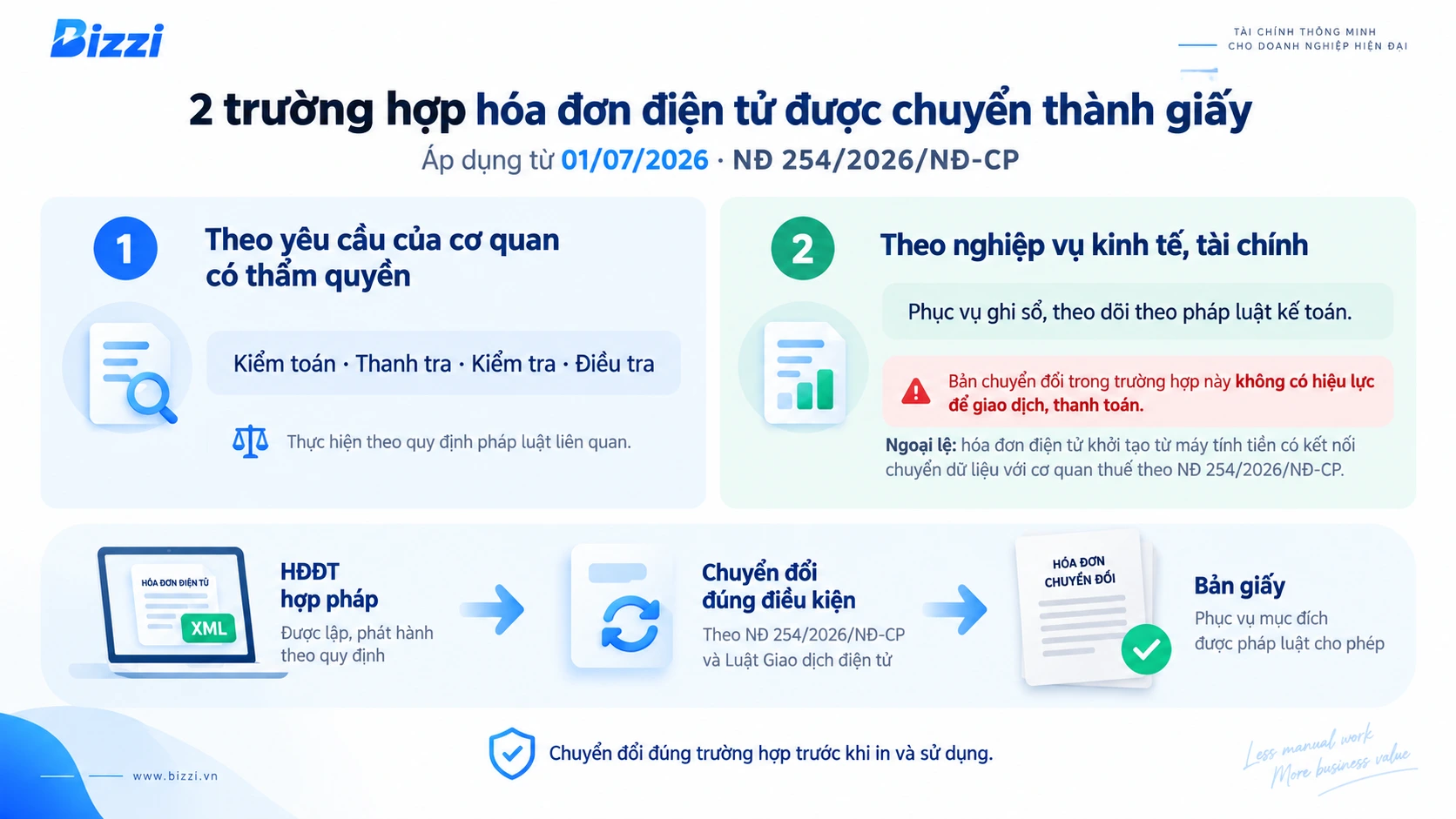
As requested by the competent authority
Electronic invoices may be converted into paper form upon request from auditing, inspection, investigation, and other relevant legal regulations.
Serving economic and financial operations.
Businesses can convert to paper-based systems to facilitate record-keeping and tracking in accordance with accounting laws when actual transactions require the use of paper documents.
If you need to review other changes to electronic invoices from July 1, 2026, Bizzi has compiled them separately in this article. Decree 254 and Circular 91: Points businesses need to update..
What information should a converted invoice template include?
Decree 254/2026/ND-CP and regulations on electronic transactions do not provide a single Word file for businesses to download and fill out themselves. What needs to be checked is... Will the invoice content remain unchanged, and will the paper copy contain sufficient information to identify and retrieve the conversion?.
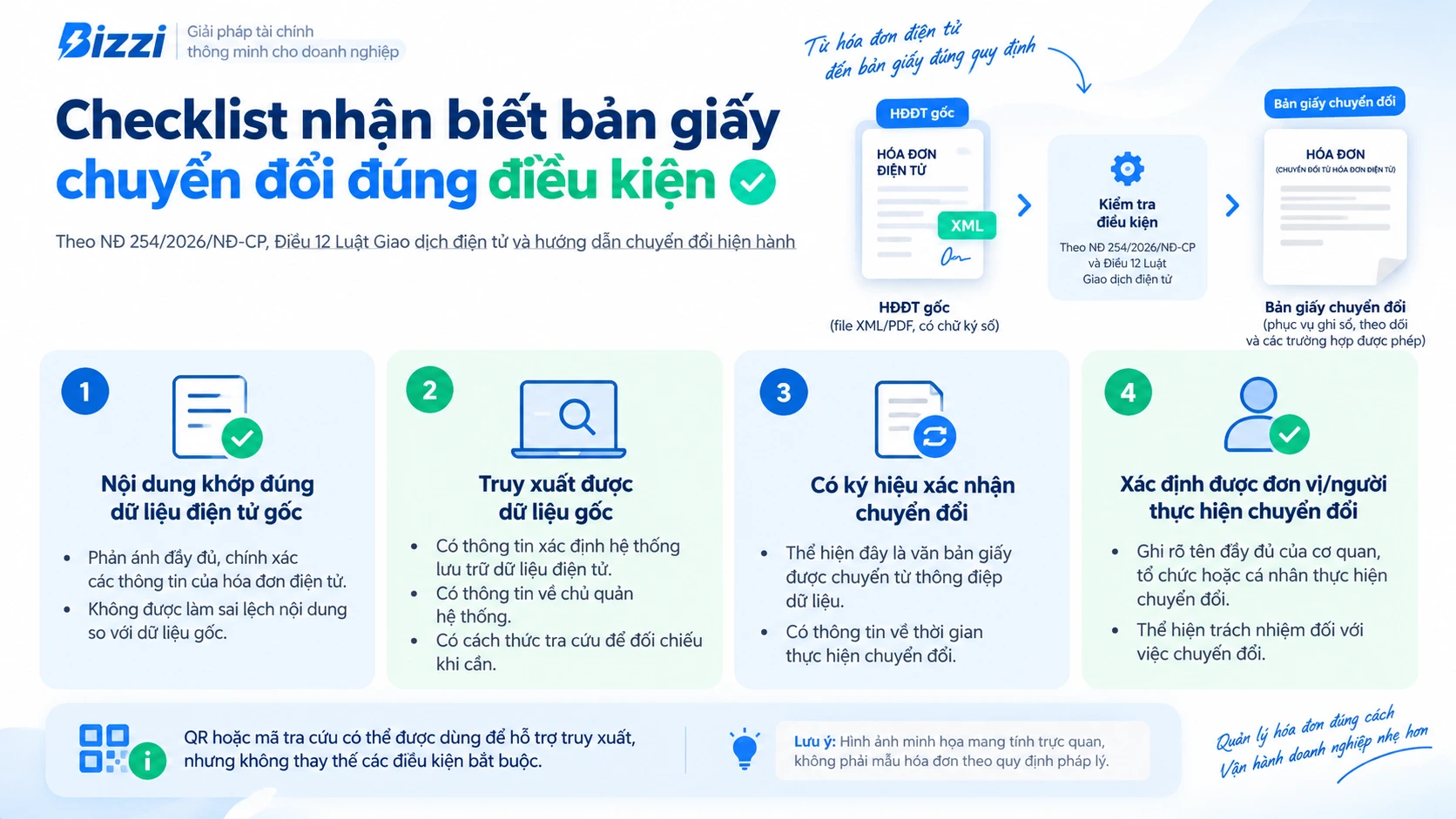
Decree 137/2024/ND-CP allows the use of links or access codes to retrieve original data. QR codes can be added to support retrieval, but QR codes do not replace the required information for conversion..
Details regarding the requirements for converting electronic data to paper documents: Decree 137/2024/ND-CP.
What are the uses of a converted invoice?
It shouldn't be simply understood that a converted invoice "has" or "doesn't" have legal validity. Accountants need to determine... In what circumstances are paper documents converted and for what purposes are they being used?.
| Situation | How to use |
|---|---|
| Record keeping and tracking. | Paper copies can be used for accounting purposes when the conversion is appropriate and meets all the necessary conditions. |
| Transactions, payments | For converted versions used for economic, financial, and accounting purposes, the paper version is not valid for transactions or payments. Decree 254 makes an exception for electronic invoices generated from cash registers as stipulated. |
| Internal records | Businesses may stipulate that paper documents are used as supporting documents in internal processes. This internal regulation does not alter the legal validity of paper documents. |
When receiving a paper document, an accountant should check three things: From which electronic invoice was this document created, what was it converted for, and is the original data recoverable?.
Distinguishing between electronic invoices, converted invoices, and printed lookup invoices.
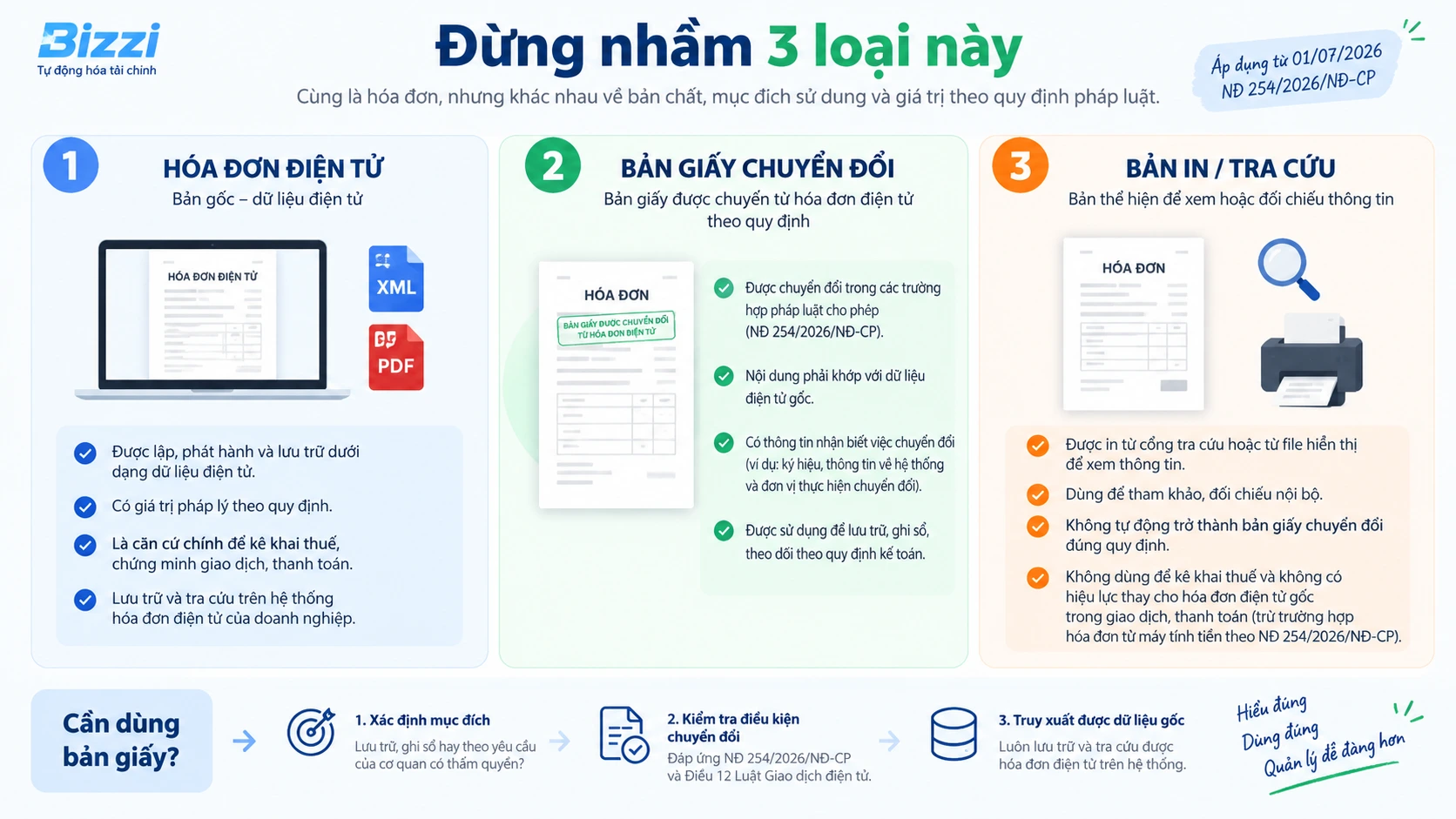
Three types of documents can all display the information of an invoice, but they differ in nature and purpose. The most important point is... A printed copy for viewing information does not automatically become a properly converted paper copy..
| Criteria | Electronic bill | Paper conversion | Print/Lookup |
|---|---|---|---|
| Nature | Invoices are created, sent, received, and stored as electronic data. | Paper documents are converted from electronic invoices in cases and under conditions stipulated by law. | Printables from display files, screens, or lookup systems are used to view and compare information. |
| Accessibility | Managed through an electronic invoicing system. | Information is needed to identify the system, the entity managing the system, and access the original data. | There may be a lookup code or reference information, but it does not automatically meet the conversion requirements. |
| Conversion information | Not applicable. | It includes a conversion symbol, time, and information about the agency, organization, or individual performing the conversion. | This information is not required. |
| Is this a conversion? | Not a paper copy. | Yes, when the conversion is done correctly and meets all the necessary conditions. | Are not. Clicking "Print" does not automatically convert the paper copy into a converted invoice. |
How to convert electronic invoices to paper invoices
The interface of each software may differ, but accountants can control the process in the five steps below. The goal is not just to find the "Print" button, but to create the correct paper copy while still being able to retrieve the original electronic invoice.
-
Step 1: Identify the correct electronic invoice to be transferred.
Before proceeding, check the seller, buyer, invoice number, date, and contents of the invoice.
-
Step 2: Determine the reason for needing a paper copy.
Clarify whether the conversion was carried out at the request of a competent authority or to serve economic, financial, and accounting purposes.
-
Step 3: Perform the operation on a system with conversion functionality.
The system must be able to retrieve the original data, generate information identifying the conversion, and preserve the invoice content.
-
Step 4: Check the paper copy
Compare the content, conversion time, unit or person performing the conversion, and the information used to retrieve the original data.
-
Step 5: Continue saving and managing electronic invoices.
Paper copies do not replace the responsibility of preserving electronic data. Businesses still need to keep electronic invoices for future reference and transaction processing.
How should electronic invoices and their converted versions be stored?
Decree 254 requires that invoices and supporting documents be preserved and stored safely, securely, and in their entirety, without being altered or corrupted during the storage period; the retention period shall comply with accounting laws.
For accountants, the practical principle is Do not let paper documents become the only source of data.. Businesses still need to retain electronic invoices and the ability to retrieve the original data, while the converted version is saved according to the needs of the records and transactions.
Frequently asked questions
Who is responsible for making the conversion on the electronic invoice?
The law does not prescribe a single job title for all businesses. The document must show the full name of the agency, organization, or individual carrying out the conversion. Businesses should delegate authority to the person performing the conversion according to their internal systems and procedures.
Do converted invoices require signatures or stamps?
There is no general rule that every converted invoice must have a handwritten signature or company seal. The general requirement is that it must include identifying information about the conversion and the name of the entity or person performing the conversion. The Electronic Transactions Law has specific requirements regarding signatures and seals when the data being converted is an electronic certificate.
Are electronic invoices still limited to one conversion at a time?
Current Decrees 254/2026/ND-CP and 137/2024/ND-CP do not stipulate a general condition that each electronic invoice can only be converted once. Therefore, the rule of "conversion only once" should not continue to be used as a general legal requirement unless there is other specialized basis applicable to specific cases.