


The retail industry is facing a double pressure: massive multi-channel transaction volumes and thin profit margins. For CFOs, maintaining a manual accounting team is no longer a sustainable option.
This article by Bizzi provides a comprehensive roadmap on Automating the financial processes of retail chains.This helps businesses free up resources and optimize cash flow (CCC) through AI & RPA technology.
What is financial process automation in the retail industry?
Automating financial processes in the retail industry involves applying technologies such as RPA (Robotic Process Automation), AI (Artificial Intelligence), and OCR (Optical Character Recognition) to automatically perform core financial tasks such as account payable processing (AP), order reconciliation (O2C), and financial reporting. The goal is not only to reduce manual work but also to redefine the role of the finance department in modern retail businesses.
In the traditional model, accountants primarily act as "bookkeepers"—recording and processing data after transactions have occurred. However, as retail chains expand with thousands of transactions daily, this model reveals significant limitations: errors accumulate with volume, personnel costs increase linearly, and reporting delays make it difficult for CFOs to make timely decisions.
The hidden cost of manual operations doesn't lie in a single error, but in the cumulative cost of mistakes, rework time, and compliance risks. A single incorrect invoice can trigger a chain of consequences: requiring reconciliation with the supplier, adjusting accounting entries, delaying payments, or even generating tax risks due to invalid documentation. When these discrepancies occur on a scale of thousands of transactions per month, operating costs and financial risks increase exponentially.
Therefore, digital transformation in retail finance is no longer just an improvement option, but a strategic priority. In this context, automating retail chain finance processes helps shift the finance department from a cost center to a strategic partner, where data is processed near real-time and directly contributes to optimizing cash flow.
So what are the biggest bottlenecks in retail finance operations that need to be automated?

3 core automation pillars that help retail chains optimize cash flow.
Here are the details of the three core automation pillars that help retail chains optimize cash flow:
Automating accounts payable (AP) in the Procure-to-Pay (P2P) process.
In the retail industry, accounting departments have to process thousands of invoices each month from hundreds of suppliers. This creates enormous pressure on data entry, reconciliation, and validity verification, especially in the context of the increasing risk of fraudulent invoices or invalid tax identification numbers.
Automating the financial processes in the retail industry. It starts with standardizing the input data. When the Master Data is not consistent, deploying robots will only amplify errors. Therefore, the fundamental step is always cleaning up supplier data and product catalogs.
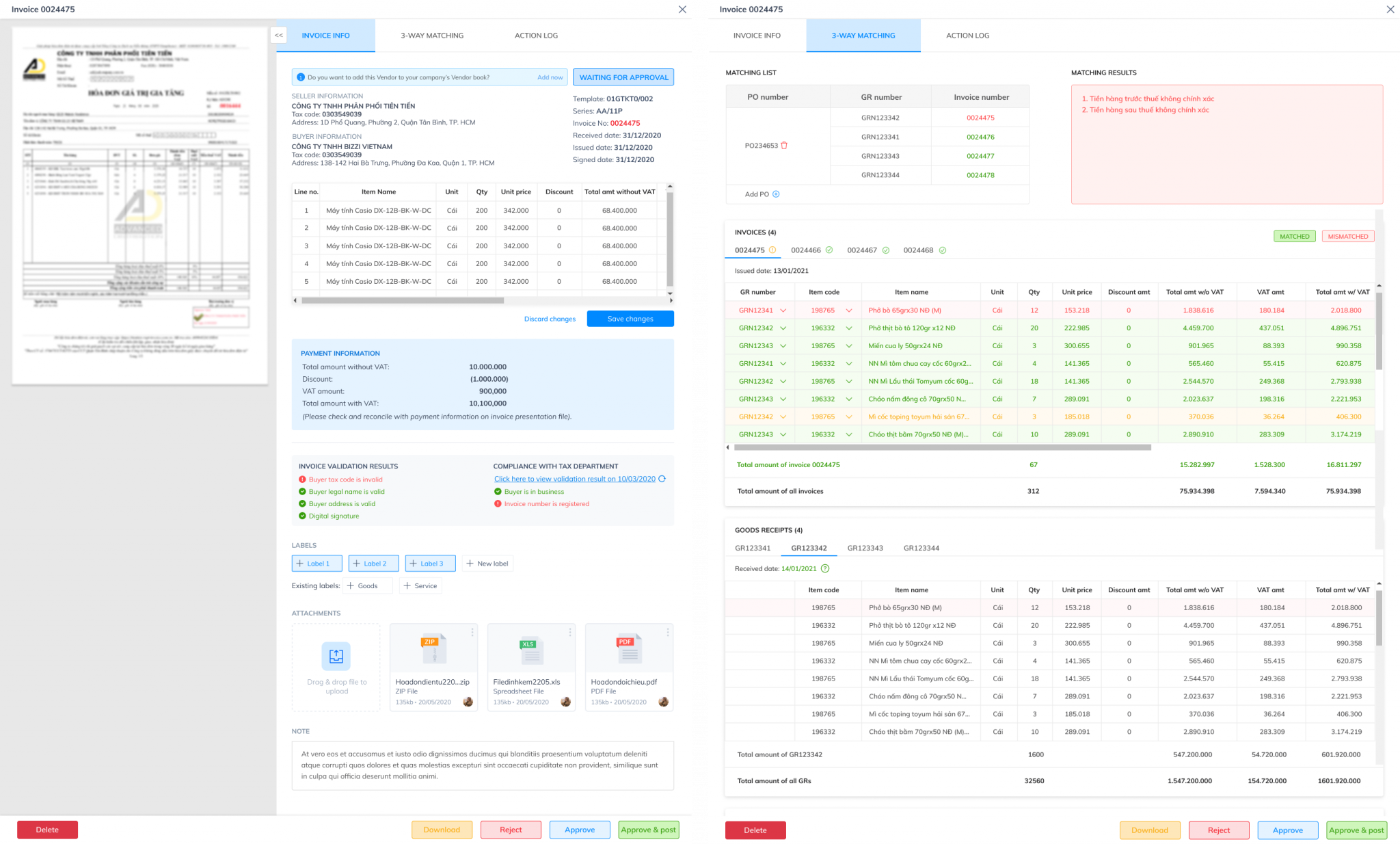
Bizzi's solution addresses this problem through Bizzi Bot. The system automatically collects invoices from email or data portals, then uses AI to extract information and process them. 3D matching process Transactions between Purchase Order (PO), General Manager (GR), and Invoice are processed in real time. Only transactions that match the 100% code or have acceptable tolerance levels are pushed into the ERP system for accounting.
As a result, businesses not only reduce invoice processing time but also virtually eliminate the risk of incorrect payments or fraud. This is the foundation of tax risk management in a multi-vendor retail environment.
Optimizing accounts receivable (AR) and cross-channel (O2C) revenue reconciliation.
If the AP is the place that controls the outflow of money, then... O2C (Order-to-Cash) is the key factor determining the speed and accuracy of cash flow.In the multi-channel chain store and retail model, the challenge doesn't just stop at reconciling COD payments from shipping companies, but also involves integrating data from various sources. POS, e-wallets, credit cards, and cash in-store.
The challenges of data fragmentation: The biggest problem lies in matching the revenue recorded in the internal system with the actual data coming in from dozens of bank statements and e-wallets. When done manually in Excel, errors such as: The store manager entered incorrect data, used incorrect transfer syntax, or there were discrepancies in payment fees between different e-wallets… This becomes a barrier that causes accountants to spend days "cleaning" the data. As a result, revenue reports are always delayed, creating a risk of cash flow loss and increasing the DSO (Demand on Sales) ratio.
The Power of Automation & AI: RPA acts as an automated "digital assistant" that collects and reconciles data in multiple dimensions: matching POS revenue with bank/e-wallet statements and electronic invoice data in real time. The system will automatically detect and alert to discrepancies (overall or detailed down to individual transactions) immediately.
Meanwhile, AI helps analyze revenue fluctuations by channel/store to forecast cash flow and manage debt risk. As a result, CFOs not only shorten reconciliation time from several days to just a few minutes but also gain a comprehensive overview to make timely business decisions.
This is a significant step forward in financial digitalization: shifting from "processing past data" to "managing cash flow in real time," transforming complex reconciliation processes into a competitive advantage for retail chains.
Automated Record-to-Report (R2R) and multi-dimensional financial reporting.
In the retail chain model, financial data is fragmented across systems ranging from POS systems and inventory software to ERP. This fragmentation makes the process of consolidating reports a time-consuming and error-prone task. The solution...R2R Automation It was created to bridge this data gap, transforming manual accounting into real-time digital management.
R2R Process Automation This allows the system to automate general ledger entries and instantly synchronize transaction data from all stores.
- Automatic accounting: Eliminate manual data entry, minimizing discrepancies between POS and accounting systems.
- Fast Close: Instead of waiting 5-10 days after the end of the month, CFOs can now track business performance on a daily, even hourly, basis.
When the R2R process is integrated Enterprise performance management (EPM) systemThe true power of new data is unleashed through multidimensional reports:
- Granular Insights: Track revenue, expenses, and profits in detail by geographic region, sales channel (online/offline), or specific product category.
- Accurate prediction: Normalized data from the R2R process is a reliable input for building financial scenarios and forecasting cash flow.
Automating the Record-to-Report process isn't just about software; it's a revolution in the role of the finance department.
“By freeing up 70% time for data aggregation tasks, the finance team can shift its focus to in-depth data analytics (FP&A), directly engaging in strategic advisory and profit optimization for the business.”
5-Step Roadmap for Successful Digital Transformation in Retail Finance 2025-2026
To successfully implement digital transformation in the retail finance industry, businesses need a clear roadmap rather than deploying individual tools in a piecemeal fashion.
First, the CFO needs to assess the company's digital maturity level, clearly identifying bottlenecks in current processes. Next, they should standardize processes using the "simplify first" principle – simplify before automating.
The third phase is the "quick-win" option, where AP Automation often delivers the fastest results due to its large transaction volume and clear ROI. After that, The system needs to be integrated with ERP. Using APIs to ensure data integrity.
Ultimately, the key to success lies not in technology but in people. Businesses need to build a digital culture and implement change management to ensure their accounting team is ready to adapt.
An important caveat: deploying RPA on unstandardized processes will create “technical debt”—where errors are automated and scaled up at a faster rate.
KPIs for measuring ROI when implementing financial automation for chain stores.
The effectiveness of What is retail finance process automation? It cannot be judged solely on subjective feelings; it needs to be measured using specific indicators. Before automation, processing a single invoice could take 5–15 minutes, with error rates ranging from 2–51 TP3T. After implementing a system like Bizzi, this time dropped to under 30 seconds, and accuracy approached 1001 TP3T.
The closing cycle is also shortened from 10–15 days to 3–5 days, giving CFOs earlier access to financial data for decision-making. Simultaneously, operating costs are reduced by 40–60% due to economies of scale, while reconciliation capabilities are upgraded from periodic to real-time.
More importantly, ROI comes not only from cost savings, but also from the value of working capital freed up and the additional revenue generated through improved operational efficiency.
What are common questions CFOs ask about retail finance process automation? (FAQ)
CFOs in the retail industry typically focus on ROI (return on investment), deployment speed, compliance, and cash flow optimization when automating financial processes. Common questions revolve around reducing operating costs and ensuring data accuracy. Integrated ERP/POS systemsand information security.
Below are the groups of FAQ (frequently asked questions) that CFOs are interested in:
Will automation completely replace accountants?
No. Technology will replace repetitive tasks, but the analytical and control roles of accounting will remain crucial. The finance department will shift to a more strategic role.
Can the Bizzi system be integrated with existing ERP systems?
Yes. Bizzi acts as a middle-layer, capable of integrating with legacy systems via API or RPA without requiring a complete ERP replacement.
How will Decree 70/2025/ND-CP affect things?
This decree tightens regulations on electronic invoices, especially for retail models using cash registers. Therefore, data automation and standardization become mandatory requirements to ensure compliance.
How long is the payback period?
Typically, this takes 6–12 months, depending on the transaction size and level of automation.
How is data security ensured?
Platforms like Bizzi adhere to international security standards (ISO), ensuring the safety of financial data.
How can we prevent the accounting team from "resisting"?
Training, internal communication, and demonstration of practical benefits are needed to shift the perception from "being replaced" to "being upgraded."
Conclude
What is retail finance process automation? It's no longer a conceptual question, but a survival strategy in the context of fierce competition and increasingly thin profit margins. When implemented correctly, Automating the financial processes of retail chains. This not only helps reduce operating costs but also optimizes cash flow, shortens the CCC cycle, and enhances the CFO's decision-making capabilities.
Solutions like Bizzi act as a connector for the entire financial ecosystem – from invoices and contracts to ERP – creating a unified and transparent data platform. This is the core foundation for business success. Digital transformation in retail finance and build a sustainable competitive advantage in the 2025–2026 period.
To receive advice on effective corporate financial management solutions, schedule an appointment with Bizzi here: https://bizzi.vn/dat-lich-demo/