


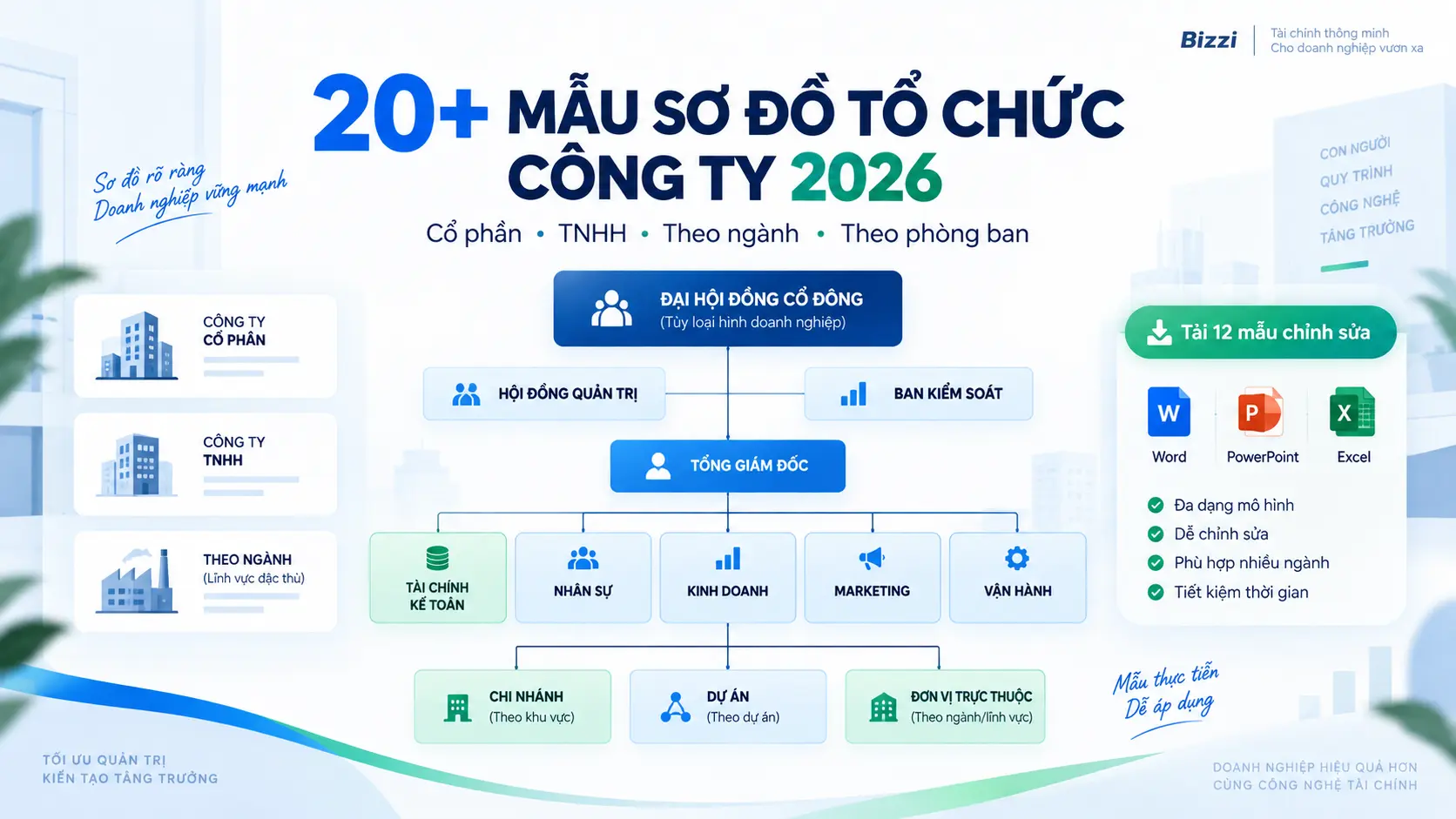
There is no single organizational chart that fits every business. The model should be chosen based on four factors: legal form, size, operating method, and industry. A joint-stock company needs to accurately reflect the legal governance structure; a small business needs a streamlined, low-level structure; and a multi-project enterprise may require a matrix model.
This article compiles over 20 sample designs for reference, categorized by business type, operating model, industry, and department.
Quickly select an organizational chart template that suits your business.
Choose based on the operational scenario first, then adjust the department names and job titles. The table below helps determine which pattern to look at first.
| Demand | Sample to see | Why is it suitable? |
|---|---|---|
| Joint Stock Company | 2 models of joint-stock companies | It is necessary to properly separate the management layer according to Article 137 from the operational department layer. |
| Limited Liability Company | Chairman of the company or Board of Members | The owner, as an organization, can choose one of two management models. |
| Limited Liability Company with Two or More Members | Board of Directors → Chairman of the Board of Directors → Director/General Director | It's suitable to set up a legal management layer before adding departments. |
| Small businesses/SMEs | Compact functional structure | Fewer management layers, potential for role merging while maintaining a clear reporting line. |
| Multiple projects running simultaneously. | Matrix structure | Allows for the integration of expertise management and project management. |
| Multiple regions/branches | Geographic structure | Separate the central headquarters and responsibilities by region. |
| Manufacturing enterprise | Production sample | Clarify the roles of Production, Planning, QA/QC, Purchasing, and Logistics. |
| Construction company | Construction model | Separate the project/construction, design, supervision, and materials blocks. |
| Retail chain/multiple outlets | Chain business model | Separate the headquarters, regional management, and store/point of sale divisions. |
What is a company organizational chart? How does it differ from corporate governance?
A company's organizational chart is a visual representation of the structure, positions, departments, and reporting relationships within a business. It answers questions such as: which department belongs to which block, who manages whom, which level is responsible for operation, and how the functional groups are organized.
Meanwhile, business administration It encompasses a broader scope: including mechanisms for guidance and supervision, the rights and responsibilities of governance entities, and how the enterprise makes and controls important decisions. Therefore, "corporate governance chart" should not be equated with "organizational chart".
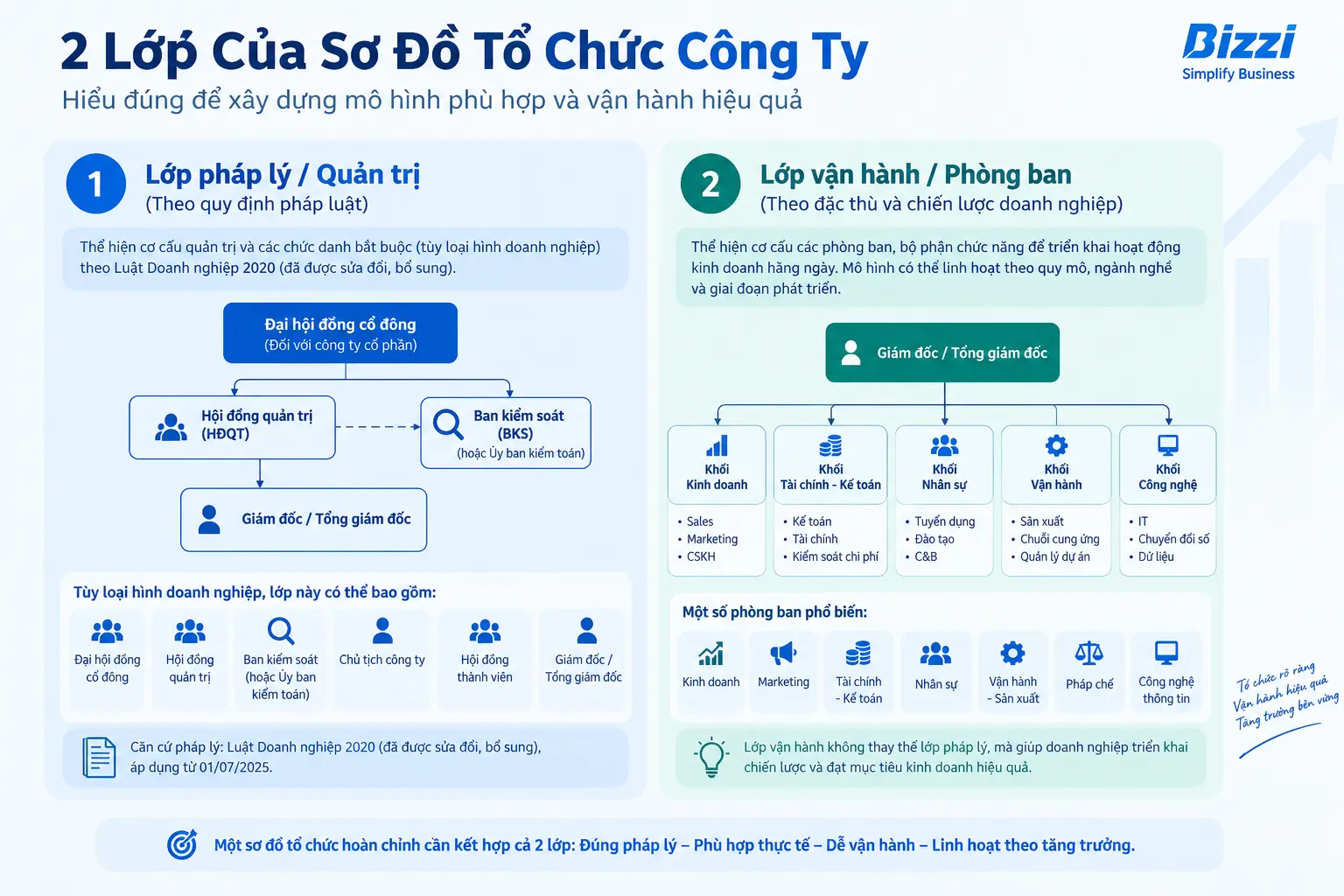
Legal/Administrative Class
This illustrates the management structures and positions according to the type of business and its charter. For example, in a joint-stock company, there is the General Meeting of Shareholders, the Board of Directors, the Director/General Director, and supervisory bodies according to the applicable model.
Operating Class
This represents the departments designed by the business based on actual needs, such as Finance - Accounting, Sales, Marketing, Operations, Human Resources, Production, Purchasing, or Logistics.
These two layers may appear on the same diagram, but it's necessary to clearly indicate which part is which. legal framework and to some extent just illustration department.
5 common organizational structure models and when to choose one.
The five most common models are hierarchical, functional, matrix, geographic, and planar. This is the operational layer arrangement; businesses must still ensure that the legal and governance layer is appropriate for their type.
| Model | Suitable when | Main advantages | Points to control |
|---|---|---|---|
| Hierarchy | A clear chain of command and hierarchical responsibility is needed. | It is easy to identify superiors and authority. | Avoid having too many layers that slow down decision-making. |
| Function | Businesses specialize by department. | Focus on professional expertise. | A mechanism for inter-departmental coordination is needed. |
| Matrix | Many projects share resources. | Flexible expert allocation | The authority of functional managers and project managers must be clearly defined. |
| Geographically | Many regions, branches, factories | Rapid local response | Avoid duplication of functions and lack of common standards. |
| Plane | Small team, need speed and autonomy. | Fewer floors, faster communication. | It's difficult to scale up if decision-making authority isn't clear. |
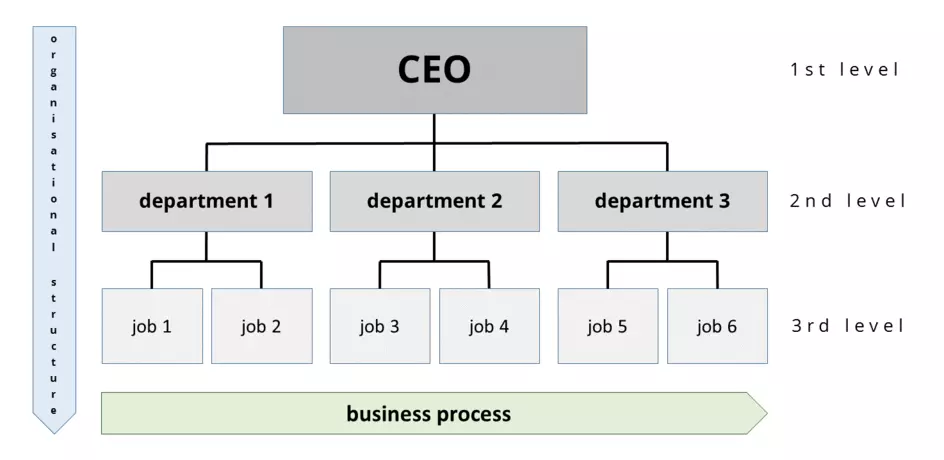
Hierarchical organizational chart
The hierarchical model arranges positions from top management down to lower levels. Each position typically has a direct superior, suitable for businesses that need clear accountability and reporting flows. When implementing this model, the number of management levels should be limited to what is truly necessary.
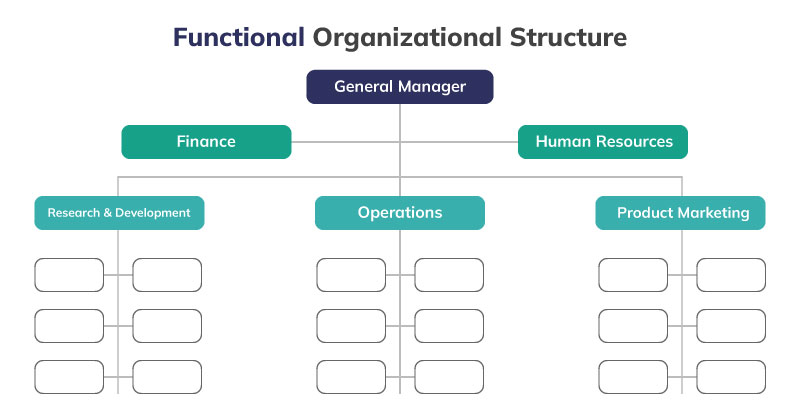
Functional organizational chart
This model organizes personnel into functional teams based on specialization, such as Sales, Marketing, Finance-Accounting, Human Resources, or Operations. It's easy to implement for small and medium-sized enterprises, but it should include coordination mechanisms for tasks that run across multiple departments.
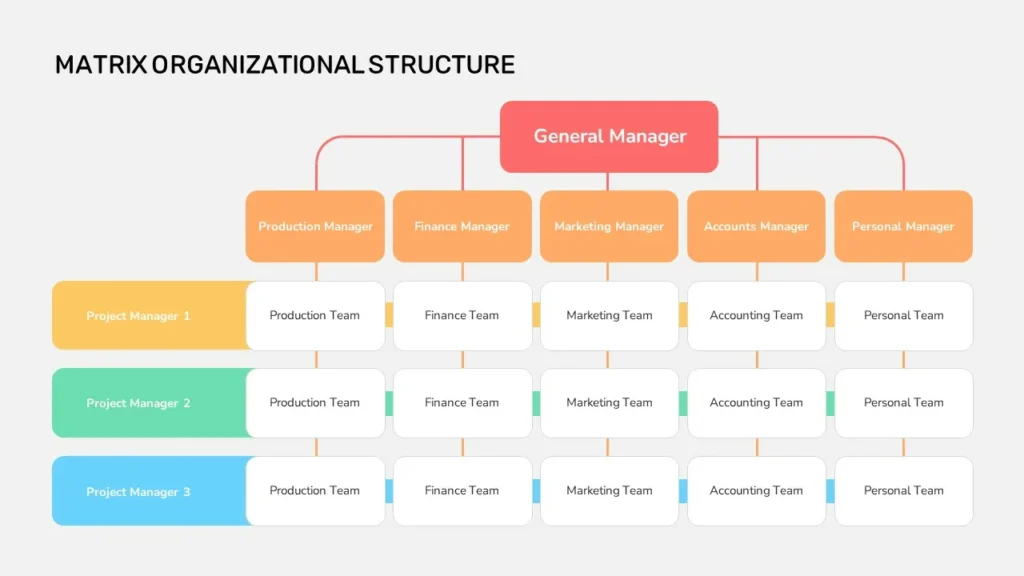
Matrix organizational chart
In a matrix structure, a single person can simultaneously participate in both the functional and project lines. The key is not the number of connections on the diagram, but rather clearly defining who makes decisions regarding expertise, who determines the project's schedule, resources, and budget.
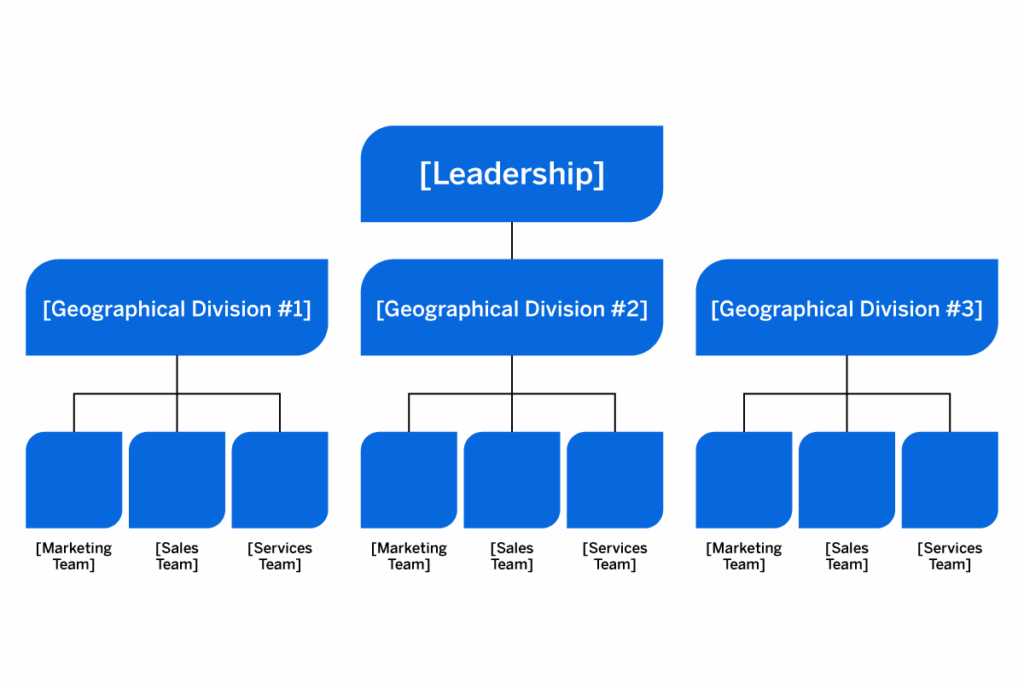
Geographical organizational chart
A geographically-based model is suitable when a business has multiple provinces, regions, countries, branches, or factories. The head office typically maintains common standards, while regional/branch managers are responsible for local operations.
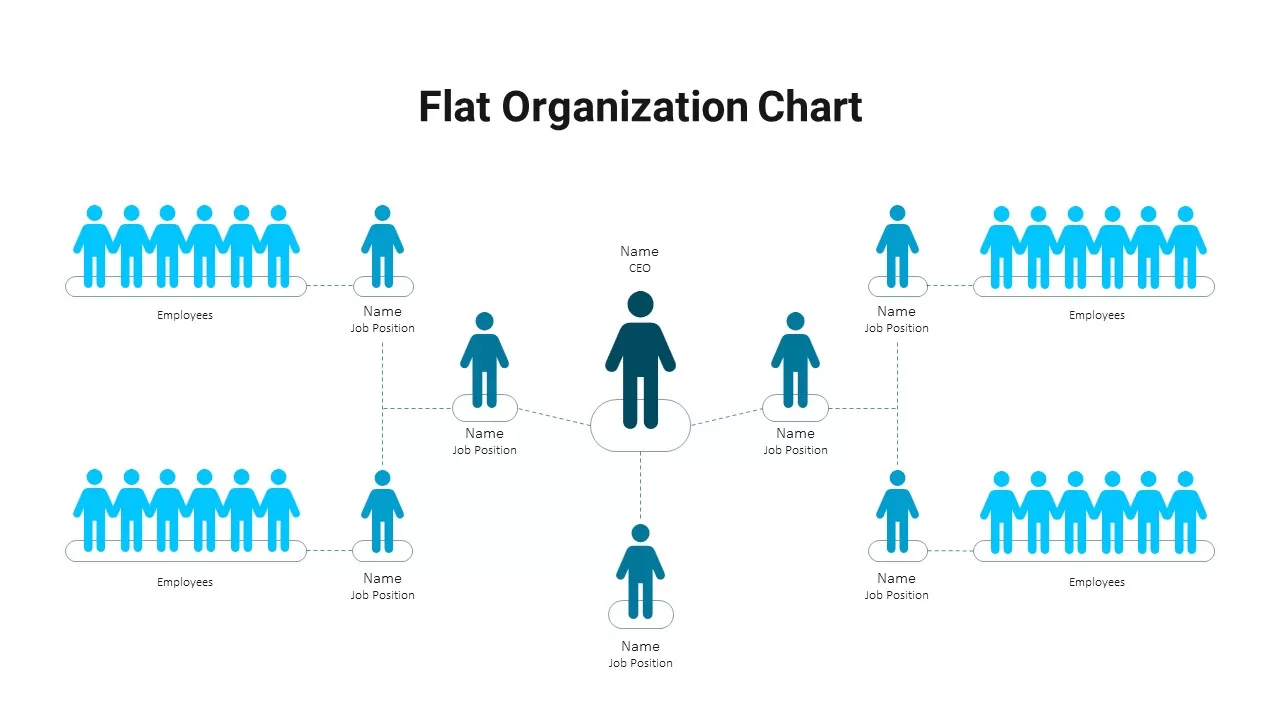
Flat organizational chart
A flat structure reduces the number of middle levels and increases autonomy for the team. This model is suitable for small teams or phases requiring speed, but as personnel increase, decision-making authority, management roles, and coordination mechanisms must be redefined to avoid ambiguity of responsibility.
Sample organizational chart by business type
The legal form that determines the management framework should be stated first; operational departments can be added later as needed. The following section uses the amended and supplemented Enterprise Law 2020 as a reference source. Law 76/2025/QH15 amends several articles of the Enterprise Law and takes effect from July 1, 2025.
Joint-stock companies: it's necessary to distinguish between two management models.
This is a section that requires special attention because The board of directors is not the body that manages the day-to-day operations of the business.. According to Article 162, the Director/General Manager is responsible for the day-to-day operation of the business and is subject to the supervision of the Board of Directors.
Model 1: Has a Supervisory Board
Administration class: Shareholders' General Meeting → Board of Directors → Director/General Director; Supervisory Board performs supervisory functions according to the applied model.
According to Article 137, with a Supervisory Board model, the law also stipulates that a Supervisory Board is not mandatory when the company has fewer than 11 shareholders and the shareholders are organizations owning less than 50% of the total shares.
Model 2: Independent Board Members + Audit Committee
Administration class: Shareholders' General Meeting → Board of Directors → Director/General Manager; at least 20% of the Board of Directors members are independent members and there is an Audit Committee reporting to the Board of Directors.
After the management level, businesses add operational departments such as Finance - Accounting, Business, Operations, and Human Resources - Administration.
Download PowerPoint to directly edit these two joint-stock company templates.
One-member limited liability company
With a single-member limited liability company organization as owner, Article 79 allows for management to be organized according to one of two models: Chairman of the company + Director/General Manager or Board of Members + Director/General Director. Therefore, these two options should not be combined into a single scheme.
The Finance-Accounting, Business, Operations, or Human Resources departments are merely illustrative operational layers and are not a legally mandated list of departments.
Limited Liability Company with two or more members
The basic management framework includes Board of Members, Chairman of the Board of Members, and Director/General Director. When drawing a diagram, this management layer should be placed at the top, then add departments according to how the business actually operates.
Partnership company
All members together form the Board of Members. The Board of Members elects one partner as Chairman; this person may also simultaneously hold the position of Director/General Director unless otherwise stipulated in the Articles of Association. Therefore, the organizational chart of a partnership company should not be simplified to conform to the structure of a limited liability company.
Private enterprise
Private business owners can direct management and operation or hire someone else to be the Director/General Manager.. Even if they hire managers, private business owners remain responsible for the business's operations.
Diagram templates based on scale and operation.
The smaller the scale, the more streamlined the organizational chart should be; only when the level of complexity increases do additional management layers or horizontal coordination mechanisms become necessary. You shouldn't copy the structure of a large corporation for a small team.
Small and medium-sized enterprises: streamlined functional structure
An SME might start with a CEO and 4–5 functional teams: Sales, Marketing, Finance – Accounting, Operations, and Human Resources – Administration. One person may hold multiple positions, but it's crucial to clearly define who the direct supervisor is and who has the final decision-making authority.
Multi-project enterprise: matrix structure
When the same technical, finance, or marketing team has to serve multiple projects, a matrix structure helps to share resources. Businesses should clearly define two lines of responsibility: functional line and project route, Instead of just drawing two reporting lines without specifying the authority.
Businesses with multiple branches
It can be divided into a headquarters and regional/branch units. Functions that need standardization across the entire company, such as finance, human resources, or technology, are often managed centrally; local operational decisions can be delegated to regional managers or branch directors.
Sample organizational chart by industry
The main differences between industries lie in their core operational components. Support units such as Finance, Accounting, and Human Resources usually remain, but the structure of Manufacturing, Construction, Logistics, or Retail Chain will be significantly different.
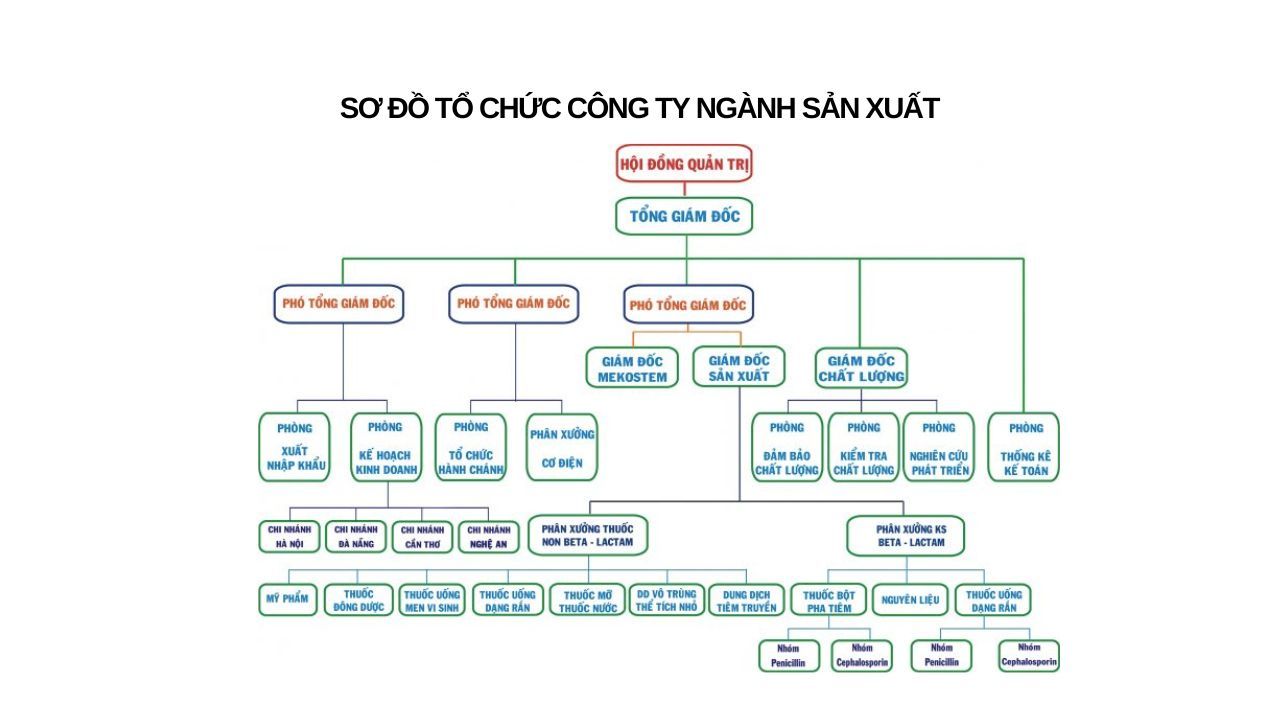
Manufacturing enterprise
The structure typically requires teams for Production, Planning, QA/QC, Purchasing, Warehouse – Logistics, Sales – Marketing, Finance – Accounting, and Human Resources – Administration. Depending on the size, the business may also separate teams for Maintenance, R&D, or Supply Chain.
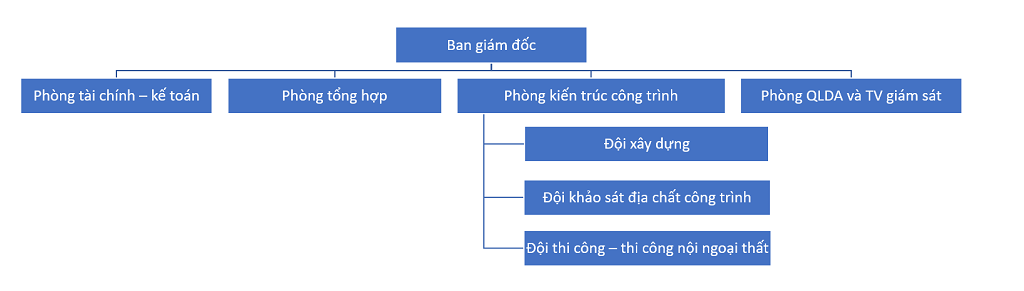
Construction company
The operational structure typically revolves around Project/Construction, Design, Consulting - Supervision, Procurement - Materials, Sales, Finance - Accounting, and Human Resources - Administration. The actual model needs to be adjusted depending on whether the company acts as a general contractor, consultant, designer, or builder.
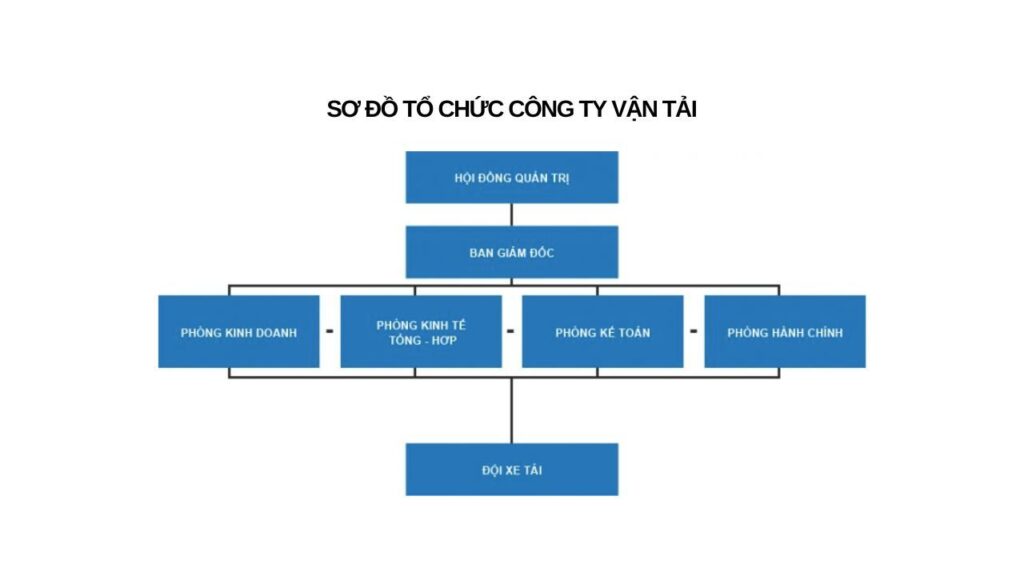
Logistics and transportation
Specialized departments typically include Operations/Coordination, Transportation or Fleet, Warehousing, Customer Service, Sales, Finance/Accounting, and Human Resources. If the business has multiple warehouses or hubs, a geographical structure may also be incorporated.
Chain business
It should be separated. headquarters and chain operations unit. The headquarters may include Finance and Accounting, Human Resources, Marketing, Purchasing, and Sales Outlet Development; the operations division includes Regional Management and Stores/Sales Outlets.
Sample organizational chart by department
The departmental structure only needs to show the main roles and reporting pathways. There's no need to include every possible job title in a diagram; the number of levels and positions should reflect the actual team size.
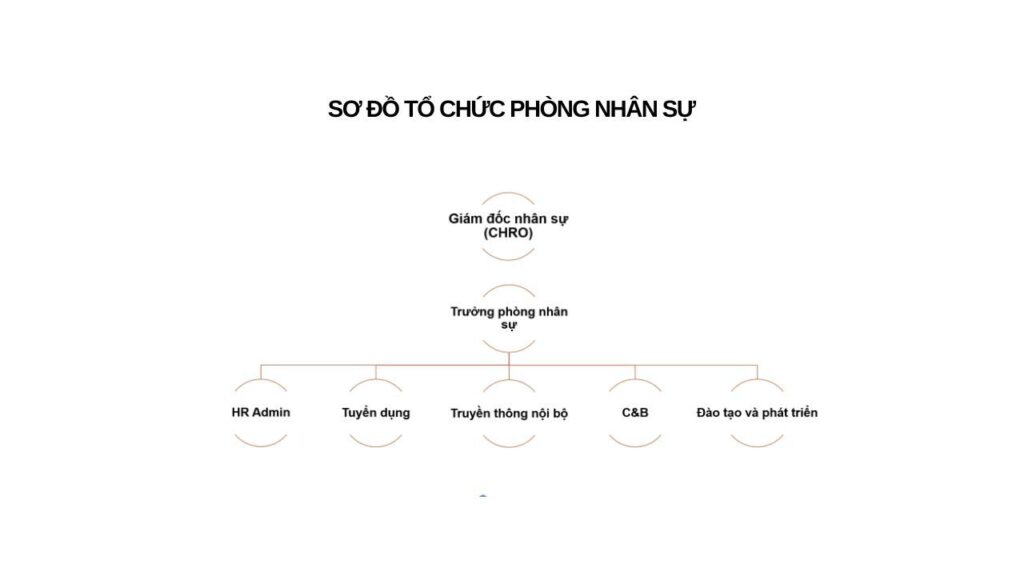
Human Resources Department
This may include Head/Director of Human Resources, Recruitment, Compensation & Benefits, Training & Development, and Administration. In small businesses, many roles may be combined.
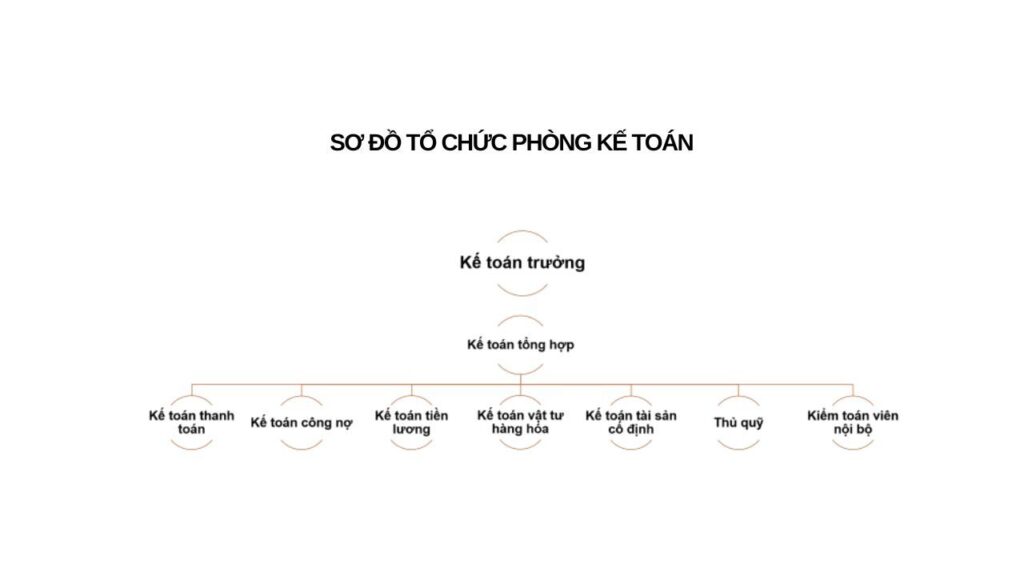
Finance and Accounting Department
This may include Chief Accountant/CFO, General Accountant, Accounts Payable Accountant, Accounts Receivable Accountant, and other specialized positions depending on the department.
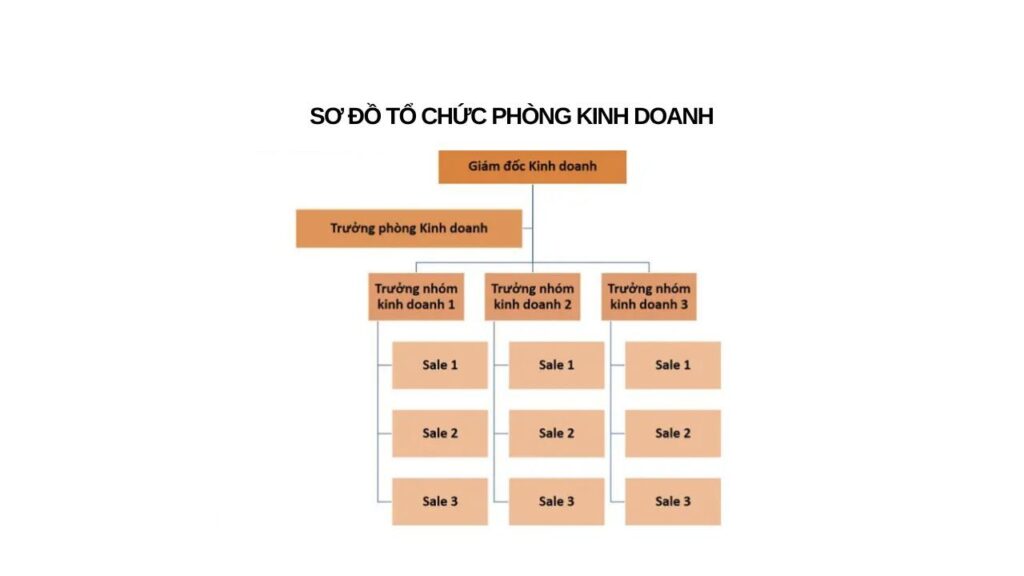
Sales Department
Typically, there is a Department Head, Team Leaders, and Sales Staff; they may be divided by region, customer segment, or product.
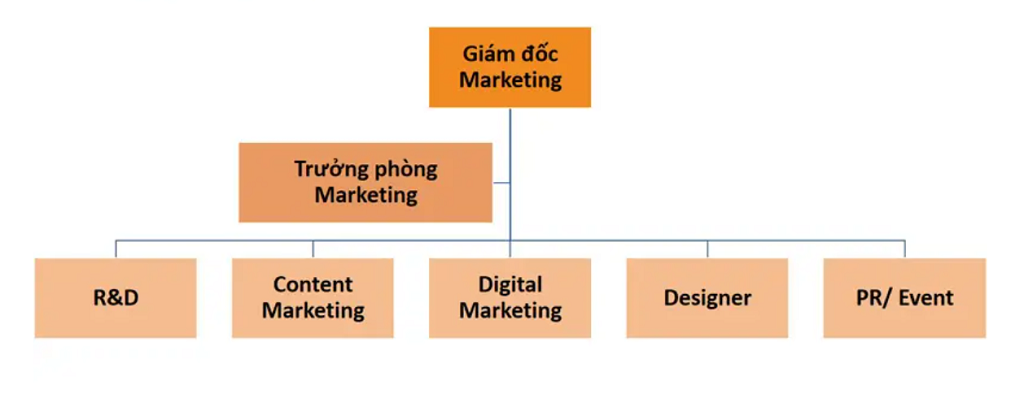
Marketing Department
Depending on the business model and budget size, it can be categorized as Content, Digital, Trade Marketing, PR/Event, or Market Research.
Download 12 organizational chart templates in Word, PowerPoint, Excel, and Draw.io.
The downloaded file set includes a system of 12 templates that you can edit directly. Word is suitable for internal documents, PowerPoint is convenient for presentations, Excel supports hierarchy review and reporting relationships, and Draw.io is suitable when you need flexible drag-and-drop diagrams.
| Format | Most suitable | What can be adjusted? | Download file |
|---|---|---|---|
| Word | Regulations, personnel documents, internal documents | Box name, department, job title, table layout | Download Word |
| PowerPoint | Presentations, organizational meetings, presentations to leaders. | Box, color, position, content, and layout | Download PowerPoint |
| Excel | Hierarchy management and reporting relationship review | Diagram + hierarchy/position/superior/notes | Download Excel |
| Draw.io | Redraw the diagram, drag and drop, and expand the branches. | Boxes, connectors, layouts, and tree structures. | Download the Draw.io source ZIP file. |
How to use Draw.io: load ZIP source: Draw.io, Extract the files on your computer, then open the file. .drawio using diagrams.net. This is an additional format; Word, PowerPoint, and Excel remain the three easiest options for most businesses to use.
12 samples are included in the loader.
- Joint-stock company – a model with a Supervisory Board.
- Joint-stock company – a model with an audit committee.
- A limited liability company with a single owner, owned by an organization – the Chairman of the company model.
- A limited liability company with a single owner, owned by an organization – the Board of Members model.
- Limited liability company with two or more members.
- Partnership company.
- Private enterprise.
- Small and medium-sized enterprises – structured by function.
- Multi-project enterprise – matrix structure.
- Manufacturing businesses.
- Construction company.
- The business operates as a chain.
Templates help to create a structure faster, but they do not replace the charter, internal procedures, authorization matrix, or legal advice for a specific case.
5 steps to building a company organizational chart
A useful diagram should begin with decision-making and reporting relationships, not with the choice of drawing tools.
- Identify the legal class and the person/agency with decision-making authority. Check the type of business, its articles of incorporation, and its current management structure.
- List the core functions for operation. Examples: sales, production, operations, finance, human resources, technology, purchasing.
- Assign responsibility and direct superiors. Each position needs to know who they report to; with a matrix model, the project route must also be indicated.
- Choose the appropriate way to present it. Use functional, matrix, geographic, hierarchical, or a combination thereof, depending on how the business operates.
- Draw, review, and set update conditions. Updates occur when there are changes to managers, departments, functions, reporting paths, or approval permissions.
6 common mistakes when using organizational charts
A diagram is only useful if it accurately reflects how the business actually operates and is updated as the structure changes.
- Align the organizational chart with the process/SOP: The diagram shows who belongs where and reports to whom; the SOP outlines the steps in which the work is performed.
- Listing only job titles without providing reporting options: A list of boxes is not sufficient to define management responsibilities.
- Copying the entire organizational chart of another business: Industries within the same sector don't necessarily have the same strategy, scale, or delegation of authority.
- Too many layers of management: Each new tier needs a clear operational rationale; otherwise, it will lengthen the decision-making chain.
- It will not be updated when the structure changes: The old organizational chart easily creates confusion regarding managers and responsibilities.
- There is a work plan, but it lacks a division of labor across departments. When multiple departments are involved, additional resources should be added. RACI matrix or an equivalent delegation mechanism to identify the implementer, the ultimate responsible party, those consulted, and those to be informed.
From organizational charts to authorization flows and expense approvals.
The diagram shows who belongs to which department and who reports to whom; to manage spending, businesses need to translate that structure into specific approval authority, budget, and limits.
For example, a spending request might follow this flow: employee creates the request → department head checks the need → finance department checks the budget/documents → authorized level approves within the budget limit. The exact structure of this flow depends on the spending regulations and authorization levels of each company.
Once the department and responsible person have been identified, the business can proceed to two layers of operations: budget allocation and management for each unit, then standardize. expense approval process according to limits and authority.
When this structure needs to be put into practical operation, Bizzi Expense supports the digitization of requests and approvals, expenditure control by limit/department/purpose, and tracking of actual spending against budget on a centralized system. This handoff is suitable when businesses have clearly defined responsibilities but approval and budgeting authority is still being managed via email, chat, or separate spreadsheets.
Frequently Asked Questions about Company Organizational Charts
Which type of organizational chart is suitable for a small business?
Small businesses are typically well-suited to simple functional structures with few layers of management. One person may handle multiple tasks, but clear reporting relationships and decision-making authority are essential.
Are organizational charts and process flowcharts the same thing?
No. An organizational chart describes the structure, departments, positions, and reporting relationships; a process flow chart describes the work steps and processing flow.
Can the templates be edited using Word or PowerPoint?
Yes. Bizzi's download package includes Word, PowerPoint, Excel, and the Draw.io source code in a ZIP package. Word is suitable for internal documents, PowerPoint for presentations, Excel offers additional features like hierarchical tables and relationship reporting, and Draw.io is ideal for flexible drag-and-drop diagramming.
When should you update your organizational chart?
Updates should be made whenever there are changes to management, departments, functions, reporting pathways, legal structure, or scope of decision-making authority.
Which template should a joint-stock company use?
The choice should be based on the actual management model and the Articles of Association. Article 137 of the Enterprise Law stipulates two main models; therefore, a single organizational chart should not be used for all joint-stock companies.